Gravity does not care how long you have lived among the stars. For months, or sometimes over a year, the body unlearns the heavy anchor of Earth. Fluids shift upward. Muscles forget their constant, quiet struggle against the pull. Spine vertebrae decompress, and astronauts grow taller in the vacuum of free fall, stretching like plants reaching for a sun that never sets on them for long. They orbit at seventeen thousand five hundred miles per hour, suspended in a fragile tin can, watching sixteen sunrises and sunsets every single day.
Then comes the day of reckoning.
The descent is not a gentle glide. It is a calculated, violent deceleration. When a Russian Soyuz capsule or a commercial crew vehicle detaches from the International Space Station, it leaves behind a sanctuary of shared purpose. Up there, politics dissolve into the thin, glowing ribbon of the horizon. National flags painted on shoulders matter far less than the seal of a hatch or the scrubbers cleaning the air. Yet, gravity eventually reclaims its own.
Consider what happens inside the descent module as it plunges back into the atmosphere. The spacecraft hits the air molecules at hypersonic speeds, compressing the air ahead of it so fiercely that temperatures outside soar to nearly three thousand degrees Fahrenheit. A wall of fire envelops the capsule. Plasma dances across the reinforced windows. Inside, the crew is pinned to their custom-molded seats by forces reaching four to five times the weight of their own bodies. Every breath requires conscious effort. Chests feel as though a heavy stone rests upon them.
(Note: While I have never personally burned through an atmospheric entry, aerospace engineers and returning astronauts describe this brutal G-force phase as feeling like an elephant sitting squarely on your chest.)
Communication crackles and then fades entirely as the plasma sheath blocks radio waves. For several long, agonizing minutes, mission control hears nothing. Absolute silence blankets the radio frequencies. On the ground, in the cold steppes of Kazakhstan or out on the rolling swells of the ocean, recovery teams wait with bated breath. They watch radar screens and telemetry dots, knowing that the smallest calculation error could spell disaster. This is the invisible cost of space exploration. We celebrate the launch, the breathtaking photography, the scientific breakthroughs in microgravity, but we often gloss over the violent poetry of the return.
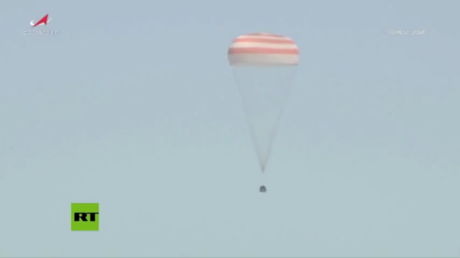
Silence breaks. A parachute deploys with a deafening jolt that rattles teeth. The capsule slows from terrifying velocities down to a manageable crawl. But comfort is still a distant memory. A Soyuz capsule does not land softly. At the very final fraction of a second before impact, solid-fuel braking rockets ignite on the base of the spacecraft, kicking up a blinding cloud of dust and snow, absorbing the final blow of the planet.
Thud.
The journey is over. The sky is behind them.
Recovery crews swarm the capsule with practiced urgency. They pry open the hatch, greeting tired, flushed faces smelling of ozone and sweat. They pull the spacefarers out, not because they are weak, but because their bodies are temporarily alien to the ground. Dizziness washes over them. Blood pools in legs that forgot how to push it back to the heart. The air tastes thick, rich, and overwhelmingly heavy compared to the recycled breeze of the orbital station.
We watch these broadcasts on our screens. We see the footage of the capsule descending under its orange-and-white canopy. We see smiling, exhausted faces hoisted from the hatch into the waiting sunlight. But do we truly comprehend the sheer audacity of it?
Humanity spent millennia looking up at the night sky, weaving myths out of constellations, trapped by our own biology to the dirt beneath our feet. Today, we routinely send people above the atmosphere, let them live in falling motion for months, and pluck them safely out of the sky on a schedule. It is a staggering triumph of engineering, born from decades of shared human ingenuity, trial, error, and immense courage.
When the hatch finally opens and the fresh wind of Earth hits skin that has only known station air, something fundamental shifts back into place. The circle closes. They left as explorers. They return as reminders of what we are capable of achieving when we look past the horizon and decide to reach together.