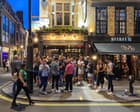
The directive arrived without warning. London Mayor Sadiq Khan intervened directly to force a local authority to scrap a controversial proposal that would have effectively frozen new pubs, bars, and clubs in Soho and the wider West End.
This intervention exposes a high-stakes tug-of-war between municipal preservation efforts and the economic survival of the capital's entertainment districts. Westminster City Council wanted to introduce a blanket containment policy. City Hall stepped in and told them to back down.
Behind the bureaucratic language of planning documents lies a stark reality. London's night-time economy is bleeding. Regulations disguised as neighborhood protection often serve as quiet executioners for venues that give the city its cultural pulse.
The Anatomy of a Contained Crisis
Policy documents rarely capture the smell of stale beer, the neon glare of late-night signage, or the hum of generators behind a basement club at three in the morning. Planners sit in quiet rooms and draft cumulative impact assessments. These assessments treat nightlife not as an economic engine, but as an environmental nuisance to be managed and minimized.
Westminster Council argued that Soho reached saturation point. Their logic relied on a simple premise. Too many venues lead to too much noise, too much waste, and too much strain on local services.
On paper, this sounds reasonable. Residents deserve sleep. Streets need cleaning.
In practice, a blanket restriction acts as a dead stop on innovation. When authorities make it legally exhausting to open a new venue, independent operators go elsewhere. Landlords pivot to corporate chains that can absorb years of legal fees, or worse, leave commercial units vacant while waiting for retail conversion rights.
The Economic Engine Beneath the Neon
Soho is not a quiet residential suburb. It is a dense, commercial ecosystem built on decades of bohemian commerce, hospitality, and creative friction.
When politicians try to freeze a district in amber, they ignore how cities actually survive. A healthy nightlife district requires constant churn. Old concepts die, new ones take their place, and capital flows between independent risk-takers and landlords.
Stopping new venues does not stop people from wanting to go out. It simply drives economic activity into the unregulated underground or pushes patrons out of central London entirely.
The financial footprint of the West End extends far beyond the bar tab. Think of the logistics networks, the late-night security staff, the independent audio engineers, and the food suppliers. Every license denial ripples through a vast, invisible supply chain of working-class Londoners who depend on the hospitality sector to pay rent.
The Mayor's Dilemma and Municipal Friction
Why did the Mayor of London step in? Because the capital cannot afford to look closed for business.
Post-pandemic recovery remains fragile. Central London footfall patterns changed permanently with the rise of hybrid work models. Office towers empty out by Thursday evening. If the weekends and late-night hours cannot pick up the slack, the commercial heart of the city hollows out.
When a local borough tries to restrict growth in the middle of this structural shift, the regional authority takes notice.
Khan’s directive forces a recalibration of how local plans interact with regional economic strategy. It signals that London cannot legislate its way to a quieter city by choking off the very industries that draw millions of international visitors to its streets every single year.
Zoning Realities and the Battle for Space
Planning law is a blunt instrument. Councils often rely on zoning tools designed for mid-century industrial towns rather than modern, multi-use global metropolises.
When an area receives a cumulative impact designation, the burden of proof shifts entirely onto the business owner. Instead of the council proving that a new venue will cause harm, the applicant must prove a negative. They must demonstrate that opening a bar or pub will somehow generate zero additional impact on an already busy entertainment district.
This requirement is legally burdensome and financially prohibitive for independent operators. Only well-funded hospitality groups with teams of planning lawyers can clear such hurdles.
The result is homogenization. Independent punk bars and small jazz cellars get replaced by generic gastropubs and corporate cocktail lounges backed by private equity. The soul of the neighborhood gets paved over by conformity.
What Happens Next on the High Street
Forcing Westminster Council to drop the ban is a temporary reprieve, not a permanent cure. The underlying tensions between permanent residents and temporary visitors remain entirely unresolved.
Housing advocates point out that central London residential populations grew over the last two decades. People moved into Soho expecting the quiet charm of a village while living in the geographic center of a megalopolis. That contradiction generates endless friction.
Councils will continue finding creative ways to restrict licensing through the backdoor, utilizing noise complaints, waste management audits, and highway regulations to achieve what a blanket ban could not.
The battle for London's nightlife is fought block by block, permit by permit, and appeal by appeal. The mayor's intervention bought the West End some time, but the underlying pressures demanding its transformation have never been more intense.