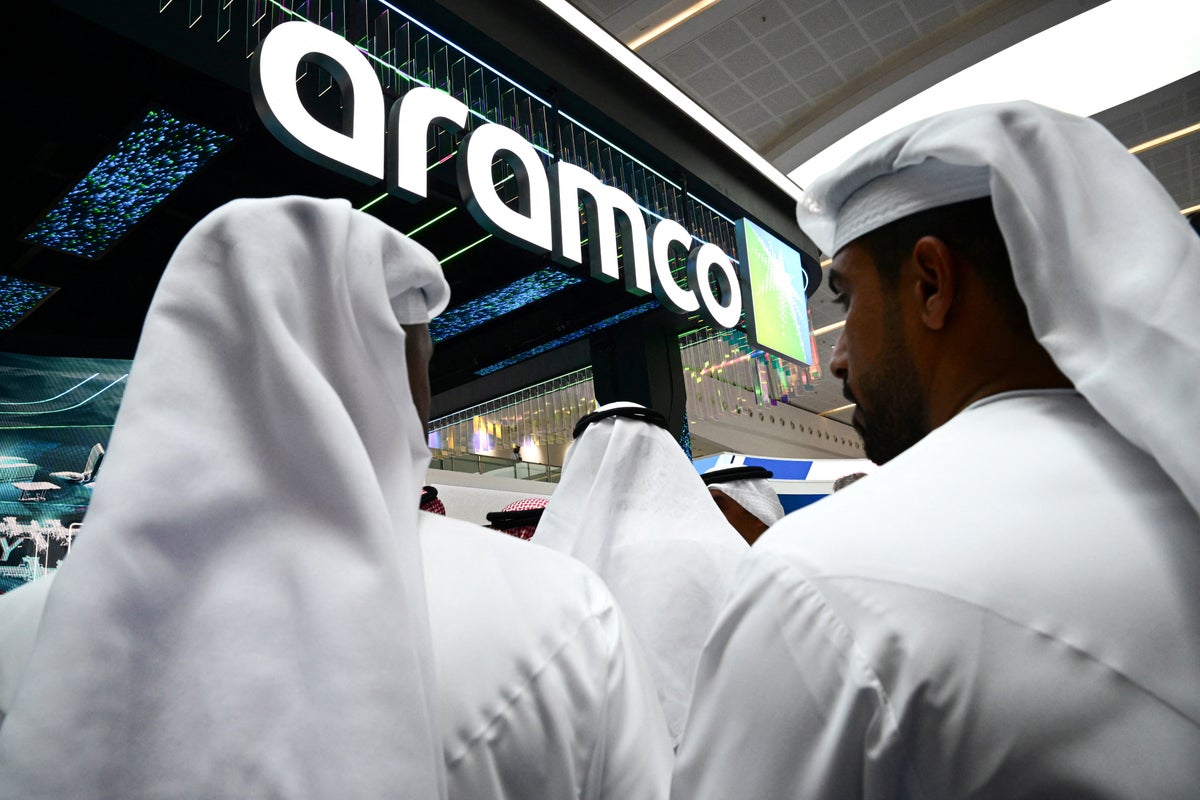
Saudi Aramco’s reported 25% profit surge is not a byproduct of market volatility, but a realization of high-capital strategic redundancy. While regional instability in the Strait of Hormuz—a chokpoint handling roughly 20% of global oil consumption—creates a risk premium for competitors, Aramco’s ability to bypass this bottleneck via the East-West Pipeline (Abqaiq-Yanbu) transforms a geopolitical threat into a competitive moat. This is the monetization of physical infrastructure as a financial derivative.
The Logistics Hedging Framework
The fundamental value proposition of Aramco during periods of maritime disruption rests on its Alternative Export Capacity (AEC). Most national oil companies (NOCs) are geographically locked into specific export terminals. Aramco’s infrastructure allows for the decoupling of production and export geography.
- The East-West Pipeline (Petroline): Spanning 1,200 kilometers, this 5-million-barrel-per-day (mb/d) artery links the eastern oil fields to the Red Sea port of Yanbu. This bypasses the Strait of Hormuz entirely.
- The Risk Premium Capture: When shipping rates in the Persian Gulf spike due to insurance premiums or physical threats, Aramco shifts volumes to the Red Sea. The cost of pipeline transit remains fixed, while the market price of oil rises to reflect the "Hormuz Risk." Aramco captures the delta between the elevated global price and its stable operational cost.
- Inventory Buffering: By maintaining massive storage hubs in Rotterdam, Okinawa, and Sidi Kerir, the company can fulfill contracts from "behind the gate" during active disruptions, ensuring 100% reliability while competitors face force majeure.
The Profit Function: Revenue Growth vs. OpEx Efficiency
The 25% increase in net income to $161.1 billion is driven by a specific interaction between crude prices and lifting costs. Aramco’s Upstream Cost Advantage is the bedrock of its balance sheet. While US shale producers face marginal costs often exceeding $40 per barrel, Aramco’s lifting costs remain approximately $3 per barrel.
When global Brent prices rise due to supply constraints, the profit margin expands disproportionately for the lowest-cost producer.
$$Profit = (Quantity \times (Price_{Market} + Risk_{Premium})) - (Lifting Cost + Transport_{Fixed})$$
In this equation, the Risk Premium is generated by external instability, but the Transport Fixed variable is maintained by the Petroline. This creates a "Logistics Arbitrage" where Aramco sells oil at a price reflecting a risk it does not actually incur for a significant portion of its exports.
Decoupling from Global Volatility through Downstream Integration
Aramco is aggressively pivoting from a pure-play extractor to a global chemicals power. This strategy, categorized as C2C (Crude-to-Chemicals), aims to convert up to 4 million barrels per day of crude into high-value petrochemicals.
This creates a natural hedge. When crude prices are high, upstream profits soar. When crude prices soften, the input costs for the downstream refining and chemicals divisions drop, preserving margins across the total enterprise. The acquisition of a 70% stake in SABIC (Saudi Basic Industries Corporation) was the structural move that finalized this integration.
Structural Advantages of Downstream Integration:
- Captive Demand: Downstream facilities provide a guaranteed outlet for upstream production, regardless of global demand fluctuations.
- Margin Expansion: Converting crude into ethylene, propylene, or aromatics captures value-added revenue that is 3x to 5x higher than the raw commodity price.
- Geographical Diversification: Refining assets in China (HAPCO), South Korea (S-Oil), and the US (Motiva) allow Aramco to place volumes directly into the fastest-growing markets, bypassing the need for long-haul maritime spot-market transactions.
The Capital Expenditure Paradox
To maintain this level of dominance, Aramco’s capital expenditure (CapEx) is projected to reach $45–$55 billion annually. This is a "Defensive CapEx" strategy. It is not designed solely for growth, but to maintain the Maximum Sustainable Capacity (MSC) of 12 million barrels per day.
Maintaining spare capacity is a tool of geopolitical and economic leverage. If a competitor is sidelined by war or technical failure, Aramco can flood the market within 30 days. This "Swing Producer" status ensures that the company—and by extension, the Saudi state—dictates the global supply curve.
Operational Resilience and Technical Hardening
The 2019 attacks on the Abqaiq and Khurais processing plants served as a stress test for the company’s recovery protocols. The speed at which production was restored demonstrated that Aramco’s value is not just in its reserves, but in its Redundancy Engineering.
- Modular Recovery: Spare parts and critical components for processing units are prepositioned to bypass traditional supply chain lead times.
- Cyber-Physical Hardening: Integration of AI-driven threat detection across 12,000 kilometers of pipeline reduces the probability of a "Black Swan" event causing a total system shutdown.
- Operational Continuity Planning: The company maintains a workforce of over 70,000 people with military-grade response protocols for infrastructure repair.
Financial Sustainability and the Dividend Floor
The $75.8 billion in dividends paid out annually creates a "hard floor" for the stock's valuation but also places a massive requirement on free cash flow. This dividend is a sovereign necessity, funding the "Vision 2030" diversification of the Saudi economy.
The tension exists between maintaining this dividend and the necessary CapEx for the energy transition. Aramco is investing heavily in Blue Hydrogen and Carbon Capture and Storage (CCS). The goal is to produce "low-carbon crude"—a product that remains viable even under strict global ESG mandates. By reducing the carbon intensity of extraction, Aramco aims to be the "last producer standing" as the world moves toward net-zero.
The Limits of Logistics Arbitrage
Despite the current profit surge, three structural risks remain:
- The Red Sea Bottleneck: While the East-West pipeline bypasses Hormuz, it terminates in the Red Sea. If instability spreads to the Bab el-Mandeb strait, the logistical advantage is halved.
- Technological Obsolescence: The rapid acceleration of EV adoption in China—Aramco’s largest customer—presents a long-term threat to transportation fuel demand.
- Geopolitical Alignment: Reliance on the Petroline requires total security of the Saudi interior. Domestic stability is the prerequisite for the entire financial architecture.
The current 25% profit surge is a validation of the "Fortress Balance Sheet" and "Fortress Infrastructure" approach. By spending billions on redundant pipelines and massive storage hubs over the last decade, Aramco effectively bought an insurance policy that is now paying out.
The strategic play for investors and competitors is to recognize that Aramco is no longer an oil company; it is a logistics and infrastructure conglomerate that happens to deal in hydrocarbons. The ability to move molecules through proprietary, secure channels while the rest of the world relies on contested sea lanes is a structural advantage that cannot be replicated by Western Supermajors. The future of the energy market belongs to those who control the "hard" assets of transit as much as the "soft" assets of the reserves.