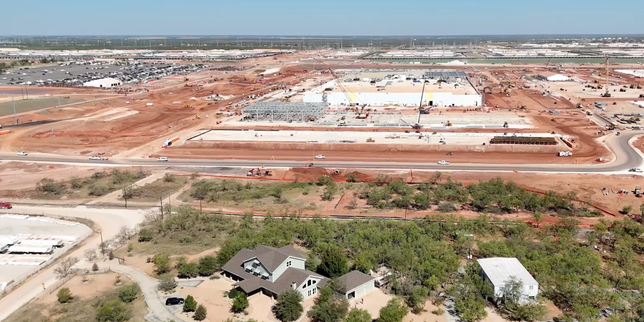
Hyperscale artificial intelligence data centers do not merely occupy land; they fundamentally alter the thermodynamic, electrical, and economic equilibrium of the municipalities that host them. When a frontier AI developer or its cloud infrastructure partner breaks ground adjacent to a residential community, the resulting friction is rarely a simple case of aesthetic disruption. Instead, it is the predictable collision between exponential compute demand and finite local infrastructure. Understanding the true impact of a massive ChatGPT-scale training or inference cluster requires decomposing the facility into its core physical inputs, operational externalities, and municipal fiscal mechanics.
The Architecture of Compute Density
Traditional enterprise data centers operate at power densities of 5 to 10 kilowatts per server rack. Large language model infrastructure, built around tightly coupled clusters of graphics processing units (GPUs) or custom tensor accelerators, pushes rack densities to 40, 80, or over 120 kilowatts. This order-of-magnitude leap dictates every physical characteristic of the facility that neighbors observe.
- Footprint and Geometry: To minimize signal latency between thousands of interconnected processors—where speed-of-light delays across fiber optics degrade training efficiency—architects cannot spread servers thinly across sprawling, single-story campuses. They must build dense, multi-story concrete structures with reinforced floor slabs capable of supporting heavy liquid-cooling manifolds and battery banks.
- Acoustic Signatures: Moving heat away from silicon at megawatt scale requires industrial-grade airflow and fluid pumping. The primary noise vectors for adjacent residents are not the servers themselves, which sit behind thick concrete walls, but the external heat-rejection equipment: rooftop chillers, evaporative cooling towers, and high-static-pressure exhaust fans. These systems emit low-frequency tonal hums (typically in the 60 to 250 Hertz range) that travel farther and penetrate residential building envelopes more effectively than high-frequency traffic noise.
- Backup Power Arrays: Tier III and Tier IV reliability standards mandate uninterrupted power. Because grid outages cannot be allowed to corrupt multi-week AI training runs worth tens of millions of dollars, facilities install banks of industrial diesel generators—often dozens of 2-to-3-megawatt units per building. While these run infrequently, mandatory monthly load-bank testing introduces acute spikes in localized air particulates, nitrogen oxides, and decibel levels.
The Grid Load Function and Transmission Bottlenecks
A single gigawatt-scale AI campus consumes as much electricity as a mid-sized city of 750,000 homes, but with a radically different load profile. Residential demand follows a predictable diurnal curve, peaking in the early evening and dropping overnight. AI training clusters operate at a near-constant 90% to 98% load factor, 24 hours a day, 365 days a year.
This flat, massive baseload creates three distinct structural pressures on regional power grids:
- Substation and Transmission Constraints: Local distribution networks are engineered for residential or light commercial loads. Connecting a 100-megawatt to 1-gigawatt facility requires constructing dedicated high-voltage substations and multi-mile transmission interconnects. The construction phase alone involves heavy civil engineering, right-of-way clearing, and temporary road closures that disrupt daily life long before a single server boots.
- Marginal Generation Dispatch: Because renewable energy sources like wind and solar are intermittent, meeting a flat 24/7 gigawatt load forces grid operators to keep baseload fossil fuel plants—primarily combined-cycle natural gas turbines—running continuously, or to delay the retirement of older coal assets.
- Cost Allocation Asymmetry: Regulated utilities recover the capital costs of grid upgrades through rate cases approved by public utility commissions. If the power purchase agreement between the utility and the data center operator does not strictly ring-fence transmission upgrade costs, residential ratepayers end up subsidizing the electrical infrastructure required to run private AI models through higher monthly delivery charges.
Thermodynamic Trade-Offs in Cooling Systems
The first law of thermodynamics dictates that virtually every watt of electrical power entering a data center converts directly into waste heat. Removing 100 megawatts of thermal energy forces engineers into a strict binary trade-off between water consumption and electrical efficiency.
Evaporative Cooling (Water-Intensive):
Open-loop cooling towers exploit the latent heat of vaporization. By evaporating water into the atmosphere, the facility rejects heat with minimal mechanical compressor work, achieving a low Power Usage Effectiveness (PUE)—often between 1.10 and 1.20. However, a 100-megawatt facility using evaporative cooling can consume between 1 million and 1.5 million gallons of potable or reclaimed water per day. In regions experiencing aquifer depletion or seasonal drought, this creates direct competition between municipal water supplies, agricultural irrigation, and server cooling. Furthermore, roughly 60% to 80% of this water is lost to evaporation rather than returned to the local watershed, while the remaining "blowdown" water contains concentrated minerals and anti-scaling chemicals that must be processed by local wastewater treatment plants.
Closed-Loop Air or Liquid Cooling (Power-Intensive):
To eliminate water consumption, operators deploy closed-loop dry coolers or mechanical chillers, particularly when paired with direct-to-chip liquid cold plates. While this reduces ongoing water draw to near zero after the initial loop fill, rejecting heat into warm ambient air requires massive electrical energy to run compressors and fans. This drives PUE upward toward 1.35 or higher, compounding the strain on the local electrical grid during summer heatwaves when both residential air conditioning and data center chillers hit peak demand simultaneously.
The Municipal Fiscal Paradox
Local governments routinely offer aggressive tax incentives—such as property tax abatements, sales tax exemptions on server hardware, and expedited zoning—to attract hyperscale developments. Politicians justify these subsidies by framing data centers as clean, high-tech economic engines. The empirical operational reality diverges sharply from standard industrial development models.
Unlike manufacturing plants or corporate headquarters, an operational AI data center requires minimal human labor. Once construction crews depart, a 500,000-square-foot facility typically employs only 30 to 50 full-time personnel, consisting of facility engineers, security guards, and physical hardware technicians. The capital-to-labor ratio is among the highest of any commercial asset class, often exceeding $20 million in capital expenditure per permanent job created.
Consequently, the local economic multiplier is weak:
- Payroll Tax Yield: With a small permanent headcount, local income tax revenues and secondary spending at nearby restaurants, retail stores, and housing markets remain negligible after the construction phase ends.
- Property Tax Compression: When municipalities grant 10-to-20-year tax abatements on real property and exempt business personal property taxes (which would otherwise capture the multi-billion-dollar value of the GPUs), the local school district and municipal budget receive a fraction of the facility's true assessed value, even as the campus consumes disproportionate grid and water capacity.
- Real Estate Valuation Divergence: Land zoned for industrial use near high-voltage transmission corridors experiences rapid speculative price appreciation. Conversely, residential properties directly bordering the perimeter fence frequently suffer from diminished buyer liquidity and valuation discounts due to perceived noise, industrial visual blight, and loss of rural or suburban character.
Navigating the Regulatory and Community Interface
For residents, civic leaders, and urban planners confronting the arrival of a hyperscale AI facility, reactive opposition after permits are issued rarely alters project trajectories. Capital commitments at this scale are locked in years prior to public announcements through nondisclosure agreements with utilities and economic development boards. Effective mitigation requires targeted intervention during the zoning, environmental permitting, and utility rate-setting phases.
1. Enforce Acoustic Modeling and Property-Line Decibel Caps
Standard municipal noise ordinances often rely on A-weighted decibel (dBA) averages, which filter out low-frequency sound and fail to capture the intrusive nature of cooling fan hums. Communities must demand C-weighted decibel (dBC) limits and octave-band frequency restrictions measured at the residential property line during nighttime hours. Operators should be contractually required to install acoustic louvers, sound-attenuating parapet walls, and variable-frequency drives on cooling fans before receiving a certificate of occupancy.
2. Mandate Closed-Loop Cooling in Water-Stressed Basins
Permitting authorities must evaluate water consumption not on annual averages, but on peak summer withdrawal rates during drought conditions. Zoning approvals should explicitly prohibit once-through potable water cooling and mandate closed-loop liquid systems or verified non-potable municipal effluent reuse.
3. Ring-Fence Transmission Capital Expenditures
Public utility commissions and municipal intervenors must scrutinize special contracts between power utilities and data center entities. Tariffs should mandate minimum demand charges—requiring the data center to pay for at least 80% to 90% of its contracted capacity regardless of actual usage—and require upfront capital contributions for dedicated substations and transmission line upgrades so that stranded asset risks do not fall on residential ratepayers.
4. Restructure Tax Abatements Around Infrastructure Offsets
If local governments offer tax incentives, those agreements must be tied to binding community benefit obligations rather than illusory job-creation targets. Effective stipulations include direct funding for municipal road reinforcement, localized microgrid battery storage that supports community resilience during outages, and strict limits on generator testing hours.
The Structural Trajectory
The physical centralization of AI compute is a direct consequence of current deep learning scaling laws, which demand massive concentrations of power and bandwidth within single geographic locations. As long as frontier model training relies on synchronous parallel processing across tens of thousands of chips, hyperscale campuses will continue to expand outward from primary internet exchange hubs into exurban and rural communities where land is cheap and transmission lines pass overhead.
Municipalities and residents that treat these projects as conventional commercial real estate developments will consistently absorb uncompensated environmental and infrastructure costs. The definitive strategic play for host communities is to shift from passive tax-incentive competition to strict utility and environmental underwriting: pricing water and grid capacity at true marginal replacement cost, enforcing low-frequency acoustic standards, and eliminating tax exemptions on rapidly depreciating compute hardware so that local tax bases capture real value from the physical footprint.