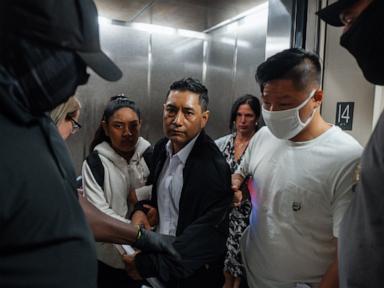
Imagine showing up to a required legal appointment only to find plainclothes agents waiting in the hallway to put you in handcuffs. For thousands of immigrants across the country, this scenario became a reality over the past year. That reality came to a sudden halt on Tuesday when a federal judge issued a nationwide injunction blocking the Trump administration from making civil immigration arrests at immigration courthouses.
U.S. District Judge P. Casey Pitts of San Francisco handed down a 71-page ruling that invalidates the administration's aggressive courthouse enforcement policies. The decision marks a massive legal setback for the White House's deportation strategy. It shifts the playing field for federal immigration enforcement.
The case focuses on a core dispute about how federal agencies can use their power. The administration claimed that arresting people inside courthouses was an efficient way to catch individuals who were already in the building for legal proceedings. Immigrant rights groups argued that the practice turned halls of justice into traps, scaring people away from showing up to their own hearings. Judge Pitts agreed with the advocates, ruling that the government failed to think through the consequences of its choices.
The Law That Stopped a White House Policy
The administration did not lose this case because a judge disagreed with its political goals. It lost because of a boring, 80-year-old law called the Administrative Procedure Act of 1946. This statute requires federal agencies to provide rational, well-reasoned explanations for major policy shifts. Agencies cannot just reverse long-standing rules on a whim. They must prove they evaluated the real-world impact of their decisions.
Judge Pitts wrote that the administration's sudden reversal of previous restrictions resulted not from unreasoned decision-making, but from a complete lack of decision-making. The government basically ignored decades of established practice without showing its work.
When federal agencies act without considering critical factors, courts label those actions arbitrary and capricious. In this instance, the Department of Homeland Security and the Department of Justice completely bypassed the required administrative steps. They did not justify why they threw out rules that previously kept immigration courthouses safe from routine civil arrests.
Why the Chilling Effect Matters to Judges
The main legal flaw in the government's approach was its failure to address the chilling effect. For decades, immigration enforcement stayed away from schools, hospitals, and courthouses. The logic was simple. If people fear arrest while trying to comply with the law, they will stop showing up.
When Immigration and Customs Enforcement agents began staking out hallways and waiting outside courtrooms, attendance plummeted. Defense attorneys reported that clients were terrified to attend routine hearings. Witnesses refused to testify. Crime victims stopped reporting abuse out of fear that stepping into a courthouse would end in detention.
Judge Pitts noted that the government failed to address how courthouse arrests hurt the court system's own efficiency. If a noncitizen stays home to avoid an ICE agent, the immigration judge cannot process their case. The entire system grinds to a halt. You cannot run a functional legal system when the act of showing up is treated as a vulnerability to be exploited.
The ruling emphasizes that simply extending enforcement policies to cover immigration courthouses does not fix their fundamental flaws. The government must explicitly explain how it plans to keep courts functional if it wants to arrest people inside them. Because the administration did not even try to address this problem, the policy could not survive legal scrutiny.
Short Term Holding Cells and the 12 Hour Limit
The lawsuit also took aim at a lesser-known practice involving short-term holding facilities. Alongside the expansion of courthouse arrests, federal authorities began holding detained individuals in temporary cells for extended periods. The administration tried to stretch the maximum allowed time for short-term detention from 12 hours up to 72 hours.
Holding someone in a temporary cell for three days creates massive logistical and humanitarian problems. These small facilities lack the infrastructure for overnight stays. They do not have proper beds, adequate medical facilities, or setups for regular hot meals. They were built for quick processing, not prolonged multi-day confinement.
Judge Pitts struck down this extension. He reinstated the strict 12-hour limit that existed under previous rules. The administration cannot use short-term holding cells as a substitute for long-term detention centers. This part of the ruling severely limits ICE's logistical ability to conduct sweeps, as agents must now move detainees to fully equipped facilities almost immediately.
The Backstory of This Nationwide Fight
This is not the first time courthouse arrests have faced a wall of legal resistance. In May, a federal judge in New York issued a similar order blocking these arrests within that state's boundaries. The New York ruling was a warning shot, but it left the rest of the nation open to continued enforcement sweeps.
The new California ruling changes everything because it applies nationwide. The case started when an asylum seeker was arrested immediately after leaving a routine hearing at a San Francisco immigration court. The individual had followed every rule, kept every appointment, and co-operated fully with the legal process. The arrest sparked immediate backlash from legal advocacy groups.
The Lawyers' Committee for Civil Rights of the San Francisco Bay Area pushed the lawsuit forward, arguing that the federal government was using courthouses as a hunting ground. By winning a nationwide injunction, they protected immigrants across all fifty states, not just those in liberal legal circuits.
The Furious Reaction from the Administration
The response from the White House and the Department of Homeland Security was immediate and angry. James Percival, the general counsel for the U.S. Homeland Security Department, blasted the decision on social media. He called the ruling an example of judicial overreach that interferes with basic law enforcement.
Percival argued that when a local judge sentences a criminal defendant, that person goes straight into custody. He believes the exact same logic should apply to immigration courts. According to his view, if an immigration judge orders someone removed from the country, ICE agents should be allowed to take them into custody on the spot. Percival went so far as to call the ruling naked judicial activism that serves an open-borders agenda.
This furious reaction highlights the deep ideological divide over how immigration laws should be enforced. The administration views courthouses as secure, controlled environments where agents can easily locate individuals who are out of status. They argue that blocking these arrests forces agents to go out into communities, which can be more dangerous for both the officers and the public.
What Happens Next for Immigration Enforcement
If you are wondering how this impacts the daily operations of federal immigration enforcement, the immediate answer is that ICE must change its tactics. The ruling forces the agency to revert to older guidance.
Under those previous rules, civil immigration arrests at courthouses are restricted to very specific, extreme circumstances. Agents cannot simply hang out in the lobby waiting for a name to be called on a docket. They can only make an arrest if there is an immediate national security threat, a risk of imminent physical danger to the public, or if they are in hot pursuit of a suspect who is fleeing a crime.
This means routine enforcement will move back into neighborhoods and workplaces. It will slow down the administration's aggressive deportation metrics. The White House will almost certainly appeal the decision to the Ninth Circuit Court of Appeals, and this case could easily find its way to the Supreme Court.
If you are a noncitizen with an upcoming immigration court date, you still need to consult with your attorney before making any decisions. The nationwide injunction protects you from being arrested inside or immediately outside the courthouse building during your proceeding, but it does not erase an outstanding deportation order or stop ICE from seeking you out elsewhere.
Keep your court dates. The legal landscape is shifting fast, but skipping a hearing still triggers an automatic order of removal in your absence. That is a mistake you cannot afford to make. Maintain direct communication with your legal counsel and monitor how the Department of Justice responds to this latest judicial roadblock.