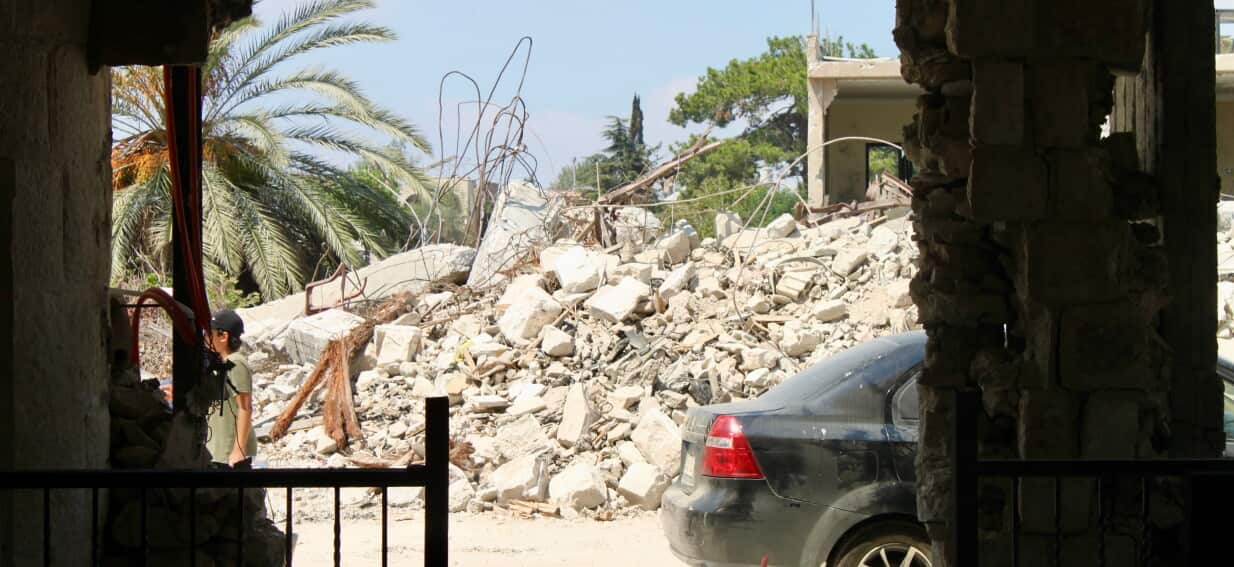
Everybody wants to talk about violations. Every time a drone hums over southern Lebanon or an artillery shell impacts a ridge near the Litani River, the headlines write themselves. Ceasefire broken. Three dead. Back to square one.
Stop buying the narrative.
The lazy consensus in international journalism treats ceasefires like fragile glass ornaments dropped by clumsy actors. The narrative assumes that a piece of paper signed in a conference room is an endpoint, a permanent stabilization mechanism that fails only because someone lacked the discipline to respect it. That perspective is not just naive; it is professionally illiterate.
I have spent years watching diplomats draft agreements that look magnificent on high-gloss parchment and crumble the moment they interact with operational reality. A ceasefire in an asymmetric conflict is never a peace deal. It is a tactical pause disguised as diplomacy. It is a breathing space where both sides catch their breath, reposition assets, calculate new vectors of attack, and wait for the other guy to make the first miscalculation.
When three people die in a strike despite an active agreement, the knee-jerk reaction is to ask how the agreement can be fixed. That is the wrong question entirely. The right question is why anyone expected a document written by external parties to override the fundamental physics of ongoing military necessity on the ground.
The Myth of the Paper Shield
Let us define what a ceasefire actually is in modern asymmetric warfare. It is not an armistice between equal sovereign states recognizing mutual borders. It is a temporary containment grid.
When international brokers push for cessation of hostilities, they are managing optics, not resolving existential friction. They need a headline to calm global markets and give politicians a temporary win. They achieve this by drafting ambiguous texts that mean entirely different things to the signatories.
Take the mechanics of the recent arrangement regarding southern Lebanon. On one side, you have a state actor bound by international pressure but driven by domestic security mandates to eliminate structural threats across its northern border. On the other side, you have a deeply entrenched non-state force that views territorial control as an existential mandate, embedded within civilian infrastructure that makes surgical separation mathematically impossible.
When you drop a paper agreement on top of that dynamic, physics takes over.
A ceasefire does not freeze time. Intelligence-gathering operations do not stop. Tunnel networks do not automatically seal themselves. Rocket caches do not evaporate. When one side spots a squad moving heavy ordnance under the cover of civilian movement, do you honestly expect them to check the clause in paragraph four before neutralizing the threat? Of course not. They strike. And then the commentary class acts surprised.
The Flawed Logic of Enforcement
People ask: Why can't the peacekeeping forces enforce the agreement?
That question betrays a complete misunderstanding of what peacekeepers are permitted and equipped to do. They are observers with clipboards and white vehicles, not an occupying enforcement army willing to take heavy casualties to disarm deeply committed combatants. Expecting a peacekeeping mandate to police an active, simmering war zone is like asking a traffic cop to stop a tank brigade with a whistle.
Let us look at the actual mechanics of compliance failure.
- Asymmetric Verification: One side operates with transparent public reporting and domestic accountability; the other operates through decentralized cells and deniable logistics. Verification is structurally impossible.
- The Strategic Vacuum: Stopping kinetic strikes does not stop ideological attrition. The silence of artillery is immediately replaced by electronic warfare, recruitment drives, and subterranean engineering.
- The Deterioration Trap: Every day the ceasefire holds without addressing root causes, the pressure builds. The longer the pause, the more devastating the eventual rupture.
Imagine a scenario where two heavily armed adversaries are locked inside a glass elevator. A mediator outside tapes a sign to the door that reads "No Fighting Allowed." For five minutes, everyone stands still. Then someone shifts their weight, someone else panics, and elbows start flying. Blaming the sign for failing to stop the brawl is absurd. The sign was never going to work.
The Uncomfortable Truth About Escalation Control
The hardest pill for foreign policy analysts to swallow is that stability is frequently achieved through exhaustion, not agreement. Wars end when one side is completely broken, or when both sides realize the cost of continuation exceeds any possible gain.
A premature ceasefire short-circuits this natural brutal process. It freezes a conflict in an awkward, unresolved middle state. It leaves the fundamental threat matrix intact while stripping away the immediate urgency required to solve it.
When three people die in a targeted strike during a declared truce, it is tragic, but it is not an anomaly. It is the natural friction of a system designed to look like peace while functioning as a holding pattern for the next phase of violence.
Stop looking for violations to condemn. Start looking at the structural inevitability of the next explosion. The paper was worthless before the ink even dried.