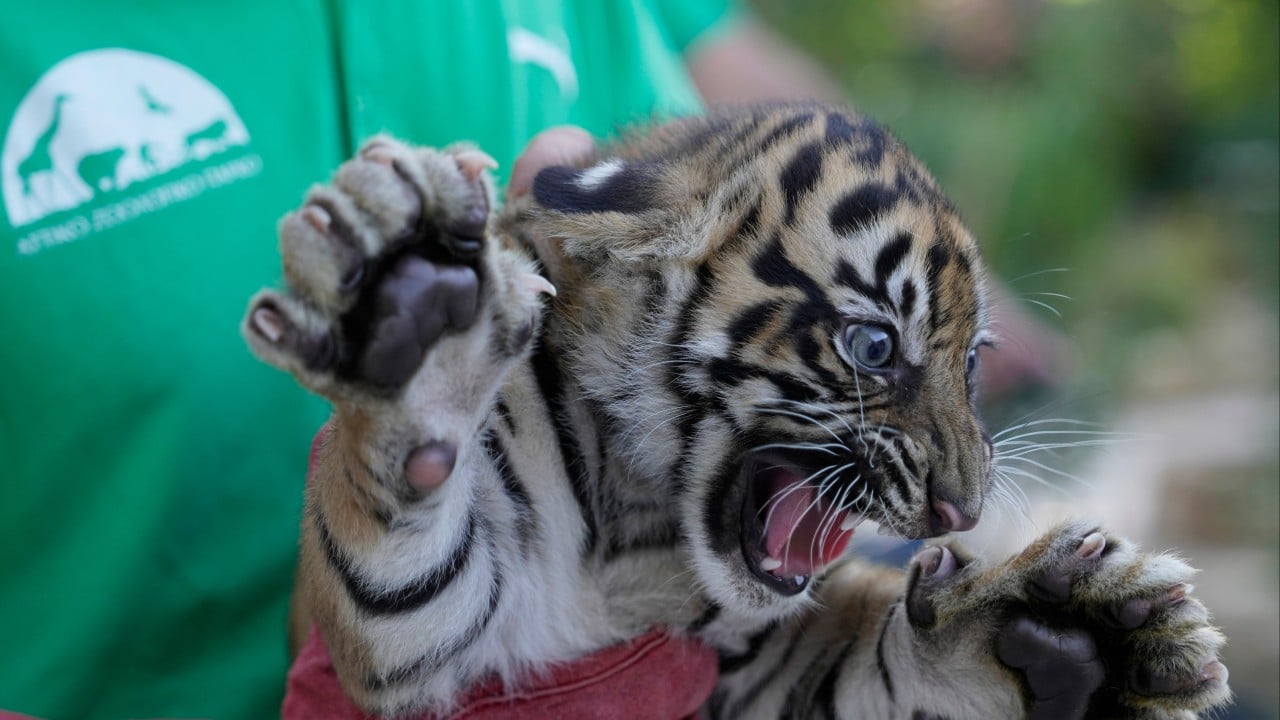
The air inside the concrete enclosure smelled of raw beef, wet straw, and a cold that had nothing to do with the weather.
I stood there in the predawn quiet, the kind of silence that only exists right before a zoo opens its gates to the public. My breath plumed in the dim light. Behind the heavy double-mesh barrier, three hundred pounds of ancient fury paced. A Sumatran tiger. Or rather, the ghost of one.
To look into those amber eyes is to realize something terrifying: there are fewer than four hundred of these animals left breathing free air on this planet. They are walking ghosts, surviving on the shrinking margins of an island halfway across the world, hunted by chainsaws, poachers, and the slow, suffocating creep of palm oil plantations. Sumatra is burning. And the fire is reaching the edges of the last green sanctuaries.
Then, out of nowhere, a miracle happened in Greece.
The Concrete Ark
We usually think of zoos as prisons with gift shops. We look at the glass walls and feel a quiet, heavy guilt. But context changes everything.
(Note: The following scenario illustrates the mechanics of modern captive conservation programs, based on the actual events at the Attica Zoological Park near Athens.)
Imagine a keeper named Nikos. He has spent twenty years sweeping floors, hauling frozen carcasses, and learning the exact pitch of a tiger’s chuff—a greeting sound that vibrates through your chest cavity. Nikos does not see a museum exhibit. He sees a family.
When the call came that a pair of rare Sumatran tigers needed a home outside their shrinking native habitat, the logistics were staggering. Permits, temperature-controlled cargo holds, veterinary clearances, and thousands of miles of transit. But the real weight was psychological. Could an apex predator born of the deep equatorial jungle find peace in the Mediterranean sun?
They did. And last spring, the concrete ark delivered.
Two cubs were born. Tiny, blind, trembling balls of orange fuzz striped with ink.
Statistically, it sounds like a rounding error. Two cubs. What do two cats matter when a species is sliding toward extinction?
Everything. They matter entirely.
The Architecture of Survival
Let us talk about safety nets. We love the phrase in business and finance, but in conservation, a safety net is literally a collection of steel cages, studbooks, and obsessive geneticists who track animal lineage with the precision of medieval royalty.
In the wild, the Sumatran tiger is cornered. Their gene pool is fracturing as forests are sliced into isolated green islands by logging roads. Inbreeding threatens them just as surely as a poacher's snare.
This is where European zoos—specifically institutions accredited by the European Association of Zoos and Aquaria—play a role that makes purists deeply uncomfortable. They are living gene banks. The birth in Greece was not an accident of nature; it was the result of a meticulously calculated European Endangered Species Programme. Every mating is charted across continents to ensure maximum genetic diversity.
It feels sterile. It sounds cold. Matching animals like chess pieces on a board.
(As a hypothetical analogy to explain this complex matchmaking: imagine trying to preserve the last surviving library of an ancient civilization, but every book is written in a slightly different, dying dialect. You cannot just pile them together; you have to cross-reference every sentence to ensure the language doesn't die out completely.)
Nikos didn't care about the spreadsheets when he saw the mother nudge the first newborn toward her belly. He cried. I know he cried, because I saw the salt tracks dried on his cheeks when he talked about it later.
The Weight of the Cage
We have made a terrible bargain with the natural world.
We cut down the trees. We paved the paradise. And then, when the last wild creatures are backed against the ocean, we build concrete boxes and call ourselves saviors. It is a profound contradiction. How can you champion freedom while locking a creature behind three inches of laminated glass?
Yet, standing there in the Athenian morning, watching those two cubs tumble over each other like drunken bowling balls, the philosophical debate felt suddenly academic. Philosophy doesn't feed a starving subspecies. Concrete and meat do. Money from ticket sales buys veterinary equipment. Global breeding networks buy time.
And time is the one thing the Sumatran tiger ran out of a decade ago.
We are living through an extinction event, quiet and relentless. Most people go their entire lives without seeing a wild animal larger than a stray cat, insulated by asphalt and digital screens from the collapsing biospheres that sustain us. We treat nature as a backdrop, a screensaver, something out there.
Until a cub in Greece opens its eyes for the first time and looks right through the mesh at you.
The Final Stripe
The cubs are older now. They have grown out of their clumsy-pawed phase into sleek, muscle-bound terrors with amber eyes that hold the weight of a vanishing world.
They will never stalk a wild tapir through the peat swamps of Riau. They will never feel the true, thick humidity of an Indonesian monsoon. That is the tragedy we cannot erase. We cannot give them back the jungle we stole.
But they are alive. Their breath fogs the Mediterranean air. Their growls rattle the glass.
Somewhere in Sumatra, a chainsaw roars in the distance, chewing through the canopy. But in a quiet enclosure under the Greek sun, two tigers sleep piled on top of each other, dreaming a wild dream they never had.


