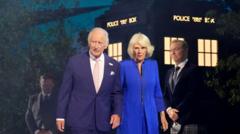
You couldn't make this up if you tried. On a rainy Thursday evening in Glasgow, the King of England stepped out of a fictional time machine.
Alongside Queen Camilla and cycling legend Sir Chris Hoy, King Charles III emerged from Doctor Who's iconic blue police box inside the OVO Hydro arena. It was quirky, surreal, and surprisingly effective. When Victoria abruptly pulled out of hosting duties due to spiraling costs, many critics wrote off these Games entirely. Glasgow had to scramble, slash budgets, and scale down the whole operation.
Yet the opening ceremony proved that you don't need a multi-million-pound budget to pull off something unforgettable. You just need a sense of humor and a blue wooden box.
A Whovian Entrance That Worked
The opening sketch set a playful tone right away. Pre-recorded footage showed the TARDIS sweeping across iconic Scottish landmarks, from Loch Ness to Edinburgh Castle. Sir Chris Hoy and actor Greg McHugh took the controls, with seventh Doctor Sylvester McCoy making a quick cameo.
After a pitstop at Balmoral Castle to pick up the royal couple, the police box materialised right on stage in an artificial garden. Charles and Camilla walked down the ramp to loud cheers, taking their seats in the royal box alongside Scottish First Minister John Swinney and Prime Minister Andy Burnham.
It was a clever nod to Scottish history. Few people realize that the classic police telephone box design was actually created by Scottish architect Gilbert MacKenzie Trench back in 1929. Using it as the central prop gave the night a distinctly local touch.
It also echoed a famous moment from the London 2012 Olympics when Queen Elizabeth II appeared alongside Daniel Craig's James Bond. Royal stunts like this are tricky. They can easily feel tacky or forced. But this one landed just right because everyone involved leaned into the absurdity.
Stripped Down But Big On Energy
Let's be honest about the context here. These Games are running on a fraction of the budget seen in Birmingham four years ago. The sport count dropped from 19 down to 10. Only around 3,000 athletes from 74 nations are participating, compared to nearly 5,000 in 2022.
Instead of endless pyrotechnics and massive stadium props, Glasgow relied on raw enthusiasm. The arena crowds went wild when wrestler Grado appeared dressed as a giant Scottish teacake. Actor Sam Heughan shared the stage with a mechanical Loch Ness monster that roared out the opening notes of Flower of Scotland.
Musically, the night kept rolling on local pride. Nathan Evans sang Scotland Is A Place Called Home as flashmob dancers took over the floor. Later, KT Tunstall brought down the house with No Scotland No Party and Suddenly I See, leaving thousands of athletes dancing on the floor before the parade even wrapped up.
It felt authentic. It felt like Glasgow.
Why the Royal Speech Shifted Focus
When King Charles officially opened the 23rd Commonwealth Games, his speech took an unexpected turn. Beyond praising the grit of the athletes, he focused heavily on environmental policy.
The official baton relay carried a specific message about ocean conservation throughout its 500-day journey. Charles urged member nations to step up their efforts against plastic waste in global waterways. He tied the health of marine life directly to the economic survival of coastal communities.
It was a sharp political note in an otherwise lighthearted evening. The King argued that protecting 30% of global oceans by 2030 isn't optional anymore.
What Needs to Happen Next
The opening spectacle succeeded in creating momentum, but the hard work starts now. Glasgow has shown that reduced-scale multi-sport events can still capture public attention. Whether that model can secure the long-term survival of the Commonwealth Games remains an open question.
If you're following the action over the next 11 days, here is how to get the most out of it:
- Focus on the Para sports integrated directly into the main track and swimming schedules for maximum competition depth.
- Keep an eye on smaller nations in lawn bowls and weightlifting, where the reduced athlete pools create tighter medal races.
- Pay attention to how Glasgow manages venue logistics across the 10 sports to see if this lower-cost hosting model becomes the permanent template for future host cities.