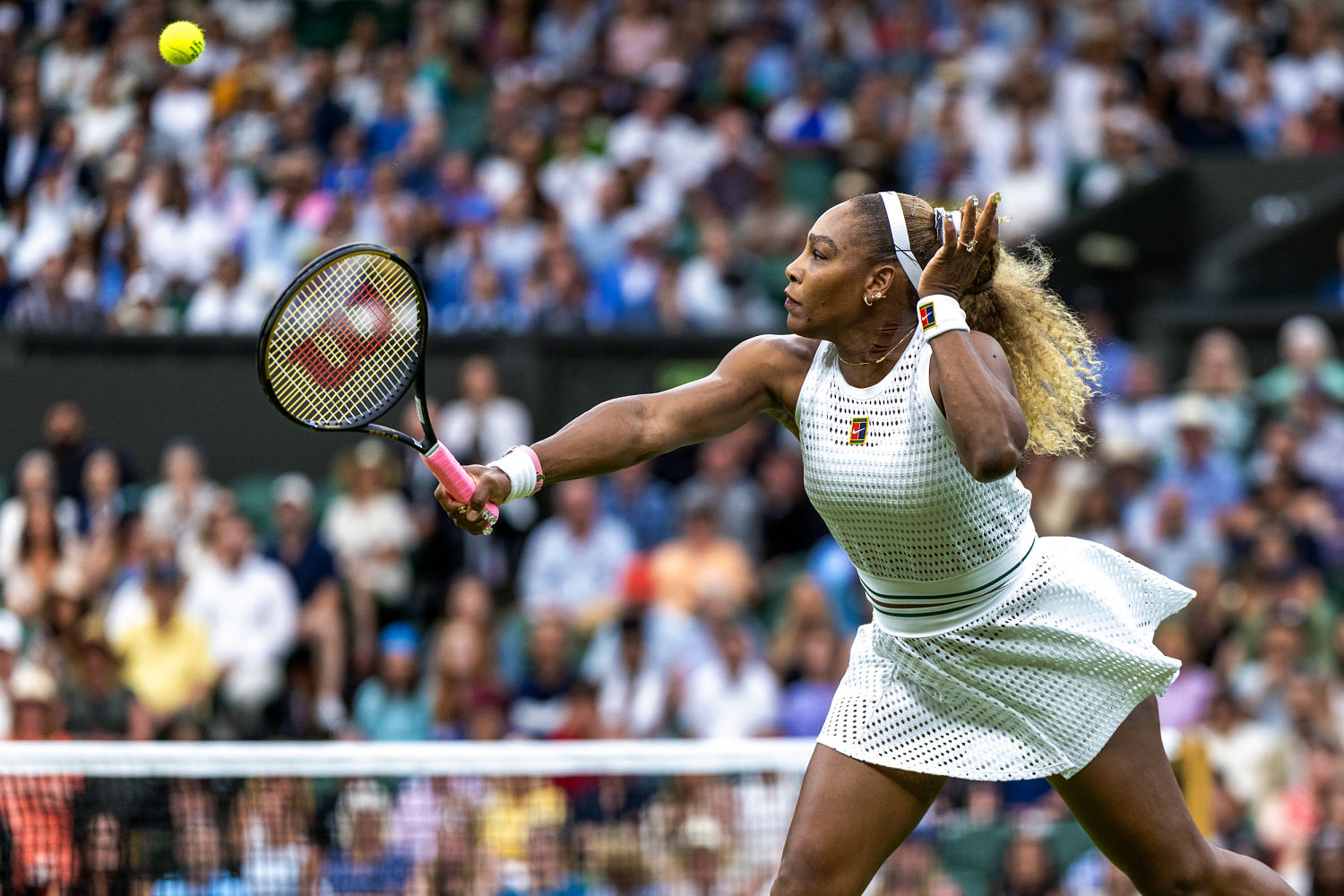
Elite athletic performance at the absolute margin of human biology operates on a razor-thin structural equilibrium. When a 44-year-old athlete returns to elite professional tennis after a multi-year absence, the mechanical forces exerted on the musculoskeletal system scale exponentially rather than linearly. Serena Williams’ withdrawal from the Wimbledon doubles draw alongside Venus Williams, following a three-set singles loss to 20-year-old Maya Joint, serves as a case study in the biomechanical tax of sudden high-velocity load exposure. The transition from a controlled training environment to the unyielding, multi-directional deceleration demands of competitive grass-court tennis creates a precise structural bottleneck.
To evaluate the operational limits of an aging elite athlete, the breakdown must be isolated into three core components: the mechanics of acute joint effusions, the kinetic disparities of grass-court locomotion, and the scheduling dynamics of tournament management.
The Biomechanical Mechanism of Joint Effusion
The structural failure point occurred during the first set of the singles match, characterized as a right knee strain or twist. In professional tennis, acute knee trauma under high load frequently manifests as an immediate accumulation of intra-articular fluid, clinically known as a joint effusion.
Williams documented the removal of significant fluid volume via four syringes post-match. The presence of this volume of synovial fluid or blood within the joint capsule reveals a specific physiological response to structural stress:
- Synovial Hypersecretion: The joint's membrane overproduces fluid in response to acute trauma, acting as an internal biological splint.
- Mechanical Inhibition: Excess intra-articular pressure physically restricts the degree of knee flexion and extension, directly compromising the deep kinetic chain required for elite tennis movement.
- Neuromuscular Arthrogenic Inhibition: The swelling prevents the quadriceps from firing at full capacity, structurally rendering the leg incapable of absorbing the high-velocity impact forces of a professional match.
While the aspiration of fluid temporarily mitigates intra-articular pressure, the underlying tissue damage—likely involving minor ligamentous laxity or meniscal irritation—cannot structurally stabilize within a 96-hour recovery window. The joint requires localized rest to down-regulate inflammatory markers and restore normal proprioceptive feedback. Attempting to compete under these parameters introduces an unacceptable probability of catastrophic structural failure.
The Kinetic Trajectory of Grass-Court Tennis
Grass courts represent the most taxing surface in professional tennis concerning rapid, low-center-of-gravity stabilization. Unlike clay, which allows for controlled sliding to dissipate kinetic energy, or hard courts, which offer predictable friction coefficients, grass requires absolute instantaneous braking and directional acceleration.
For an athlete with a long hiatus from competitive match play, the deceleration phase of movement presents the greatest injury risk. The kinetic energy generated during a full-sprint lateral run must be absorbed through the ankle, knee, and hip joints. A younger musculoskeletal system features highly elastic connective tissues capable of rapid eccentric loading. At an advanced biological age for professional sports, these tendons and ligaments exhibit reduced compliance.
The match data against Maya Joint illustrates the physical deficit. A three-set match lasting multiple hours forces the veteran athlete to endure thousands of micro-decelerations. As muscular fatigue accumulates, the burden of stabilization shifts from the active primary movers—the quadriceps and hamstrings—to the passive structural components of the knee joint. The twisting motion reported at the end of the first set was the direct mechanical consequence of a stabilization failure under fatiguing conditions.
Tournament Scheduling Boundaries and Rule Optimization
The logistical management of the Wimbledon draw underscores the immense institutional value placed on the Williams sisters' partnership, alongside the rigid operational boundaries of Grand Slam execution.
Tournament organizers utilized maximum scheduling flexibility to accommodate Williams' recovery timeline. By Friday evening, every single first-round women's doubles match had reached completion except for the Williams sisters' scheduled match against Camila Osorio and Solana Sierra. The tournament delayed scheduling the match into a fixed time slot on Saturday, designating it as "To Be Announced" and delaying the earliest possible start time to late afternoon.
This operational delay maximized the chronological window for physiological recovery, allowing approximately 96 hours from the initial injury event. However, the physical reality of tissue healing rates operates independently of tournament schedules. The replacement of the wildcard pairing by alternates Samantha Murray Sharan and Lanlana Tararudee demonstrates the finality of the competitive timeline; a Grand Slam draw cannot compromise its subsequent rounds to accommodate extended clinical recovery.
The Strategic Path Forward in North American Hard Courts
The focus now shifts to the upcoming North American hard-court swing, culminating in the US Open. Williams indicated an intention to continue competing, stating a desire to return in subsequent cities. Transitioning from grass to hard courts alters the mechanical demands on the right knee joint:
- Increased Friction Coefficient: Hard courts offer absolute traction, eliminating the micro-slippage inherent to grass. This increases the absolute peak force transmitted through the joint during sudden stops.
- Predictable Ball Bounces: Hard courts feature a higher, more consistent bounce trajectory. This reduces the requirement for deep, low-center-of-gravity squats, potentially alleviating stress on the patellofemoral joint.
- Linear Kinetic Transfer: Hard court movement permits more linear, aggressive footwork patterns, which are less likely to induce the specific rotational torque that caused the initial injury on grass.
To successfully participate in warm-up events such as the Cincinnati Open or the National Bank Open, the preparation framework must pivot entirely toward eccentric strength restoration and localized inflammation management. The operational objective cannot be immediate match-play volume; it must be the systematic rebuilding of the knee's load capacity under controlled lateral stress. Failure to strictly meter this workload will result in chronic re-effusion, prematurely terminating the competitive season prior to arrival in New York.