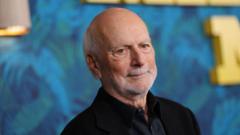
You probably watched an episode of his this week without even knowing it. When you think of a sitcom, you think of a cozy living room or a dimly lit bar where a group of deeply flawed, wildly charming people swap lightning-fast insults. You think of the comfort. That cozy feeling wasn't an accident. It was meticulously engineered over five decades by James Burrows.
The legendary director died on June 19, 2026, at the age of 85. While his name flashed past in a blink during the opening credits of Cheers, Friends, Taxi, Frasier, and Will & Grace, his DNA is baked into the foundation of American comedy. He didn't just direct television. He literally changed the physical space of the multi-camera format to make it feel like you were sitting right there on the couch with the cast. Meanwhile, you can explore related developments here: The Architecture of XG and the Brutal Reality of Corporate Pop Globalization.
Most people think television directing is just about telling actors where to stand and when to talk. Burrows knew it was about spatial mechanics, rhythm, and building a genuine workplace family behind the scenes so that the chemistry onscreen felt undeniable.
The Director Who Treated Television Like Live Theater
Burrows grew up as a self-described "theater rat" in New York. His father, Abe Burrows, was the brilliant mind behind massive Broadway hits like Guys and Dolls. That Broadway bloodline defined everything James did when he migrated to Hollywood in the 1970s. To understand the bigger picture, we recommend the recent analysis by Deadline.
"What I do is not really television," Burrows said in a 2022 interview. "It's really theater that I film for television."
Every single tape night with a live studio audience felt like an opening night on Broadway to him. Because he viewed the medium through a theatrical lens, he threw out the rigid rules of old-school TV.
In the early days of sitcoms, directors used three cameras. They stood still, capturing flat, safe shots. Burrows changed the game by popularizing the four-camera setup. That extra camera didn't just capture more angles; it gave the actors freedom to move naturally. They could pace, cross the room, or throw out physical gags without worrying about stepping out of a tight lighting zone.
He also obsessed over sophisticated lighting. He hated the bright, washed-out look of traditional 1970s studio sets. When he co-created Cheers, he insisted on warm, moody lighting that replicated a real Boston pub. He wanted the shadows. He wanted the grime. He knew that physical texture made the bar feel lived-in, turning the set into a character itself.
Why Form Chosen Families Ruled His Filmography
If you look at the massive hits Burrows guided, a distinct pattern emerges. He rarely focused on traditional nuclear families. Instead, he pioneered the "chosen family" sitcom structure.
- Taxi: A basement garage full of down-on-their-luck drivers looking out for each other.
- Cheers: A basement bar where a washed-up pitcher, a snobby waitress, and a bunch of regulars form an unlikely sanctuary.
- Friends: Six 20-somethings navigating early adulthood in Manhattan apartments.
- Will & Grace: A tight-knit group of friends rewriting the rules of modern relationships.
He understood that the audience craved a sense of belonging. By building these tight, insular television worlds, he made the viewers feel like they were part of the inner circle.
David Schwimmer, who played Ross Geller on Friends, noted after Burrows' passing that the director's warmth and humility made the cast feel safe. "He looked out for us, on camera and off," Schwimmer shared. That protective, paternal energy allowed young ensembles to take massive creative risks, fail during rehearsals, and discover the exact comic timing needed to make a scene land.
The Absolute King of the Pilot Episode
Network executives didn't just hire Burrows to keep successful shows running. They brought him in to breathe life into brand-new ideas. He directed over 75 pilot episodes during his career, including the first episodes of Two and a Half Men and The Big Bang Theory.
Setting the tone for a series is the hardest job in television. You have to introduce five or six characters, explain the premise, make the audience care, and generate massive laughs, all in exactly 22 minutes. Burrows had a supernatural instinct for casting and chemistry. He could spot the invisible spark between actors during auditions and manipulate the script to feed that specific energy.
When he directed all 246 episodes of Will & Grace, he acted like a symphony conductor. He knew exactly when to push a physical joke further and when to pull back for an emotional beat. Debra Messing recalled how he would explode in laughter when a comic moment landed perfectly, creating an environment where the actors actively sought his validation.
The Incomparable Footprint of a Master Craftsman
With 11 Emmy Awards and more than 1,000 television episodes under his belt, Burrows achieved a level of industry dominance that will likely never be replicated. Modern television has largely shifted toward single-camera comedies like The Bear or Abbott Elementary, which are shot more like feature films without a live audience. Burrows proudly stuck to his roots, preserving the endangered art of the traditional studio sitcom.
His loss leaves an immeasurable void in the entertainment world, but his structural blueprints are permanent. Every time you stream an old episode of Frasier for comfort, or catch a rerun of Cheers, you are participating in the specific communal warmth that James Burrows spent his entire life creating.
To truly appreciate his genius, skip the highlight reels. Go watch the pilot episode of Cheers or the early seasons of Friends. Pay attention to how the characters move across the room, how the lighting sets the mood, and how the jokes breathe. You'll see the invisible hand of a master director who spent 50 years making sure you never felt alone on a Friday night.