The air in the Sunda Strait does not just feel hot. It feels heavy, thick with the phantom weight of a billion tons of pulverized stone that once choked the sky. If you stand on the black sand beaches of the Indonesian coast today, looking out across the water toward the fractured remains of Krakatoa, the view is deceptively serene. Waves lap gently against the shore. Fishing boats bob on the horizon.
But beneath that calm lies the scar of an event that literally shook the planet.
We often think of islands as permanent fixtures of our geography, ancient monoliths that have always watched over the oceans. They feel like safety. They feel like solid ground. Yet, some places on this earth were not built by the slow, patient accumulation of time. They were forged in a single, terrifying instant of self-destruction.
To understand how a massive volcanic mountain utterly erased itself from the map—and in doing so, birthed a completely new ecosystem—we have to look at what happens when the earth quite literally loses its mind.
The Day the Sky Fell Black
Step back to August 1883. The world was interconnected by the telegraph, but still vastly localized in its daily rhythms. On the volcanic island of Krakatoa, nestled between Java and Sumatra, the earth had been rumbling for months. The locals were used to it. Indonesia sits directly atop the Ring of Fire, a massive horseshoe of tectonic activity where plates collide and grind past one another. Up to this point, the mountain was just another neighbor clearing its throat.
Then came the twenty-sixth of August.
Let us drop a hypothetical observer onto the deck of a passing merchant ship, a captain named logan, watching from what he hoped was a safe distance. To Logan, the world would have seemed to dissolve. The mountain did not just erupt; it ruptured. The pressure built up by trapped gases and rising magma became so intense that the very walls of the volcano could no longer contain it.
The sound was the loudest noise ever recorded in human history. It was heard nearly five thousand kilometers away in Rodriguez Island in the Indian Ocean, where residents reported hearing what sounded like distant gunfire. Imagine sitting in London and hearing an explosion in New York. That was the scale of the acoustic wave.
The sky went dark at midday. Ash fell like heavy gray snow, burning the skin of anyone caught in the open. But the true horror was not the fire or the smoke. It was the water.
When the giant volcano emptied its massive underground magma chambers, it left a colossal, hollow void beneath the earth's crust. The weight of the mountain above was too great. The ceiling collapsed. In a spectacular act of self-annihilation, Krakatoa collapsed inward, falling into the empty chambers below.
The sea rushed into the newly formed abyss. The displacement of water triggered catastrophic tsunamis, walls of water reaching over forty meters high that swallowed coastal villages whole. Over thirty-six thousand people vanished into the ocean in a matter of hours. By the time the dust settled, two-thirds of the island of Krakatoa had simply ceased to exist. Where a towering mountain had stood, there was now only open ocean, framed by three small, broken remnants of the original island's rim.
The Ghost in the Water
For decades, the area remained a watery grave, a silent testament to a disaster that dropped global temperatures by over a degree for the following year due to the sheer volume of ash reflecting sunlight back into space. The world moved on. The telegraph wires hummed with new crises.
But nature is impatient with voids.
Consider what happens next: far beneath the surface, the tectonic plates continued their relentless march. The magma chamber that had emptied so violently in 1883 began to fill once more. The pressure was building again, but this time, it had no massive mountain capping it down.
By 1927, fishermen casting their nets in the strait noticed columns of smoke rising directly from the waves. The water was boiling. Dead fish floated to the surface by the thousands. The ghost of Krakatoa was clawing its way back into the daylight.
A series of underwater eruptions began blasting ash and steam into the air. Layer by layer, eruption by eruption, a new landmass began to form. The sea fought back, washing away the loose volcanic debris as fast as the earth could spit it out. But the magma was relentless.
By 1930, a permanent new island had broken through the surf. The locals named it Anak Krakatau.
The Child of Krakatoa.
A Living Laboratory in the Death Zone
To land on Anak Krakatau today is an exercise in profound humility. The island is not just a geological wonder; it is a time machine. It shows us exactly how life began on Earth.
When the island first emerged, it was a sterile, hostile wasteland of black basalt and acidic ash. There was no soil. There were no seeds. There was absolutely nothing living. It was a blank slate, surrounded by hundreds of miles of ocean.
Yet, life found a way.
The first pioneers were not animals, but microscopic organisms and wind-blown ferns. Seeds drifted across the Sunda Strait on ocean currents, washing ashore on the black sands. Birds flying between Java and Sumatra used the new island as a resting point, inadvertently depositing seeds through their droppings.
Within a few decades, a miracle occurred. The barren rock began to turn green. A coastal forest sprouted. Crabs crept up from the surf. Rats, lizards, and insects arrived on floating logs and debris thrown into the sea by distant storms.
Scientists flocked to the island. It became one of the most important ecological study sites on earth. Here, they could watch the natural succession of species in real-time, undisturbed by human intervention. It was a stark reminder that life does not just adapt to destruction; it thrives on it. The very minerals that made the volcanic ash so deadly to breathe were the exact nutrients that fueled the rapid growth of this new jungle.
The Cycle That Never Ends
But the story of this Indonesian island is not a simple fable of rebirth and happily ever after. Anak Krakatau is the child of a monster, and it carries its parent’s volatile DNA.
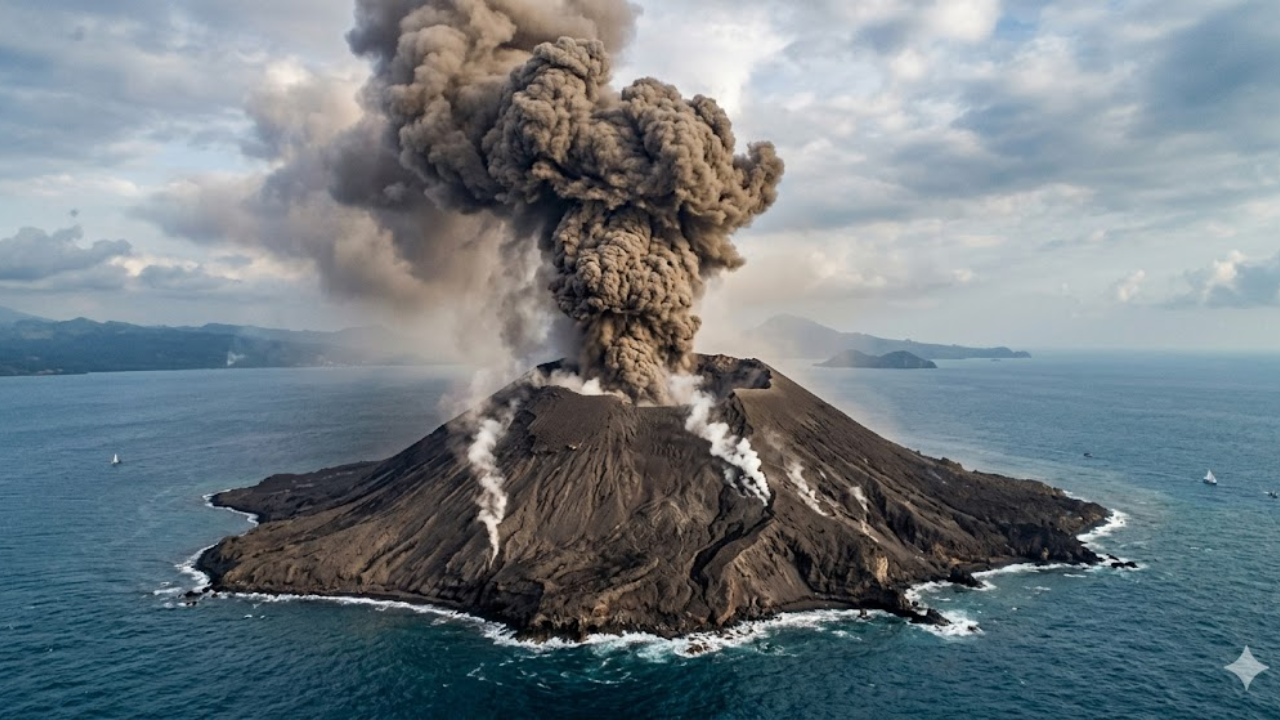
The island has been growing at an astonishing rate, adding meters to its height every single year as it continues to erupt. It is a living, breathing entity, constantly reshaping its own borders. Anyone who walks its slopes can feel the heat radiating through the soles of their shoes. Sulfurous gas billows from the summit, a constant reminder that the giant beneath the waves is merely sleeping.
In December 2018, the world received a grim reminder of this reality. A large section of Anak Krakatau’s southwestern flank collapsed into the sea during an eruption. The sudden displacement of water triggered another deadly tsunami that struck the coastlines of Java and Sumatra, claiming hundreds of lives.
The island had shrunk, losing two-thirds of its volume in a single night, mimicking the very catastrophe that gave birth to it over a century before.
It was a chilling echo of history. It proved that the cycle of destruction and creation is not a linear story with a clear beginning and end. It is a continuous, looping rhythm. The island that was created by a volcano destroying itself is still in the process of destroying and rebuilding itself today.
Standing on the edge of the strait, watching the plume of steam rise from the black cone of Anak Krakatau, the true weight of the place hits you. The beauty of the tropical landscape is inseparable from its terror. The lush green forests that cover the island's lower slopes are rooted in the ashes of an apocalypse. It is a fragile, fleeting existence, balanced on the knife-edge of the earth's deep, molten anger.