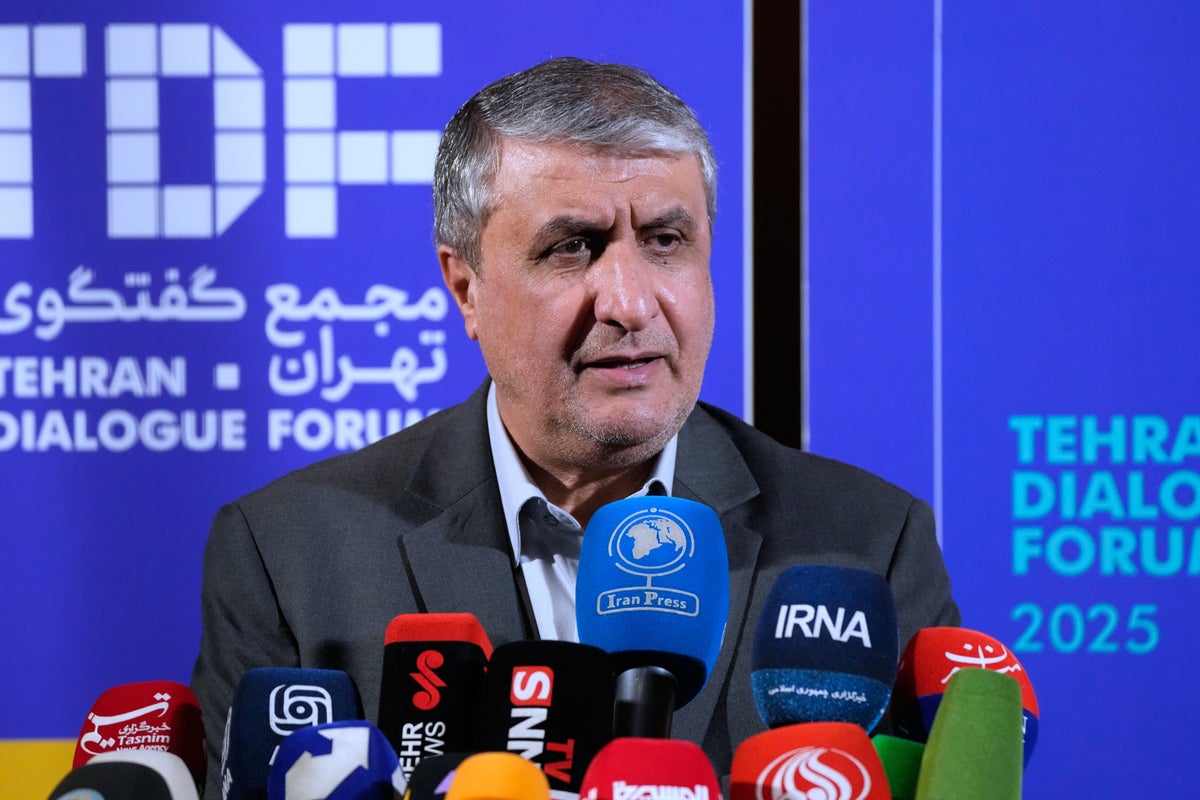
The headlines treat Mohammad Eslami staying home from the International Atomic Energy Agency General Conference as a diplomatic snub. They frame it as isolation, a sign of bunker mentality, or a tantrum thrown in the direction of Rafael Grossi.
It is none of those things. It is calculated subtraction.
When you control the enrichment centrifuges, flying to Vienna to endure a ritualistic parade of Western condemnation isn't diplomacy. It is unpaid labor. It is offering your adversaries a stage to perform domestic political theater while you quietly continue pushing the timeline forward in Natanz and Fordow.
For decades, the standard playbook dictated that Tehran had to show up to every diplomatic cattle call, hat in hand, defending its civilian energy program against a wall of hostile resolutions. Commentators hyperventilate whenever an Iranian official skips a summit, reading tea leaves about imminent escalation or total withdrawal from the Non-Proliferation Treaty. They miss the broader structural shift. The Islamic Republic has stopped playing the compliance game because they realized the scoreboard was rigged by the referee.
Let us look at the actual mechanics of modern non-proliferation enforcement. The IAEA is fundamentally an accounting firm with a security mandate. Its inspectors measure uranium hexafluoride, count cascades, and review containment seals. But when geopolitical tensions reach a boiling point, the Agency ceases to be a technical arbiter and becomes a diplomatic battering ram for the P5+1.
By refusing to send the head of the Atomic Energy Organization of Iran to Vienna, Tehran is signaling that the era of performative contrition is over. Why fly thousands of miles to listen to a curated chorus of European and American diplomats read talking points drafted in Washington, only to face another censure resolution backed by a majority that long ago abandoned objective verification for political posturing?
The lazy consensus in the mainstream press is that isolation weakens a state's hand. But in high-stakes nuclear brinkmanship, strategic absence is a form of leverage. It starves the opposition of the imagery they crave: the tense hallway ambushes, the doorstop interviews where western reporters demand answers on 60% enrichment, the curated photo-ops of Western officials lecturing an empty chair.
When you do not show up, the cameras have nothing to point at except their own irrelevance.
To understand why this move matters, we have to strip away the moralizing language of the mainstream foreign policy establishment. The standard narrative claims that Iran's nuclear program is an existential crisis requiring perpetual containment through sanctions and diplomatic pressure. I have watched analysts blow millions of dollars in think-tank funding trying to model how a regime under maximum pressure will eventually capitulate to a negotiated deal.
They are solving the wrong equation.
Sanctions did not halt the cascade installations; they forced domestic technological substitution. Every time a Western supplier cut off precision valves or digital control systems, Iranian state enterprises reverse-engineered them. The program is more indigenous, more resilient, and further advanced today than it was when the Joint Comprehensive Plan of Action was signed.
When Eslami stays home, he is acknowledging a hard, unvarnished truth: the JCPOA is a rotting corpse, and nobody has the political will or the domestic mandate to revive it. The United States cannot offer sanctions relief that survives a change in presidential administrations, and Iran has zero incentive to roll back its breakout timeline for promises written on water.
So what does the IAEA General Conference actually achieve under these conditions? It provides a veneer of multilateral legitimacy for policies that have already failed.
Consider the "People Also Ask" framing dominating media coverage: Is Iran closer to a nuclear weapon?
The question itself is a linguistic trap designed to frame a political choice as an inevitable natural disaster. The accurate technical answer is that Iran has mastered the nuclear fuel cycle up to the threshold of weaponization, maintaining a latency period that can be measured in weeks, if not days. They do not need to test a device to be a threshold state; the capability is the deterrent. Mohammad Eslami sitting in Tehran rather than a hotel in Vienna changes none of those mathematical realities. It merely strips away the diplomatic pantomime that pretends negotiations are still moving forward.
There is a profound irony in how Western capitals react to this reality. They demand transparency and cooperation while maintaining an economic blockade designed to crush the civilian economy. When the target of those policies stops participating in the polite fiction of mutual dialogue, policymakers act shocked.
Let us be entirely honest about the downside of this contrarian approach. By retreating from multilateral forums, Tehran reduces the channels for accidental de-escalation. When communication breaks down entirely, the margin for catastrophic miscalculation expands. If a regional proxy miscalculates or a cyberattack hits industrial infrastructure, there are fewer backchannels to manage the fallout. Total disengagement is a dangerous game, and treating the IAEA with casual disdain carries real military risks.
Yet, from Tehran's vantage point, the alternative was worse: endless compliance theater that yielded zero economic dividend while legitimizing continuous surveillance.
The next time you read a breathless dispatch about an Iranian official skipping an international conference, do not look for signs of weakness. Look for the silence. That is where the real power is being negotiated.


