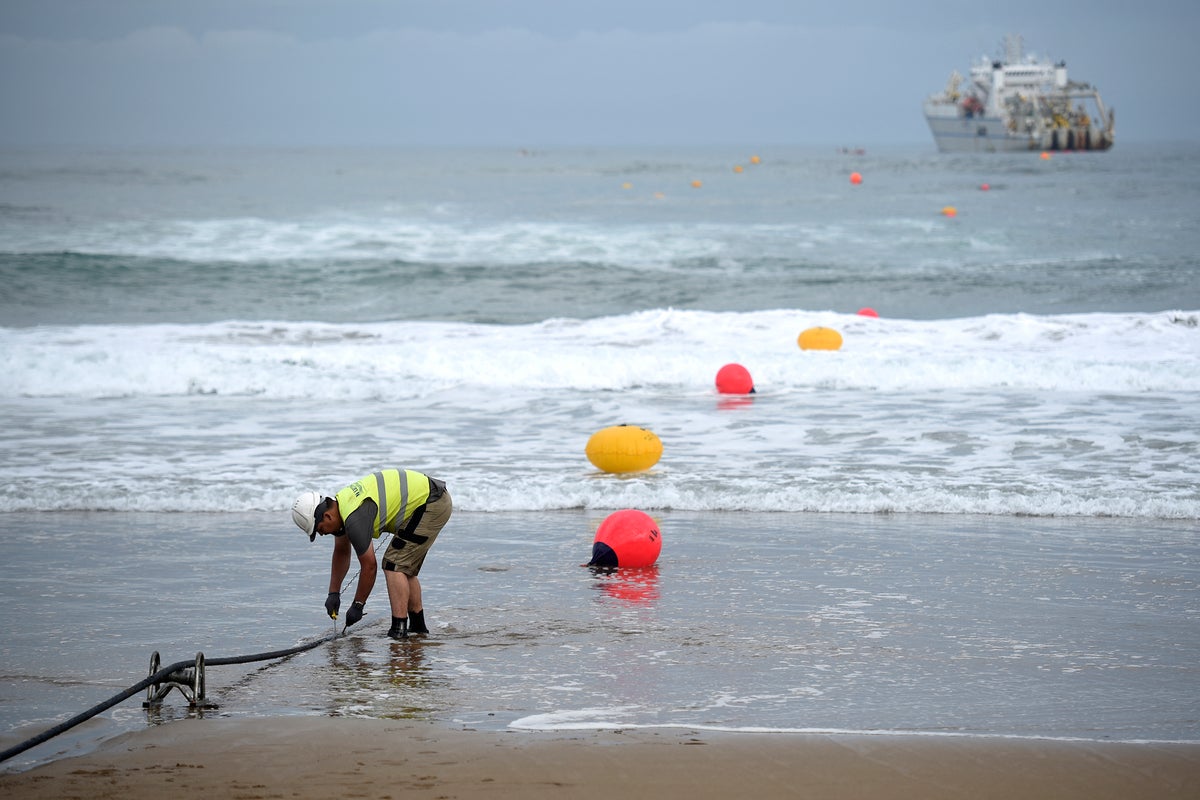
Oil isn't the only thing flowing through the Strait of Hormuz.
For decades, the world focused on the massive tankers navigating this narrow pinch point between Iran and Oman. Block the strait, and global energy markets choke. But beneath the surface, a different kind of commerce is humming through a dense web of fiber-optic cables. This infrastructure carries the literal lifeblood of the modern economy: financial transactions, cloud data, artificial intelligence training models, and the consumer apps you use every single day.
Tehran noticed.
With tensions between Iran, the United States, and Israel running hot, Iranian military officials and state-linked media are shifting their gaze down to the seabed. Last week, Iranian military spokesperson Ebrahim Zolfaghari posted a blunt declaration on X: "We will impose fees on internet cables."
The message is clear. Tehran wants the world's biggest tech companies—specifically hyperscalers like Google, Microsoft, Meta, and Amazon—to open their wallets for using the Strait of Hormuz seabed. State-linked media outlets affiliated with the Islamic Revolutionary Guard Corps (IRGC), including Fars and Tasnim, are laying out a aggressive legal and logistical framework to justify what critics call a digital shakedown.
It's a bold play for revenue and strategic leverage. But can Iran actually pull it off, or is it just geopolitical noise?
The Legal Trap and the Egyptian Ambition
To understand why Iran thinks it can tax global internet traffic, you have to look at the unique geography of the Strait of Hormuz. At its narrowest point, the waterway is only about 21 nautical miles wide. Under the 1982 UN Convention on the Law of the Sea (UNCLOS), coastal nations can claim territorial waters up to 12 nautical miles from their shores.
Do the math. The territorial claims of Iran and Oman overlap entirely. There's no international high sea here.
IRGC-affiliated media outlets are using this exact overlap to build their case. Their argument is straightforward: any fiber-optic cable laid on the seabed within their 12-nautical-mile zone constitutes an "occupation of Iranian soil underwater." Because of this, they argue that foreign operators must secure permits, pay per-meter infrastructure fees, and hand over licensing royalties.
Tehran is looking across the region with a heavy dose of envy. They're trying to replicate the Egyptian model. Egypt makes massive sums of money by charging hefty transit fees for cables crossing its land territory and territorial waters near the Suez Canal. It's a goldmine.
But Iran's plan has a massive logical flaw. The Suez Canal is an artificial waterway entirely inside Egyptian territory. The Strait of Hormuz is an international strait used for international navigation. Under international law, foreign vessels and infrastructure enjoy the right of transit passage. You can't just slap a tollbooth on a global maritime highway without breaking international treaties.
Why Big Tech Can't Just Write a Check
Let's say Iran ignores international law and demands the cash. The target list isn't small. Google, Microsoft, Meta, and Amazon have invested billions into subsea cable consortiums to keep their global cloud regions linked.
But these tech giants physically cannot pay Tehran.
Strict US sanctions explicitly prohibit American corporations from conducting financial transactions with the Iranian government, especially entities linked to the IRGC. If Google transfers millions of dollars to Tehran for a cable license, it faces catastrophic legal penalties at home.
[Image of undersea fiber optic cable cross section]
Furthermore, the physical reality of the network complicates things. Major international cable systems like the Asia-Africa-Europe 1 (AAE-1), FALCON, and Gulf Bridge International (GBI) carry traffic that is deeply aggregated. Telecommunications experts point out that you can't isolate and segregate an individual company's internet data traffic as it flashes through a fiber-optic strand at the bottom of the sea.
Most international cable operators knew the risks of dealing with Tehran long ago. To avoid geopolitical headaches, they deliberately routed their infrastructure along the southern, Omani side of the strait. However, older or highly interconnected systems like FALCON and GBI still cut through sections of Iranian territorial waters. That gives Iran exactly enough of a footprint to start causing problems.
The Hidden Threat to the Global Economy
If Iran can't legally or logistically collect these fees, then this policy isn't really about the money. It's about leverage. It's a new line item in Iran's asymmetric warfare toolkit.
The real danger isn't a tax invoice; it's the implicit threat of what happens if Big Tech refuses to pay. Iranian state media has already started warming up the rhetoric, warning that "simultaneous damage to several major cables" could trigger immediate, widespread internet blackouts across the Persian Gulf.
What happens if those cables get cut?
- The Gulf Economies Stagnate: Countries like the UAE and Saudi Arabia are investing heavily in national AI initiatives and digital economies. Their data centers rely on these subsea arteries.
- The Outsourcing Crises: A massive chunk of India's internet traffic routes through the Gulf to Europe. Severing these lines could cripple Bangalore's tech outsourcing sectors, costing billions in delayed financial transactions.
- Global Cloud Drag: While the internet is built to reroute data automatically around broken nodes, the sudden loss of multiple high-capacity cables in the Gulf would cause severe regional latency, slowing down everything from AWS cloud services to automated financial trading systems between London and Singapore.
Iran has the physical capability to back up these threats. The IRGC Navy commands a fleet of midget submarines, combat divers, and unmanned underwater vehicles (UUVs). They don't need a massive naval destroyer to drop an anchor or a specialized cutter onto a fiber-optic bundle lying in relatively shallow waters.
The Maintenance Monopolization Play
Tehran's strategy also includes a clever logistical twist. Instead of just threatening to cut lines, Iranian officials want to dictate who can fix them. The proposed framework demands that all repair and maintenance rights for cables within their zone be handed exclusively to Iranian technology firms.
Right now, if a subsea cable breaks, specialized international repair ships are dispatched to the scene. It's a slow process; repairs average about 45 days due to regulatory hurdles and ship availability. Tasnim argued that giving Iranian firms exclusive maintenance rights would drastically cut down repair times, framing it as a "competitive advantage."
In reality, it's a trap. If Iran controls the repair ships, they control the data. It gives them the ability to physically access the infrastructure, drag out repair times during a geopolitical standoff, or refuse entry to international vessels entirely under the guise of security.
Furthermore, cable repair ships must remain completely stationary for days at a time while splicing delicate glass fibers. No international maritime insurer is going to cover a commercial repair vessel sitting still in a hot conflict zone while the IRGC claims exclusive jurisdiction over the waters.
What Tech Infrastructure Leaders Must Do Next
This isn't a problem that is going away. Geopolitics and digital infrastructure are now permanently tangled. Tech companies, network architects, and enterprise businesses relying on Euro-Asian data corridors need to stop looking at subsea cables as simple utility lines and start treating them as volatile geopolitical assets.
If you manage global network operations or rely heavily on cloud infrastructure spanning the Middle East, you need to shift your strategy immediately.
First, audit your data routing paths. Don't just trust that your cloud provider has redundancy. Demand to know exactly which subsea consortiums carry your primary and backup traffic. If your data runs through the FALCON or GBI systems, you are exposed to Iranian territorial claims.
Second, diversify away from chokepoints. The industry is already moving toward overland terrestrial routes through Saudi Arabia and Jordan, as well as completely new subsea paths that bypass the Red Sea and the Strait of Hormuz entirely, such as Africa-circumventing routes. They cost more and add slight latency, but they buy insurance against a regional digital collapse.
Finally, prepare your enterprise for latency spikes. Ensure your regional data centers have robust local caching strategies so that a sudden rerouting of international traffic doesn't crash your user-facing applications in the Middle East and South Asia.
Tehran's threat proves that the internet isn't an ethereal cloud. It's a physical network of glass and steel vulnerable to the old rules of sovereign power.