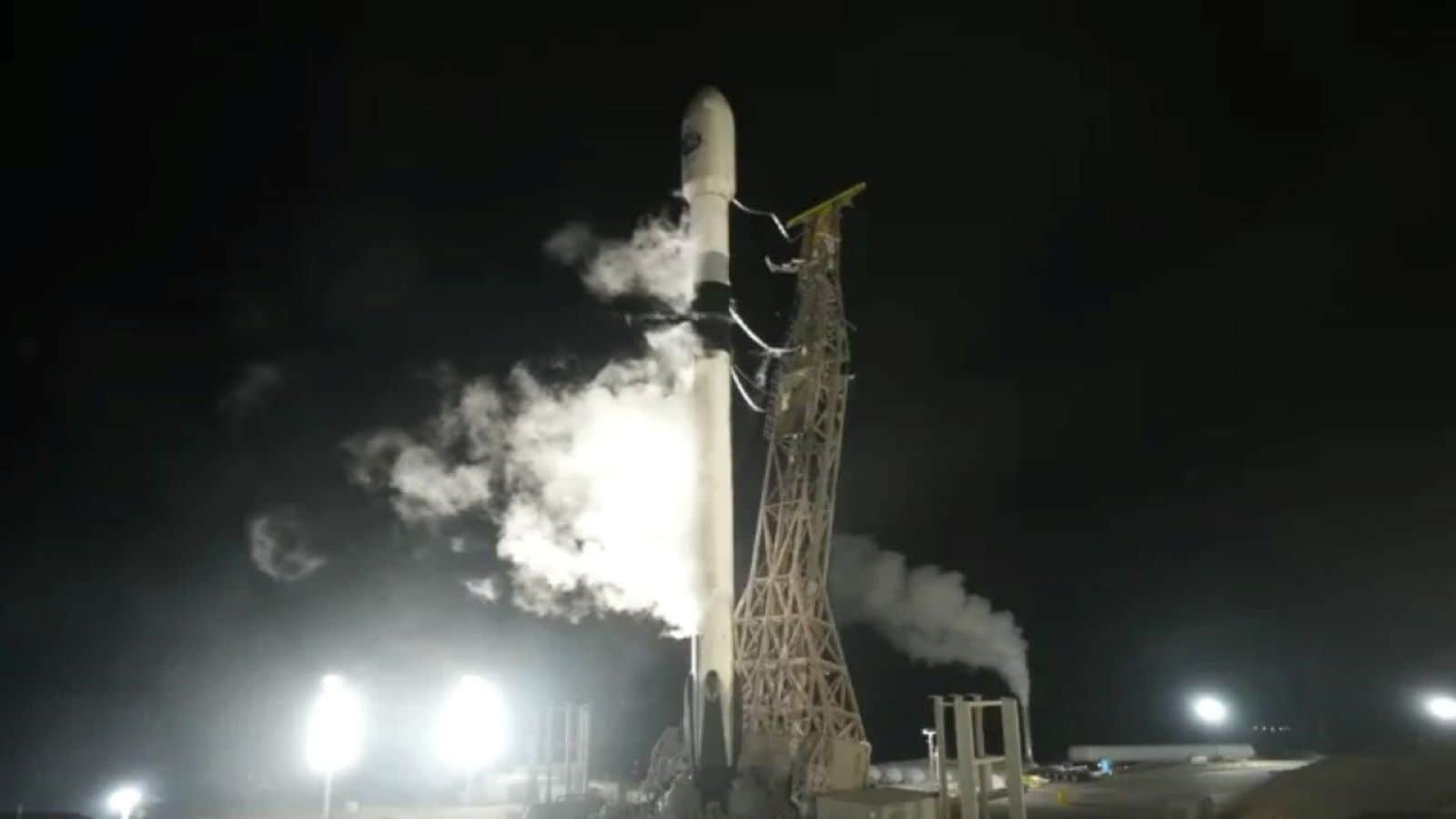
Midnight at Vandenberg Space Force Base smells like scorched RP-1 rocket fuel and cold Pacific salt.
For five agonizing days, the countdown had been frozen. Back on October 5, 2026, with just fifty-eight seconds left on the digital clock, the Falcon 9’s onboard computers sensed a faint tremor of doubt—an off-nominal whisper in Stage Two data that forced an automatic abort. In the high-stakes theater of modern defense procurement, a scrubbed launch is a quiet heartbreak. Engineers packed up tools, safety teams re-checked telemetry, and twenty-one intricate machines built by Northrop Grumman sat quietly inside their fairing, waiting for a second chance. For another perspective, read: this related article.
Then came October 10.
At 12:39 a.m. local time, the silence broke. Nine Merlin engines roared to life, turning the California coastline into a blinding, sodium-lit day. The vehicle—booster B1103 on its sixth flight—cleared the pad and pitched southward over the dark ocean. Similar analysis on the subject has been shared by The Verge.
Fire. Smoke. Thunder.
And then, quiet efficiency.
Six minutes later, while the second stage carried its silent cargo toward low Earth orbit, the first-stage booster executed its return journey, touching down softly at Landing Zone 4. It was the 668th time SpaceX successfully landed a booster, a staggering statistic that has paradoxically made the miraculous look routine. But the real story of the Tranche 1 Transport Layer A mission was not happening on the ground. It was unfolding five hundred miles above our heads.
Consider what happens next in the quiet expanse of the thermosphere.
The twenty-one newly deployed satellites are not heavy, lumbering school-bus-sized sentinels of the past. They are sleek, agile nodes designed for the Space Development Agency’s Proliferated Warfighter Space Architecture. Imagine a invisible, interconnected lattice wrapping around the globe. Each spacecraft carries optical communication terminals—lasers capable of talking to neighboring satellites at the speed of light.
For decades, military communication relied on massive, vulnerable geostationary satellites parked twenty-two thousand miles out in space. If one of those ancient giants failed or was blinded, continents went dark.
The new strategy changes the geometry of survival. By scattering hundreds of smaller, relatively inexpensive satellites across low-Earth orbit, the Pentagon is building a mesh network that cannot be easily broken. If a node is jammed or destroyed, the data simply bends around the gap, finding a new path through the laser web in milliseconds. It is the orbital equivalent of a nervous system.
Down on the ground, a tactical operator in a remote desert command post needs real-time situational awareness. They do not care about the politics of procurement or the billions allocated under National Security Space Launch contracts. They care about whether the data gets through. They care about latency measured in milliseconds.
This fourth Tranche 1 mission adds twenty-one more bricks to that celestial bridge. When combined with earlier deployments by York Space Systems and Lockheed Martin, the constellation grows denser, more resilient, and infinitely harder to outmaneuver.
The rocket has already landed. The press releases have faded. Yet high above the troposphere, invisible beams of infrared light are already intersecting in the dark, weaving a web that guards the modern world while we sleep.