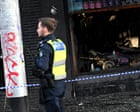
The smell of burnt plastic and scorched timber does not wash out easily. It clings to brickwork. It lingers in the frayed wool of a shopkeeper's cardigan long after the fire trucks have packed away their hoses and the police tape has fluttered down into the gutters.
For months, the night air in Melbourne has carried a sharp, chemical menace. A turf war fought with petrol cans and cheap fuses has turned hundreds of suburban tobacconists into charred skeletons. These are not grand corporate headquarters or high-profile casualties of global finance. They are corner shops, lit by buzzing fluorescent tubes, selling lottery tickets, chewing gum, and cheap imported cigarettes.
Now, a second fire is burning through the debris. It is quieter, generated by actuaries in glass towers miles away, but it is just as destructive.
Insurance policies are vanishing.
Consider a hypothetical shopkeeper we will call Arthur. Arthur has owned a small mixed business in Melbourne's inner north for fifteen years. He knows the names of the children who walk past for school ice creams. He knows which pensioners prefer the daily paper delivered and who buys menthol cartons on pension day. He pays his premiums on time, every month, without fail. He considers insurance to be a quiet agreement between himself and the modern world: a small tribute paid to peace of mind.
Then the letters arrived.
Or worse, the phone calls. Policies cancelled. Renewals refused. Premium quotes inflated by four hundred percent overnight, priced deliberately to force a surrender. When Arthur asks why, the voice on the other end of the line does not mention crime rates or local council permits. The voice speaks in the cold, clinical syntax of risk management. Because of an unprecedented spike in criminal arson targeting retail tobacconists across Victoria, the underwriters have drawn a red circle around the entire sector.
Guilt by association.
To understand why this feels like a betrayal, you have to understand how insurance actually works under the hood. It is an act of collective pooling. We all throw our coins into a vast, invisible well so that when lightning strikes one house, that family is pulled from the ash. It relies on probability, statistics, and the comforting illusion that disaster is distributed randomly across a population.
But arson is not lightning. Arson is intentional. Arson has a vector.
When criminal syndicates begin using firebombings as a brutal retail negotiation tactic—fighting over illicit tobacco distribution and turf—the traditional actuarial models break down. The probability curves go vertical. Insurers look at the Melbourne metropolitan area, see a rising tally of firebombed shopfronts, and make a binary calculation. They do not ask whether Arthur sells illegal chop-chop tobacco. They do not care if his security cameras are state-of-the-art. They see the word tobacconist on his business registration, and their algorithms issue a flat refusal.
This is where the human cost detaches from the headlines.
When a store loses its insurance, it does not just lose financial protection against fire. It loses its commercial life. Landlords demand proof of currency for building insurance before they will renew a commercial lease. Banks demand it before they will service a small business loan. Whodunit plotlines and police task forces dominate the evening news, but the real tragedy unfolds in the quiet panic of small business owners sitting at empty kitchen tables, realizing they are suddenly uninsurable, illegal tenants in their own livelihoods.
We have created an economic exclusion zone.
Walk down Sydney Road or through the suburban shopping strips of Dandenong at dusk. The shutters are coming down earlier now. Not because there aren't customers, but because the calculus of risk has shifted. The shopkeepers who have nothing to do with the criminal syndicates—the legitimate family operators trying to pay off a mortgage or put a child through university—are paying the price for a shadow war they never signed up for.
They are caught between two fires. On one side, masked extortionists demanding protection money or eliminating rivals with a Molotov cocktail. On the other side, financial institutions retreating into complete risk aversion, pulling the safety net away precisely when the tightrope walker is caught in a gale.
This is the hidden crisis beneath the crime wave. It is the steady erosion of the social contract.
When a society's financial plumbing begins to fail, it does not happen all at once with a dramatic explosion. It happens in silence. It happens when an underwriter in a Melbourne high-rise pushes a rejection button on a screen. It happens when an honest merchant locks his door for the final time because he cannot afford to operate naked to the elements.
The smoke from the firebombings will eventually clear. The police will make arrests; task forces will be funded; headlines will shift to the next urban panic. But the institutional abandonment of small-scale commerce leaves a deeper scar. It teaches a generation of independent business owners a bitter lesson about the limits of protection in a modern economy.
When the worst happens, you are entirely on your own.