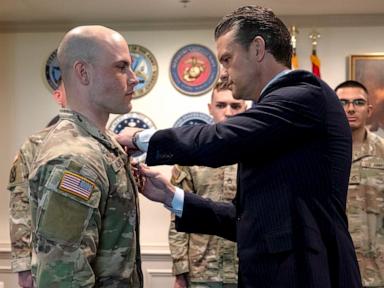
Military installations rely on absolute adherence to statutory protocols rather than situational deference to high-ranking officials. When a uniformed service member enforces federal regulations against a prominent political figure or senior defense official—such as the documented friction involving Pete Hegseth’s group at Arlington National Cemetery—the subsequent awarding of a military medal is neither an anomaly nor a partisan gesture. It is the predictable output of an institutional reinforcement mechanism designed to preserve chain-of-command integrity and statutory compliance under political pressure.
The Structural Mechanics of Federal Cemetery Governance
Arlington National Cemetery operates under strict federal mandates codified in Title 32 of the Code of Federal Regulations (32 CFR Part 553) alongside the Hatch Act and Department of Defense Directive 1344.10. These frameworks establish an unambiguous boundary between solemn memorialization and political activity. Standard journalistic coverage typically frames altercations at Section 60 or other restricted zones as interpersonal conflicts between a low-ranking official and a high-profile visitor. That framing misses the operational reality.
The enforcement architecture at Arlington relies on three distinct variables:
- Statutory Clarity: Federal law explicitly prohibits partisan political activities, unauthorized photography, and campaign-related filming within cemetery grounds. The rules leave zero room for discretionary exceptions based on a visitor's public profile, media platform, or political alignment.
- Delegated Authority: Cemetery personnel, including Old Guard sentinels and Army civilian staff, hold direct delegated authority from the Secretary of the Army to enforce these regulations on the spot. In the execution of guard and protocol duties, positional authority supersedes rank or civilian status.
- Asymmetric Risk: A failure to enforce regulations creates an immediate legal and reputational liability for the Department of the Army. Allowing one group to bypass restrictions sets an operational precedent that invalidates enforcement mechanisms for all subsequent visitors.
When an individual soldier steps forward to halt unauthorized filming or enforce perimeter boundaries, that soldier is functioning as the terminal node of a federal compliance system. The friction occurs when external actors attempt to apply civilian political norms—where celebrity, media leverage, or ideological alignment often bend rules—to a closed military environment governed by rigid administrative law.
Principal-Agent Alignment in Military Institutions
To understand why the military awards medals following high-friction protocol enforcement, one must apply principal-agent theory. In any large bureaucracy, leadership (the principal) faces the persistent challenge of ensuring frontline operators (the agents) execute rules faithfully when confronted with high-cost, high-visibility resistance.
Enforcing rules against powerful figures carries severe personal risk for a junior service member or mid-level non-commissioned officer. The immediate costs include:
- Direct Confrontation: Physical or verbal pushback from security details, staffers, or principals accustomed to deference.
- Public Exposure: The high probability of being filmed, doxxed, or subjected to targeted media campaigns by partisan outlets.
- Career Uncertainty: The fear that future political appointees might retaliate through administrative channels or stalled promotions.
If the institution leaves the agent exposed to these costs without explicit validation, rational agents will default to avoidance. They will look the other way when VIPs violate regulations, leading to rapid institutional decay.
Awarding a decoration—such as an Army Achievement Medal or Army Commendation Medal—corrects this incentive imbalance. The medal serves two structural functions. First, it compensates the individual agent by placing a permanent, objective marker of institutional approval into their Official Military Personnel File (OMPF). This insulates the soldier from informal retaliation by establishing that their actions were officially sanctioned by the command structure. Second, it broadcasts a clear signal across the entire force: adherence to written orders outweighs the perceived status of the person violating them.
Separating Confirmed Operational Facts from Media Narratives
Analysts evaluating this event must strictly separate verified institutional actions from the surrounding political commentary.
Confirmed Operational Facts:
- Federal regulations strictly govern conduct, photography, and media production at Arlington National Cemetery, particularly in areas containing graves of service members killed in recent conflicts.
- An altercation occurred involving an Arlington staff member/soldier enforcing these rules against individuals accompanying Pete Hegseth, a prominent media personality and political figure.
- Military leadership subsequently recognized the service member with an official award for their conduct and professionalism during the incident.
Educated Hypotheses and Structural Deductions:
- Deterrence Calibration: While the Army rarely releases internal deliberations behind individual awards, the timing and visibility of such decorations typically indicate a deliberate effort by command leadership to reinforce morale among protocol and security staff. When frontline personnel face public scrutiny for doing their jobs, commanders use expedited awards to prevent operational hesitation.
- Political Neutrality Maintenance: The Department of Defense operates under intense pressure to demonstrate non-partisanship. By validating the enforcement of neutral rules against a high-profile figure, the institution attempts to prove that its regulatory framework applies uniformly, regardless of who holds political influence or media reach.
What remains unverified—and operationally irrelevant to the institutional mechanics—are the internal emotional motivations of the visitors or the private political leanings of the commanding officers who signed the award citation. Military bureaucracy processes inputs (rule violations and documented enforcement) into outputs (administrative discipline or formal recognition). Personal politics are noise in that equation.
The Cost Function of Selective Enforcement
A common error in political commentary is treating protocol enforcement as a minor bureaucratic detail. From an operational standpoint, selective enforcement carries a devastating cost function that degrades military readiness and public trust.
Consider the downstream effects if the soldier at Arlington had stood down:
- Erosion of Sentinel Authority: The 3d U.S. Infantry Regiment (The Old Guard) and Arlington staff maintain order among millions of annual visitors entirely through the perceived inviolability of their authority. Once visitors observe that assertive behavior or camera crews can override a soldier's directive, compliance collapses across the facility.
- Politicization of Sacred Ground: Arlington National Cemetery retains its national legitimacy precisely because it remains insulated from partisan theater. If political figures convert burial grounds into content-creation backdrops without resistance, the cemetery ceases to function as a neutral national shrine and becomes a contested political asset.
- Command Fragility: Junior leaders watch how senior commanders respond to external pressure. If senior officers sacrifice a subordinate to appease a media figure or political faction, trust within the chain of command fractures. Subordinates conclude that regulations are merely traps—enforced when convenient, abandoned when costly.
By issuing a medal, the command absorbs the political heat generated by the incident and converts it into internal cohesion. The institution demonstrates that its internal rules have greater tensile strength than external political pressure.
Limitations of Award-Based Reinforcement
While formal recognition effectively validates individual compliance, relying on medals to manage high-profile protocol friction has distinct operational limitations.
First, awards are reactive mechanisms. A medal recognizes past performance under stress; it does not prevent the initial confrontation from occurring. As long as external actors view military installations and national memorials as high-value backdrops for political signaling, frontline soldiers will continue to face boundary-testing behavior.
Second, publicized awards risk drawing the military into the exact partisan disputes it seeks to avoid. In a polarized media environment, an internal administrative recognition is inevitably weaponized by competing political factions. One side frames the medal as a rebuke of the public figure; the other frames it as evidence of bureaucratic bias within the defense establishment. This external framing can undermine the intended message of neutral rule enforcement.
Third, tactical recognition cannot substitute for clear strategic guidance. If senior civilian and military leaders fail to establish unambiguous pre-visit protocols with high-profile guests, junior personnel remain trapped in lose-lose scenarios where they must physically or verbally block VIPs on camera.
Strategic Imperatives for Institutional Protocol Management
Organizations managing high-security, high-symbolism environments—whether military installations, federal courts, or diplomatic facilities—cannot rely solely on the courage of individual frontline operators to maintain order. To prevent recurring friction between statutory rules and external political actors, institutional leadership must execute three structural adjustments:
- Front-Load Compliance Agreements: Require mandatory, signed protocol acknowledgments from all high-profile visitors, media teams, and official entourages prior to granting access to restricted zones. Shift the enforcement burden from the frontline sentinel to the pre-visit credentialing office.
- Deploy Dedicated Liaison Officers: Assign field-grade officers or senior civilian protocol specialists to accompany prominent visitors continuously. Junior enlisted personnel and frontline staff should never be left isolated to negotiate regulatory boundaries with senior political figures or their security details.
- Standardize Rapid Institutional Backing: Codify automatic legal and administrative review protocols whenever frontline personnel are filmed or publicly named while executing lawful duties. Institutional protection must be swift, predictable, and decoupled from the media cycle.
The lesson from Arlington is straightforward: rules only exist to the extent that an institution is willing to back the person enforcing them. Organizations that fail to insulate their frontline enforcers from political blowback will quickly find they have no rules left to enforce.