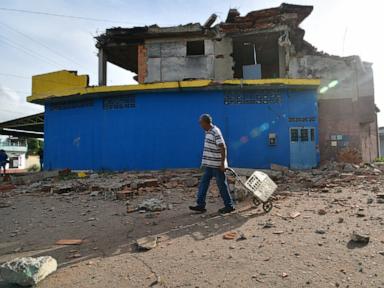
The twin 7.2 and 7.5 magnitude earthquakes that struck north-central Venezuela on June 24, 2026, are not merely natural disasters; they are structural executions. While official estimates struggle to tally the immediate deaths in La Guaira and Caracas, the truth is that a long-predicted tectonic event has collided with a completely hollowed-out state infrastructure. This was never a question of unpredictable geological cruelty. It is the predictable outcome of decades of economic decay, systemic evasion of building safety codes, and an absolute paralysis of emergency response capabilities. The disaster has laid bare the catastrophic reality of a country forced to face a major seismic crisis with nothing but bare hands.
For fifty-nine years, seismologists warned that the major fault systems running along Venezuela's northern coast were a ticking clock. When the clock stopped at 6:00 PM local time, it did so with a rare and punishing phenomenon known as a seismic doublet. Two massive tremors tore through the earth less than forty seconds apart. The first, a magnitude 7.2 foreshock centered near the coastal town of Morón, sent thousands screaming into the streets. Before the initial dust could settle, a second, more violent 7.5 magnitude shockwave struck the exact same ruptured fault segment.
This double-tap mechanic is structurally devastating. The first earthquake fractures the concrete, snaps internal shear walls, and compromises the structural integrity of buildings. The second earthquake, arriving before any evacuation can be organized or structural assessments made, finishes the job. High-rises in upscale Caracas neighborhoods like Altamira and Los Palos Grandes did not merely crack; they pancaked. In the coastal state of La Guaira, entire multi-story apartment complexes simply dissolved into mountains of concrete rubble.
The Myth of the Unforeseen Disaster
To understand why the destruction is so widespread, one must discard the official narrative of an unavoidable act of God. The northern rim of Venezuela sits directly on the boundary where the Caribbean tectonic plate grinds past the South American plate. This boundary is not a single clean line. It is a messy, highly fractured network of strike-slip faults including the Boconó fault zone in the west, the San Sebastián fault along the central coast, and the El Pilar fault in the east. Together, they accommodate roughly twenty millimeters of relative plate motion every single year.
That motion creates immense elastic strain. When that strain overcomes the frictional resistance of the rock, the ground moves. The historical record is littered with warnings. Major earthquakes flattened Caracas in 1641, 1766, 1812, and most recently in 1967. The 1967 event, a magnitude 6.6 shock, killed more than two hundred people and brought down four modern high-rise apartments in the capital. That disaster prompted engineers to establish the Venezuelan Foundation for Seismological Research, known as FUNVISIS, and to draft some of the most progressive seismic building codes in South America.
On paper, Venezuelan structures built after 1982 are supposed to withstand significant ground shaking. In practice, those codes became expensive suggestions. During the hyperinflationary spirals and severe economic contractions of the past decade, the regulatory state evaporated. Private developers, facing soaring material costs and zero regulatory oversight, routinely substituted high-grade volcanic aggregate with cheap, unwashed beach sand. This sand introduces salt into the concrete mix, slowly corroding the internal steel rebar over decades. When the 7.5 magnitude mainshock rippled through Caracas, this compromised concrete simply turned to powder.
Soil Amplification and the Architectural Trap
The geography of Caracas itself acts as a natural amplifier for destruction. The city sits inside a high-altitude valley, surrounded by the steep slopes of the Avila mountain range. The valley floor is not solid bedrock. It is composed of deep alluvial soils, thick layers of loose sediment, clay, and gravel washed down from the mountains over millennia.
When seismic waves travel through hard mountain rock and enter these loose alluvial sediments, their behavior changes dramatically. The waves slow down, their amplitudes spike, and the ground shaking multiplies in intensity. This phenomenon is called soil amplification. It explains why a building constructed on the solid rock of the Avila mountain might survive with minor plaster cracks, while an identical building situated a mile away on the valley basin completely collapses.
The problem is compounded by a dangerous architectural legacy. During the oil booms of the late twentieth century, Caracas underwent a massive vertical expansion. Architects favored the soft-story design, a structural configuration where the ground floor features open spaces for parking, lobbies, or retail shops, supported only by slender concrete columns, while the upper floors are heavy, rigid residential spaces.
In a major earthquake, these soft stories are a death sentence. The ground floor lacks the lateral stiffness to resist the horizontal shearing forces of the earth. As the ground whipped back and forth during the June 24 doublet, the ground floors of dozens of buildings swayed violently and snapped, dropping thousands of tons of upper-floor concrete directly onto the pavement below.
The Bare-Handed Rescue Effort
In the immediate aftermath of a major earthquake, the first twenty-four hours are critical. Heavy machinery, hydraulic jacks, acoustic listening devices, and trained canine units are required to extract survivors from the voids of collapsed structures. In La Guaira and Caracas, none of these were available.
Decades of underinvestment have left the country's civil defense and fire departments completely crippled. Fire stations lack operational trucks due to a chronic shortage of spare parts, batteries, and tires. Heavy excavation equipment owned by the state sits rusting in industrial yards without fuel or functional hydraulic lines.
The result is a harrowing scene of raw human desperation. In the port city of Catia La Mar, neighbors formed human chains to move heavy concrete slabs by hand. Volunteers used crowbars, car jacks, and bare fingers to dig through the remains of six-story apartment buildings. At the site of the collapsed Eduard’s Hotel Boutique in La Guaira, the silence between aftershocks was filled not with the sound of heavy rescue machinery, but with the muffled screams of people trapped beneath three feet of reinforced concrete.
The local medical system, already pushed to the brink by years of systemic shortages, collapsed entirely under the sudden influx of thousands of trauma patients. The Jose Maria Vargas Hospital in La Guaira ran out of basic surgical supplies within three hours of the first tremor. Doctors were forced to treat patients on the asphalt outside the facility, utilizing flashlights from cell phones to perform emergency evaluations. There was a profound lack of rudimentary supplies, including gauze, surgical gloves, plaster for casts, and simple analgesics. Patients with complex crush syndrome, a life-threatening condition caused by the release of toxins into the bloodstream after prolonged muscle compression, were left without the specialized intravenous fluids or dialysis machines needed to save their kidneys.
The Petrochemical Shadow Over Morón
While public attention remains fixed on the dramatic collapses in the capital, an entirely different, industrial crisis is developing to the west. The twin epicenters were located near Morón, home to one of the country's largest state-owned petrochemical complexes.
Initial satellite data and social media footage indicate significant structural damage to industrial storage tanks, refining towers, and chemical pipelines at the facility. A major earthquake in an industrial zone carries the immediate threat of cascading technological disasters, specifically hazardous chemical spills, toxic gas releases, and sweeping industrial fires. The domestic gas lines across the region were shut off overnight to prevent widespread urban conflagrations, but the integrity of massive industrial chemical reserves remains highly uncertain.
Should these facilities breach, the environmental and human toll would quickly eclipse the immediate casualties of the building collapses. The region lacks the specialized hazardous materials teams required to contain a large-scale chemical failure under normal conditions, let alone during a national seismic emergency.
The Reality of International Aid
In the wake of the disaster, expressions of international solidarity arrived quickly. Offers of rescue teams, medical supplies, and financial assistance came from Washington, Madrid, and Paris. While these gestures are vital for long-term stabilization, veteran disaster response experts understand their limitations in the acute phase of a crisis.
Foreign urban search and rescue teams require time to mobilize, fly into the country, and clear customs. With Simón Bolívar International Airport suffering severe structural damage to its terminals and runways, the primary air bridge into the disaster zone is closed. Flights must be diverted to distant regional airfields, forcing rescue workers to navigate cracked, landslide-blocked highways to reach the epicenters. By the time a foreign heavy rescue team sets up their equipment in a collapsed neighborhood in Caracas, the survival rate for individuals trapped without water beneath the rubble drops precipitously.
The true work of rescue is always local. It is performed by the untrained neighbor, the local delivery driver, and the surviving family member. Expecting international missions to magically reverse the consequences of a structurally compromised society is a dangerous form of wishful thinking.
A Systemic Disregard for Spatial Reality
The devastation of June 24 is the final, brutal receipt for an entire era of chaotic urban planning. The valley of Caracas is surrounded by steep hillsides packed with informal settlements known as barrios. Millions of people live in self-built, multi-story brick dwellings balanced precariously on slopes exceeding thirty degrees.
These informal structures completely ignore seismic engineering principles. They feature unreinforced masonry walls, inadequate foundations, and heavy concrete roof slabs supported by weak hollow bricks. Furthermore, these slopes are highly susceptible to rainfall-induced and seismically triggered landslides. The USGS Pager models for the June 24 mainshock indicated a massive exposure to ground failure, estimating that thousands of homes sit directly in high-risk landslide and liquefaction zones.
When the earth shook, entire hillsides in areas like San Bernardino and the slopes of the Avila mountain gave way. The loose topsoil, stripped of deep root systems by dense informal construction, turned into fluid mud and debris avalanches, sweeping dozens of homes down the ravines. The true scale of the casualties in these marginalized, tightly packed sectors remains hidden because emergency services cannot physically access the narrow, debris-blocked pedestrian walkways that serve as roads.
The Unforgiving Geologic Future
The doublet of June 24 did not relieve all the tectonic stress along the Caribbean-South American plate boundary. In fact, standard seismological principles of Coulomb stress transfer dictate that a large rupture on one segment of a fault line can actually increase the stress on adjacent segments, pushing them closer to failure.
The eastern extension of the fault system near the cities of Barcelona, Cumana, and the Gulf of Cariaco remains locked and highly stressed. The dozens of aftershocks exceeding magnitude 4.0 that continue to rattle the central coast are a constant reminder that the earth has not returned to a state of rest.
Venezuela is now trapped in a race against time that it is completely unequipped to run. The immediate imperative is to clear the roads, establish functional field hospitals, and distribute clean drinking water to prevent outbreaks of waterborne diseases. Yet the broader, uncomfortable truth remains completely unaddressed. You cannot retroactively fix a nation's concrete with foreign aid packages. You cannot enforce building codes after the city has already fallen.
The buildings that are still standing in Caracas and La Guaira have been profoundly weakened by the June 24 doublet. Their internal columns are micro-fractured, their foundations are shifted, and their walls are fatigued. The next major tremor, whenever it arrives, will not be fighting against the structures of 1982 or even the flawed structures of 2026. It will be fighting against a landscape of standing ruins, waiting for the final push.