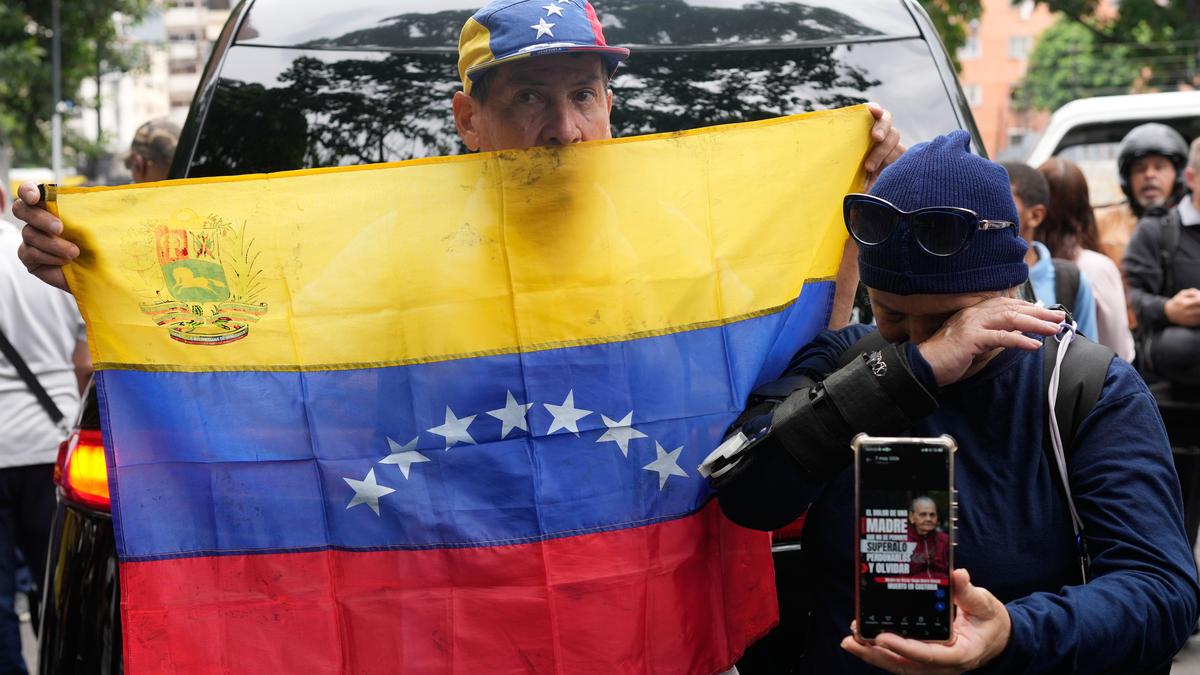
Venezuela will release 300 prisoners under an amnesty law framework this week, a move designed to signal democratic reform to international observers. National Assembly Chief Jorge Rodríguez announced that the staggered releases would take place over a five-day period ending Friday, branding the move as a humanitarian gesture under interim leader Delcy Rodríguez. However, the announcement acts as a smoke screen. While Caracas attempts to project a sweeping transition toward human rights following the U.S. ouster of Nicolás Maduro in January, independent data and legal realities tell a far different story.
The strategy relies heavily on inflated metrics and selective mercy. The interior ministry claims thousands have already benefited from the February amnesty law, yet human rights organizations like Foro Penal have verified only a fraction of those figures as actual releases of political detainees. This discrepancy highlights a calculated political maneuver. By releasing elderly prisoners, minors, and individuals long held on trumped-up common crime charges, the administration seeks to satisfy Washington's watchful eye without actually dismantling the judicial architecture used to silence legitimate political opposition.
The Mathematical Mirage of Caracas
To understand the scope of the deception, look directly at the competing numbers. Official government channels state that more than 8,000 individuals have benefited from the amnesty process since its inception. They claim 314 individuals were completely freed from custody before this week, with the remainder transitioned from parole to full liberty.
Human rights monitors see a completely different reality. Foro Penal documents fewer than 200 actual political prisoner releases under the specific amnesty law since February. The total number of people freed since the January transition sits closer to 800, but the vast majority of those individuals were released under generalized judicial reviews or standard pardons, not the formal amnesty framework.
This is not a pedantic squabble over data points. It is a deliberate effort to dilute the pool of political prisoners with common low-level offenders to meet a statistical quota. By including minors, people over 70, or individuals with chronic medical conditions who were picked up for non-political offenses, the state satisfies international demands for a high head count of released detainees while keeping its most potent political rivals behind bars.
Weaponized Loopholes and Judicially Sanctioned Exclusion
The text of the February amnesty law is written to exclude the very people who fought hardest against the previous regime. Nominally, the law covers actions and omissions classified as political offenses or misdemeanors from January 1, 1999, through February 2026.
A closer examination reveals thirteen distinct historical windows built into the text. If a political protest or dissident action did not occur within one of these narrowly defined, state-approved time frames, the defendant is entirely ineligible. Large swathes of the population who marched during unlisted crackdowns remain legally trapped.
Even more troubling are the broad, subjective categories used to deny amnesty petitions. Judges retain absolute discretion to exclude any individual accused of the following actions.
- Promoting or facilitating forceful actions against the sovereignty or territorial integrity of Venezuela.
- Incitement to hatred, a charge frequently leveled under the notorious 2017 anti-hate legislation against citizens who posted criticisms on social media.
- Military rebellion, a blanket charge used to hold hundreds of lower-ranking soldiers who refused to fire on civilian protesters.
Because the judiciary itself remains staffed by the exact same judges who executed the previous regime's purge, the application of amnesty depends entirely on the discretion of the persecutor. The repressive penal system has not been reformed. It has merely been given a new set of instructions on how to filter its captives.
The Forgotten Military Cohort
The single most significant omission from the current wave of releases is the military sector. Nearly 200 regular military personnel remain imprisoned across the country, alongside roughly double that number in civilian family members who were arrested to compel those soldiers into submission.
Consider the case of family units used as human leverage. Husbands, wives, and siblings have been detained for years without trial simply due to their relation to exiled officers. Under the current amnesty law, these individuals are routinely denied relief because their underlying files contain unproven allegations of treason or armed insurrection.
By labeling military dissidents as national security threats rather than political prisoners, the interim administration avoids the international blowback of holding prisoners of conscience while ensuring that the armed forces remain thoroughly intimidated. True national reconciliation cannot occur while hundreds of families are barred from the legal process based entirely on uniform affiliation.
Geopolitical Theatre with Washington as the Audience
Caracas is playing to a gallery located thousands of miles away. The sudden urge to release 300 detainees this week is timed to ease international sanctions and solidify the legitimacy of the interim government on the global stage.
Jorge Rodríguez made the regime's stance clear when he stated that the government was not asking for anything in return but simply wanted the gesture to be appreciated. This is a classic diplomatic gambit. By framing an obligation under international law as a voluntary act of benevolence, Caracas shifts the burden of proof back to foreign observers.
The strategy carries severe risks for the Venezuelan opposition. If international actors accept the headline figure of 300 releases at face value without auditing who is actually walking out of the prison gates, the pressure to dismantle the broader apparatus of state control evaporates. The prisons remain operational, the courts remain compromised, and the threat of re-arrest hangs over every citizen who dares to test the boundaries of this new, conditional freedom.