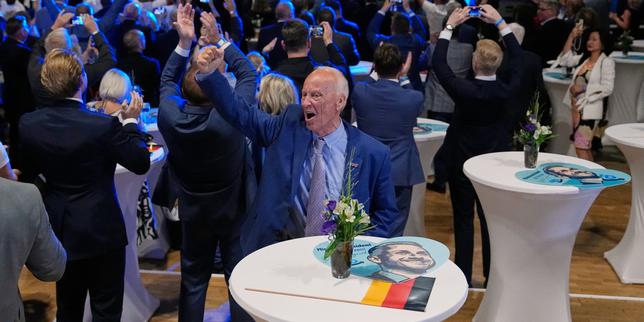
The political architecture of unified Germany is cracking along structural lines that establishment parties spent decades pretending did not exist. In Saxony-Anhalt, the Alternative for Germany party under the leadership of Ulrich Siegmund secured nearly forty-four percent of the vote in the recent state election. This seismic shift exposes a profound institutional vulnerability. Traditional political forces no longer command the loyalty, trust, or emotional resonance required to hold a fractured electorate together.
To understand how a thirty-something commercial specialist converted deep-seated regional frustration into a formidable electoral machine, one must look past the superficial shock of mainstream editorials. For years, Berlin-centric analysts dismissed eastern German discontent as economic anxiety or temporary post-reunification friction. That diagnosis was comfortable. It was also entirely wrong.
The appeal of figures like Siegmund rests on a precise psychological and sociological mechanism. Saxony-Anhalt, much of the broader former East, experienced a total systematic collapse of its social fabric following 1990. Factories vanished. Institutions dissolved. Trust in public broadcasting, centralized governance, and legacy political bodies eroded under the weight of endless compromises that left rural and semi-urban communities feeling abandoned. While conventional politicians offered technocratic management and incremental administrative adjustments, the rising populist right offered an alternative identity.
Siegmund mastered this dynamic through a calculated blend of digital native communication and uncompromising opposition. Operating one of the most-followed political channels on TikTok, he bypasses the editorial filters of traditional media entirely. Millions of video views are not generated by accident. They rely on direct, unfiltered confrontation with establishment norms. When Siegmund tells crowds that standard governance has failed them, his message resonates because daily infrastructure, medical access, and local services in towns across Stendal or Magdeburg have visibly degraded.
The institutional response to this ascent has been a study in systemic paralysis. Other parties draw a protective cordon sanitaire around power, refusing coalition cooperation while simultaneously failing to stem the ideological bleeding. By demanding an absolute majority to govern alone, Siegmund successfully frames the entire political system as an entrenched cartel. In his rhetoric, the choice is stark: either the reigning architecture remains intact, or the challenger tears it down. This uncompromising posture prevents moderate parties from co-opting or neutralizing his momentum through traditional coalition compromise.
Consider the structural implications of this strategy. Traditional coalition governments require consensus, policy watering-down, and bureaucratic inertia. For a population tired of half-measures, that inertia looks like proof of institutional corruption. When the established parties respond by labeling their opponents an existential threat to democracy, they inadvertently validate the anti-system narrative. Voters who feel alienated by mainstream discourse view institutional panic as confirmation that the opposition is striking a vital nerve.
The mechanics of this populist breakthrough also highlight a deeper failure of representation within legacy organizations. The Christian Democrats and social democrats hollowed out their local base organizations decades ago, replacing door-to-door community engagement with professionalized public relations and distant state-level committees. Conversely, local actors within the alternative right embedded themselves into civic friction points, positioning themselves as the sole defenders of local interests against distant bureaucratic mandates.
This dynamic creates a feedback loop that standard policy adjustments cannot break. Pumping federal subsidies into regional infrastructure projects fails to address the underlying cultural alienation. People do not merely want better asphalt or modernized railway connections. They want validation for the loss of their historical continuity. They want acknowledgment that the post-reunification promise of instant parity was an illusion built on hollow assurances.
The electoral ceiling for this movement remains a central question for the future of the republic. Failing to secure an absolute majority in Saxony-Anhalt means the party faces complex math and potential gridlock. Yet focusing solely on legislative arithmetic misses the broader transformation. When a major geographic region decisively rejects the consensus parties, governing from Berlin or state capitals becomes an exercise in administrative enforcement rather than democratic consent.
The established political class must confront an uncomfortable reality. Containment strategies and moral condemnation have reached their functional limit. As long as legacy institutions treat systemic popular rejection as a temporary aberration rather than a symptom of deep structural decay, the underlying forces driving this phenomenon will continue to gather strength.


