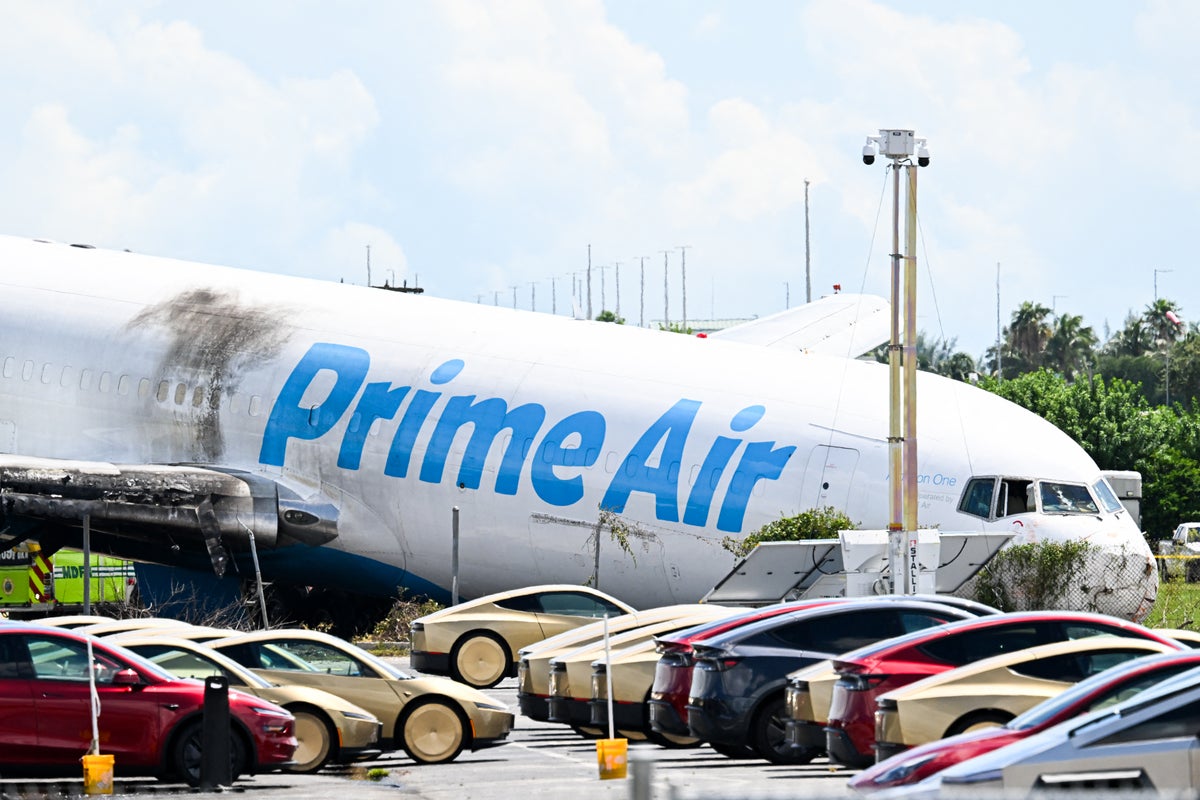
Five lives vanished in an instant when an Amazon-contracted cargo jet plowed past the tarmac boundaries at Miami International Airport. The tragedy unfolded when a Boeing 767-300 freighter operating as Amazon Air Flight 7598 arrived from San Juan, Puerto Rico, failed to decelerate within safe limits, and barreled through perimeter fences into local service roads. This catastrophic event shattered the quiet routine of warehouse workers and perimeter commuters, leaving behind a trail of crushed vehicles, active fuel leaks, and an urgent debate over airport safety infrastructure.
Local law enforcement and rescue personnel arrived to scenes of absolute chaos. Heavy black smoke choked the Florida sky as emergency responders worked feverishly to pull survivors from mangled automobiles and extract trapped flight crews from the crippled cockpit. The National Transportation Safety Board quickly mobilized an investigative team led by Chairwoman Jennifer Homendy to preserve perishable evidence and recover flight data recorders. Yet, beneath the immediate shock of the disaster lies a much deeper, systemic vulnerability that aviation experts have warned about for decades.
The Physics of a Fatal Float
Landing a heavy widebody aircraft requires absolute precision with geometric boundaries. According to preliminary flight tracking data and expert analysis, the cargo jet stayed airborne far longer than standard touchdown protocols permit. Aviation safety specialists note that the aircraft floated extensively over the runway surface without forcing its main landing gear onto the concrete.
Every foot of runway consumed by a prolonged float destroys critical stopping distance. When a pilot misses the optimal touchdown zone, the remaining tarmac shrinks rapidly. Hydroplaning risks multiply exponentially if standing water or slick residue coats the surface during sudden tropical downpours. By the time the wheels finally engaged the pavement, the aircraft lacked the physical real estate required to bleed off its forward momentum. Heavy braking and thrust reversers could not overcome the simple laws of kinetic energy within the remaining distance.
Perimeter Vulnerabilities and Missing Safeguards
The catastrophe did not end at the physical edge of the pavement. The aircraft smashed through navigation equipment and perimeter infrastructure before striking vehicles traveling on service roads outside airport property. This highlights a frightening reality across American aviation hubs. Airports often feature high-risk public or service roadways immediately adjacent to active runway safety areas.
Engineered material arresting systems, designed to safely deform and decelerate runaway planes, remain absent from numerous major runways nationwide. These crushable concrete beds absorb forward energy and bring commercial airliners to controlled halts before they breach airport boundaries. Miami International Airport lacked this specific mitigation on the accident runway, leaving zero physical buffer between a sliding widebody jet and civilian ground traffic.
The Cargo Pressure Cooker
Operating older aircraft under relentless delivery schedules introduces hidden operational strains. The accident aircraft was a 32-year-old airframe originally built for passenger transport before undergoing conversion into a freighter. While converted freighters undergo rigorous structural certifications, the operational tempo of e-commerce logistics logistics networks demands near-constant utilization.
Tight turnaround windows, combined with decentralized contracting models where major retailers lease capacity through third-party carriers, complicate oversight. Investigators will scrutinize maintenance logs, weight distribution manifests, and fatigue management protocols for the operating crew. Commercial aviation safety relies on strict redundancy, and any systemic pressure that compromises standard risk assessments creates an invisible path toward disaster.
The investigation by federal safety officials will take months to yield a definitive probable cause. Until the final report is published, the families of the victims and the broader aviation community are left confronting the stark fragility of the invisible boundaries separating bustling industrial corridors from high-speed commercial flight paths.
Witness shares video showing 2 plane crash survivors in Miami-Dade
A local witness captured early footage from the scene documenting the immediate aftermath and the complex multi-agency rescue efforts following the disaster.


