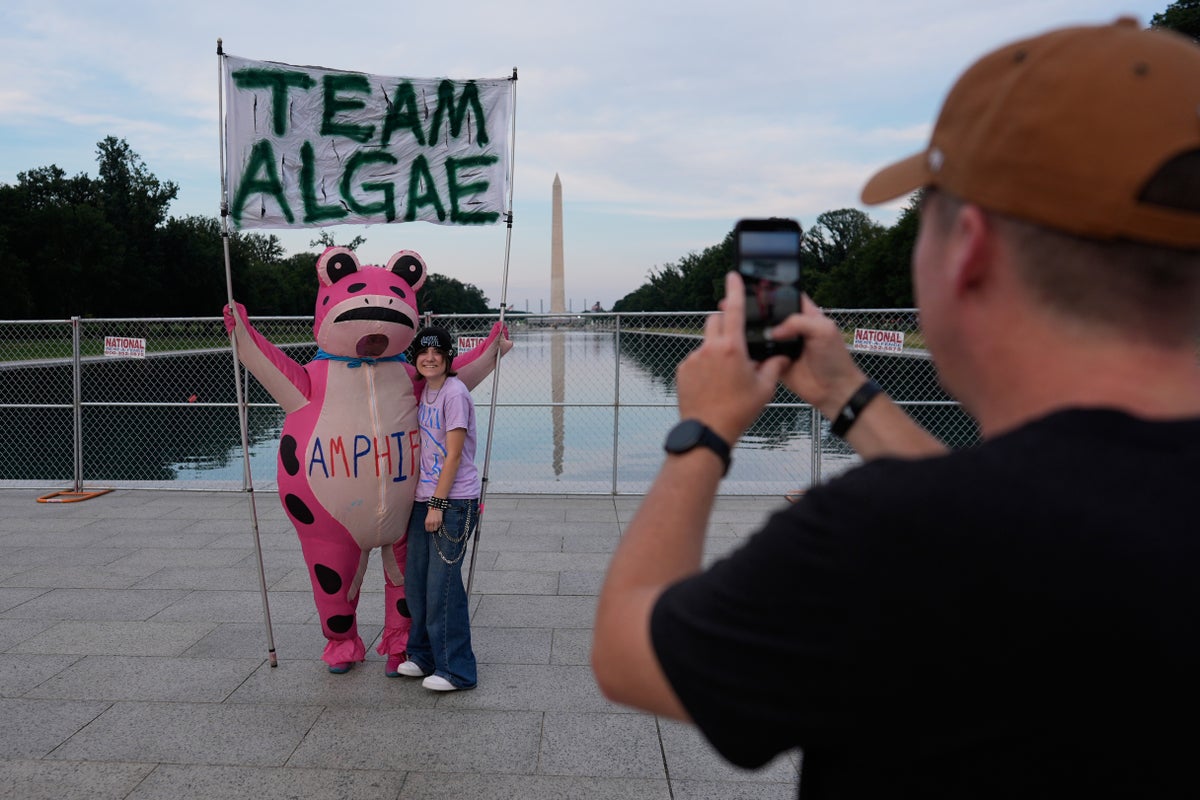
The Lincoln Memorial Reflecting Pool was supposed to be the crown jewel of America’s upcoming 250th anniversary celebrations, sporting a fresh, $14.7 million face-lift ordered by President Donald Trump. Instead, the seven-acre historic monument has morphed into a brilliant, soupy-green science experiment covered in sheets of peeling blue paint. While the administration has pinned the disaster entirely on "radical left vandals" allegedly hacking up the pool with box cutters, the reality behind the failure is far more predictable. A combination of fundamental engineering missteps, a rushed no-bid contract, and basic environmental physics doomed the project from the moment the water was turned back on.
The crisis is not a law enforcement mystery. It is a textbook lesson in what happens when political aesthetics clash with the unyielding realities of aquatic engineering and microbiology.
The Chemistry of an Instant Ecosystem
To understand why the National Mall currently smells like an overgrown swamp, one has to look at the water itself. On June 6, the pool was officially declared restored, boasting a dark coating dubbed American Flag Blue meant to provide a deep, crisp reflection of the Washington Monument. Within days, the water turned a thick, opaque green.
Testing conducted by aquatic ecologists from George Mason University quickly identified the culprit as Desmodesmus, a remarkably common genus of green algae. It is an opportunistic organism that requires only three things to trigger an explosion in population: stagnant water, heavy sunlight, and elevated nutrient levels, specifically phosphorus and nitrogen.
The fundamental issue is that the Reflecting Pool is a massive, shallow concrete pan completely exposed to the elements. Dust, organic debris, pollen, and waste from migrating waterfowl constantly rain down into the basin, continuously introducing the exact minerals algae crave.
When the pool was refilled following an eight-week construction shutdown, it was supplied with nutrient-heavy water. With no established biological competition or mature biofilm to keep things in check, the Desmodesmus cells did exactly what nature engineered them to do. They multiplied exponentially.
Why the Blue Paint Absorbed Its Own Ruin
While the algae bloom ruined the view, the physical deterioration of the pool’s bottom created a much more expensive problem. Sheets of the newly applied blue liner, some measuring several feet across, detached from the concrete substrate and floated to the surface like sheets of blue tarp.
The administration immediately pointed to a 350-foot jagged line at the bottom of the pool as proof of a well-coordinated sabotage campaign. Federal police and National Guard units were deployed to patrol the perimeter, and temporary chain-link fencing went up weeks ahead of schedule. Several curious tourists, including a former Olympic canoeist, were even detained or cited merely for touching the bubbling, peeling material.
Yet pool installation consultants and industrial coating experts point to a much more mundane culprit: improper surface preparation and thermal dynamics.
Applying a high-durability waterproof membrane over a century-old, massive concrete structure is an incredibly delicate process. The concrete must be entirely dry, perfectly cured, and free of subsurface moisture before a coating can adhere. If rain, high humidity, or ground moisture seeps through the porous concrete from beneath before the top layer fully cures, the bond fails. Once a small pocket of water or air forms under the lining, the pressure of the seven million gallons of water sitting on top will inevitably cause the entire system to delaminate and tear.
Compounding this engineering failure was the choice of color. The decision to switch to a dark, deep blue coating fundamentally altered the thermodynamics of the shallow pool. Darker colors possess a lower albedo, meaning they absorb significantly more solar radiation than lighter surfaces.
By painting the bottom a deep blue, the pool began absorbing massive amounts of solar heat, rapidly spiking the water temperature. Algae thrive in warm water, and the accelerated temperature acted as a literal incubator for the bloom.
Furthermore, the extreme heat caused the concrete and the coating to expand at entirely different rates. This thermal expansion stress, paired with water pressure and potential moisture trapped beneath the lining, created the exact recipe required for a catastrophic material failure.
The Limits of Remediation
In a scramble to save face before the Independence Day holiday, the National Park Service deployed aggressive management techniques to clear the water. Crews have spent weeks dumping massive quantities of hydrogen peroxide into the basin to act as an oxidizer, chemically ripping apart the cell walls of the green scum. Concurrently, engineers have deployed an experimental nanobubble filtration system, which injects microscopic oxygen bubbles into the water columns to suppress the phosphorus that feeds the blooms.
While these measures have managed to temporarily clear portions of the algae, scientists widely agree that they are short-term band-aids rather than permanent structural solutions. Hydrogen peroxide kills the active bloom, but as those millions of algal cells die and rupture, they drop straight back to the floor of the pool. There, they decompose, releasing their stored nutrients right back into the water, effectively laying the groundwork for the next, even larger generation of growth.
The contractor responsible for the work, Virginia-based Atlantic Industrial Coatings, has maintained that the current damage represents a minuscule fraction of the overall seven-acre footprint and is fully covered under warranty. However, a permanent fix will require completely draining the pool yet again, stripping away the compromised sections of the American Flag Blue liner, and completely reappraising how moisture is managed beneath the concrete floor.
Until the underlying structural issues of circulation, water filtration, and heat absorption are addressed, the site will remain trapped in a cyclical battle against natural biology. No amount of security fencing or political rhetoric can alter the basic laws of chemistry and thermodynamics. The water will keep turning green, and the paint will keep coming up, because nature does not care about a no-bid contract deadline.