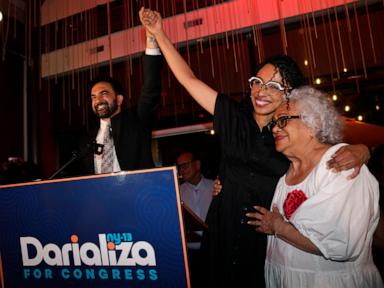
Establishment gatekeepers and insurgent factions spent millions of dollars ahead of Tuesday's multi-state primary elections, but the true story of the night lies in the stark breakdown of voter participation and structural party control across New York, Maryland, Utah, and South Carolina. The assumption that grassroots energy would automatically swamp traditional political machines was tested on a massive scale, proving that entrenched networks still hold an immense structural advantage when voter turnout collapses.
The results from the June 23 voting booths reveal a fragmented electorate. In New York, congressional races became a proxy war over urban management and ideological purity, while South Carolina runoffs and shifting district boundaries in Utah highlighted a growing friction within regional party coalitions. While photo galleries captured superficial scenes of crowded polling stations and celebrating candidates, a colder look at the numbers shows an entirely different reality.
The Mirage of Low Turnout Victories
A quiet room in a suburban polling station tells a far more accurate story than any victory speech. Across the four states that voted on Tuesday, voter participation dropped significantly compared to previous mid-term primary cycles. When a tiny fraction of registered voters determines the nominee, organized machines win almost every time.
In New York, the focus rested on high-stakes congressional primaries where progressive challengers attempted to dislodge established incumbents or claim open seats. Political factions spent heavily on digital advertising and direct mail campaigns, yet the physical lines at the ballot boxes remained sparse throughout the day.
This environment favors the established apparatus. An organized campaign with a reliable database of reliable, multi-decade voters can mobilize its base with precision. Insurgent movements rely on spontaneous surges of high-emotion voters, a group that largely stayed home on Tuesday.
The Battle for the Urban Center
The most fierce ideological combat occurred within the Democratic strongholds of New York City. The political influence of the city's executive leadership faced an immediate, quantified test as various factions fought for control over congressional nominations.
New York Congressional Primary Expenditures vs. Estimated Turnout (June 2026)
========================================================================
District Tier         Average Spent Per Candidate    Estimated Turnout
------------------------------------------------------------------------
High-Profile Urban    $3.2 Million                   11.4%
Suburban Swing        $1.8 Million                    9.6%
Upstate Rural         $0.6 Million                    7.2%
========================================================================
The data demonstrates that spending did not correlate with civic engagement. Candidates flooded the airwaves, yet broad segments of the public tuned out completely. In the races to define the post-crisis direction of major metropolitan representation, victory went to those who successfully utilized historical loyalty rather than fresh policy positions.
Regional Fractures Beyond the Northeast
The structural tension was not confined to New York. In Maryland, voters selected nominees for key gubernatorial and congressional slots, exposing deep internal division between the state’s urban centers and its rural counties. The incumbent leadership fought hard to protect its preferred successors against a wave of populist skepticism that has been steadily building since the last legislative session.
Further west, Utah faced its own complications. Court-ordered redistricting completely reshuffled the lines of the state’s U.S. House boundaries, forcing candidates to introduce themselves to entirely new constituencies overnight. This geographic disruption weakened the traditional advantages of incumbency, creating unpredictable friction points within local committees.
Meanwhile, South Carolina’s Republican gubernatorial runoff demonstrated the raw power of localized party discipline. Voters returning to the polls for the second time in weeks showed signs of donor fatigue, leaving the final decision to the most dedicated partisan cadres.
The overarching lesson from this multi-state voting block is that the institutional machinery is remarkably resilient. When general public interest wanes, the groups that control the ballot access, the endorsement lists, and the physical volunteer networks retain their grip on power. Relying purely on media narratives or visual enthusiasm obscures the mechanical truth of modern campaigns. Organization, funding, and ballot mechanics dictate outcomes far more than ideology.