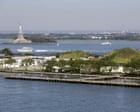
When a 22-foot Bayliner speedboat capsized near Liberty Island under calm night skies, killing a 27-year-old mother and her five-month-old infant, the immediate institutional response followed a familiar, tragic script. Forty-six-year-old Manhattan resident Manuel Hernandez was hauled into custody and slapped with 13 counts of reckless endangerment by the New York Police Department. The U.S. Coast Guard swiftly opened an inquiry into whether the recreational vessel was operating as an illegal, uninspected passenger-for-hire charter. Fourteen souls crammed onto a small motorboat designed for far lighter loads in the dark waters of the Hudson River.
The criminal charges against the captain are necessary, but they represent a surface-level reckoning for a deep-seated maritime safety failure.
The Anatomy of an Overloaded Harbor
To understand how a routine Saturday night excursion turns into a midnight mass-casualty event within sight of the Statue of Liberty, you have to look past the individual actions of the operator and examine the systemic underbelly of urban recreational boating. New York Harbor is one of the most commercially dense, fast-moving marine environments on Earth. Ferries, commercial barges, and tugboats churn the shipping lanes continuously, creating complex wake patterns that demand absolute respect from anyone at a helm.
A 22-foot bowrider or speedboat is inherently limited in its payload capacity and freeboard height. Cramming 14 people onto a vessel of that class drastically alters its center of gravity. Weight distribution becomes a matter of life and death. When passenger counts exceed safety ratings, even a modest shift in human weight combined with an unexpected wake or sharp turn can initiate a rapid, catastrophic rollover.
Investigators are heavily focused on whether this trip constituted an illegal charter operation. Unregulated passenger services routinely bypass critical oversight mechanisms. Legitimate commercial captains must pass rigorous licensing exams, maintain strict documentation, adhere to strict passenger limits, and carry specialized commercial marine insurance. Unlicensed operators dodge these mandates entirely to undercut market prices, appealing to customers looking for cheap skyline views from the water.
The Economics of Unlicensed Marine Risk
The underground economy of urban boat charters thrives in plain sight across major metropolitan waterfronts. Digital platforms and social media make it remarkably simple for unlicensed owners to market unauthorized excursions to tourists and locals alike. Customers rarely ask to see a captain's Coast Guard credential. They see a boat, a low price, and a promise of an unforgettable evening on the water.
This consumer blind spot creates a dangerous race to the bottom. Legitimate charter companies operating fully inspected vessels face steep overhead costs for safety gear, life rafts, marine-grade radios, and compliance audits. Unlicensed operators pocket those savings while exposing passengers to catastrophic liabilities. When an accident occurs, the veneer vanishes instantly.
The tragedy near Buoy 32 in the Upper New York Bay exposed the deadly real-world consequences of this unregulated market. Twelve other passengers were pulled from the water, many rescued by quick-thinking Good Samaritan vessels like a local tour boat that happened to be nearby. Without that immediate civilian intervention, the death toll could easily have been far higher. Emergency responders from the NYPD Harbor Unit, SCUBA teams, and the FDNY arrived rapidly, but in a capizing scenario, seconds dictate survival. Once a hull turns turtle in dark water, trapped passengers face disorientation, hypothermia, and immediate drowning risks long before sirens echo across the harbor.
Regulatory Blind Spots and Enforcement Realities
Maritime law enforcement agencies face an uphill battle when policing informal boat rentals. The Coast Guard and local harbor patrols cannot board every recreational vessel on the water to check headcounts and manifests. Random checks are statistically rare given the sheer volume of leisure craft navigating urban waterways during summer weekends. Enforcement is almost entirely reactive. Authorities typically intervene only after a disaster occurs or a complaint is formally lodged.
This reactive posture leaves a massive safety gap. Penalizing a captain with reckless endangerment charges after a mother and infant have lost their lives offers accountability for a specific incident, but it does nothing to deter the next unlicensed operator casting off from an unmonitored dock. True deterrence requires proactive marine policing, aggressive digital monitoring of illegal charter advertisements, and severe civil penalties for vessel owners who loan or rent their property to unqualified handlers.
The waters surrounding Manhattan do not forgive maritime negligence. Until municipal and federal regulators systematically dismantle the underground charter networks operating across local piers, families stepping onto small recreational boats will continue to assume risks they cannot see, managed by operators who lack the credentials to keep them safe.
The investigation into the Bayliner's final voyage will eventually conclude in a courtroom, establishing legal fault and cataloging the precise sequence of mechanical and human failures. Yet the structural rot allowing unqualified operators to pack overloaded vessels into commercial shipping lanes remains entirely intact.