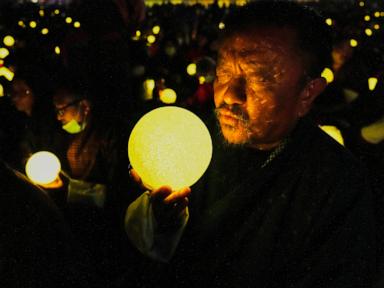
Thousands of Bhutanese citizens descended on the southern border town of Gelephu to construct 108 stupas in a single day, turning a traditional act of Buddhist devotion into a high-stakes demonstration of civic mobilization for the nation's flagship Special Administrative Region. While international headlines focused on the sheer speed of the build, the event served a far more calculated purpose: proving that Bhutan can rally massive human capital to anchor its ambitious Gelephu Mindfulness City (GMC) before global investors even break ground on commercial infrastructure.
Most observers look at megaprojects through the lens of sovereign wealth funds, foreign direct investment, and architectural renderings. In the Himalayas, the metrics are different. When King Jigme Khesar Namgyel Wangchuck announced the Gelephu Mindfulness City—a sprawling, over-1,000-square-kilometer economic hub designed to bridge South and Southeast Asia—skeptics immediately pointed to Bhutan's small population, geographic isolation, and strict environmental laws as insurmountable bottlenecks. Building 108 stupas in 24 hours was the state's answer to those doubts, blending sacred Vajrayana Buddhist tradition with modern logistical precision.
The Logistics Behind a One-Day Megabuild
Pulling off a synchronized construction feat of this scale requires more than spiritual enthusiasm. In Vajrayana Buddhism, the number 108 carries immense cosmological weight, representing the 108 earthly desires mortals must overcome to achieve enlightenment. Erecting 108 stupas—hemispherical shrines containing sacred relics and mantras—typically takes months of specialized masonry, ritual consecration, and artisan craftsmanship.
To compress that timeline into a single day, organizers relied on pre-fabrication, modular assembly, and hyper-localized supply chains. Weeks before the volunteers arrived in Gelephu, teams prepared the foundational bases, sourced local stone and clay, and pre-cast structural elements. On the day of the event, the operation resembled a military deployment rather than a casual community gathering.
Volunteers were divided into specialized squads. Civil servants, monastic bodies, armed forces personnel, and everyday farmers from across Bhutan's 20 districts worked shoulder-to-shoulder under a unified command structure. This is known locally as Zhabtog, a traditional Bhutanese system of voluntary community labor historically used to maintain dzongs (fortresses), build trails, and repair irrigation channels.
By scaling Zhabtog to an industrial level, the planners bypassed the labor shortages that routinely plague infrastructure projects in developing economies. There were no contractor disputes, no supply chain markups, and no bureaucratic delays. Just thousands of hands moving bricks, mixing mortar, and sealing relic chambers in unison.
Why Sacred Architecture Comes Before Commercial Concrete
If you have spent decades tracking special economic zones from Shenzhen to Dubai, you know the standard playbook. First come the ports, the airports, and the tax-free industrial parks. Culture and community spaces are usually bolted on years later as an afterthought to attract expatriate talent.
Gelephu Mindfulness City is inverting that sequence entirely. By anchoring the physical space with 108 stupas before pouring concrete for corporate headquarters or wellness resorts, the Bhutanese leadership is establishing non-negotiable cultural boundaries.
Spiritual Zoning as Economic Defense
The core challenge of any Special Administrative Region is preventing foreign capital from erasing local identity. Bhutan has spent half a century guarding its sovereignty through strict tourism caps and its famous Gross National Happiness framework. Opening a massive free-trade and innovation zone on the Indian border risks importing the exact kind of unchecked materialism the country has long resisted.
Planting 108 sacred monuments across the Gelephu landscape acts as a permanent spiritual survey. In Bhutanese custom, once a stupa is consecrated, the ground it occupies is permanently protected. It cannot be casually bulldozed for a shopping mall or a highway bypass. These structures physically dictate the urban planning grid, forcing future architects—including the renowned Danish firm Bjarke Ingels Group, which helped masterplan the city—to design around sacred geometry rather than over it.
The Geopolitical Signal to New Delhi and Beyond
Gelephu is not a random dot on a map. Sitting directly on the border with the Indian state of Assam, the city is positioned to become a vital land bridge connecting South Asia's massive consumer markets with ASEAN economies via Myanmar and Thailand.
However, border regions in the eastern Himalayas have historically suffered from underinvestment and occasional security friction. Mobilizing thousands of citizens to physically claim and consecrate the land sends an unmistakable message of national unity and state capacity. It tells New Delhi, multilateral development banks, and private equity firms that the Bhutanese monarchy commands absolute domestic buy-in. Investors hate political instability and local pushback; a unified workforce building monuments by hand is the ultimate proof of social cohesion.
The Structural Challenges Nobody Wants to Discuss
Awe-inspiring displays of volunteerism do not automatically translate into a functioning global financial center. Beneath the inspiring visuals of the one-day build lie hard economic realities that Gelephu Mindfulness City must confront over the next decade.
First, there is the brain drain crisis. Over the past few years, Bhutan has experienced an unprecedented exodus of young, educated workers migrating to Australia, Canada, and the Middle East in search of higher wages and modern career opportunities. Thousands of volunteers showed up for a historic religious milestone, yet keeping those same young people in Gelephu for mundane 9-to-5 jobs in finance, green tech, and hospitality requires competitive salaries that the local economy does not yet generate.
Second, infrastructure bottlenecks remain severe. Gelephu currently relies on a small domestic airport that cannot handle long-haul international flights. Building an international aviation hub capable of connecting Bhutan directly to Singapore, Dubai, and Tokyo will require billions of dollars in external financing. Volunteer labor can stack bricks for stupas, but it cannot lay precision airport runways, install high-voltage smart grids, or engineer flood defenses against the fierce monsoon rains that regularly batter the southern foothills.
Finally, there is the regulatory tightrope. To attract global capital, GMC has been granted legal autonomy to write its own business laws, potentially adopting common law frameworks similar to the Dubai International Financial Centre. Balancing Western corporate law with traditional Buddhist ethics—where industries like tobacco, weapons, and environmentally destructive manufacturing are strictly banned—will create legal gray areas that have never been tested in practice.
What Global Urban Planners Can Learn from the Gelephu Model
Despite the financial hurdles ahead, the one-day stupa build exposes a massive blind spot in modern urban development. Western planners spend billions trying to manufacture "community engagement" through town halls, focus groups, and public-private partnerships, often ending up with sterile, soulless smart cities that struggle to attract residents.
Bhutan tapped into an existing cultural operating system. By framing urban development as a collective moral and spiritual duty rather than a purely transactional real estate play, the state achieved instant emotional ownership from its citizens. Every volunteer who mixed mortar or carried stones in Gelephu now has a literal, physical stake in the city's survival.
Whether Gelephu Mindfulness City ultimately succeeds in rivaling Singapore or Zurich as a hub for conscious capitalism remains an open question. Capital is notoriously unsentimental, and global markets will eventually demand hard returns on investment, seamless digital banking, and reliable transport links. Yet as the dust settles around the 108 newly consecrated stupas, Bhutan has already proven that in an era of fractured societies and stalled megaprojects, shared purpose remains the most potent construction material on earth.


