Animation is usually built on comfort. For a century, studios have trained audiences to expect smooth vectors, bright primary colors, and comforting resolutions where every moral conflict wraps up neatly before the credits roll. Then there is Chile. More specifically, there is the chaotic, handcrafted, and profoundly unsettling output of Cristobal Leon and Joaquin Cocina. When the directing duo brings their singular brand of stop-motion terror to international festivals like Locarno, they are not simply showing movies. They are offering an interrogation of materials, history, and psychology that leaves standard commercial animation looking painfully sanitized.
The standard profile of these filmmakers usually focuses on the whimsical eccentricity of their workshop or the physical grueling nature of building sets out of tape, cardboard, and papier-mâché. That misses the point entirely. Their work is a deliberate assault on form. To understand why their particular brand of cinema matters, one must look past the festival buzz and examine the mechanical machinery of their production. They do not work with scripts in the traditional sense. They build environments, inhabit them with shifting entities, and record the decay in real time.
The Architecture of Anxiety
Commercial stop-motion relies on permanence. Every armature is engineered for absolute rigidity so an animator can move a puppet a fraction of a millimeter without the set collapsing. Leon and Cocina reject this baseline completely. Their characters—if lumps of clay, discarded furniture, and painted rags can be called characters—are constantly dissolving, reforming, and mutating before the lens.
This technique mirrors the historical trauma of their home country. While critics often lazily tie every piece of Chilean art back to the Pinochet dictatorship, the connection here is structural rather than purely thematic. Under authoritarian rule, identity was fluid, history was rewritten overnight, and spaces that felt safe could become chambers of interrogation without warning. The duo captures this ambient dread through physical transformation. A wall painting morphs into a three-dimensional hallway. A human face stretches into a wooden floorboard.
Animation usually hides its seams. Leon and Cocina celebrate the fraying thread. They leave fingerprints in the clay. They let the dust settle on the lens. They allow the viewer to see the cardboard backing of a set peeling away under studio lights. This raw transparency creates an immediate, visceral reaction. You are watching art that feels alive precisely because it is falling apart.
Escaping the Mouse Trap
The global animation market is dominated by centralized monopolies. Disney, Pixar, and major streaming conglomerates operate on assembly-line models where hundreds of technicians spend years polishing a single digital frame to look hyper-realistic. This pursuit of physical perfection has paradoxically resulted in a creative dead end. When everything can be rendered with infinite precision, the texture of human labor vanishes.
Leon and Cocina operate on the exact opposite economic and artistic spectrum. Their studio functions more like an underground laboratory than an entertainment corporation. They work with tiny crews, often funded by European cultural grants, international co-productions, and sheer stubbornness. This independence grants them a rare luxury. They do not answer to focus groups. They do not have to worry about whether a character's design will translate into a profitable plastic toy line at a big-box retailer.
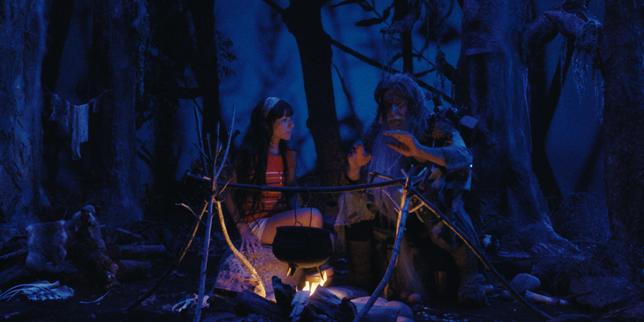
Consider their breakthrough feature, La Casa Lobo (The Wolf House). Loosely inspired by the Colonia Dignidad—a secretive German sect and torture compound established in Chile by Nazi fugitives—the film presents a young girl hiding inside a desolate house that reacts to her emotional state. The walls breathe. The animals speak in distorted whispers. The entire narrative is presented as a continuous, looping nightmare captured in a single, unbroken camera movement.
It is an uncompromising piece of cinema. Yet, it found an enthusiastic global audience precisely because it refused to pander. Viewers starved for originality gravitated toward a film that treated them like adults capable of processing historical horror through fable.
The Mechanics of Metamorphosis
How do you build a world that is fundamentally unstable? The technical process behind Leon and Cocina's work is a masterclass in low-fi ingenuity. They construct large rooms out of cheap materials. Instead of using pre-made puppets, they sculpt and paint directly on the walls and furniture of the set for each individual frame.
When a character moves across a room, the animators do not just move a static figurine. They paint the character, erase it, redraw it slightly to the left, and paint over the previous position. The background itself becomes a character. This creates a haunting painterly residue. Ghost images of past movements linger on the surfaces, giving the frame an eerie, spectral weight.
This approach destroys the traditional boundary between character and setting. In Hollywood animation, the hero stands apart from the background. In a Leon and Cocina frame, the hero is the wallpaper. This technique evokes a deep psychological claustrophobia. The environment is always consuming the inhabitant.
Festival Circuit Realities
When works like these premiere at prestigious events like the Locarno Film Festival, they occupy a fascinating space between high art and outsider cinema. They are championed by curators and cinephiles, yet they remain largely inaccessible to casual streaming audiences accustomed to three-act structures and easy comedic relief.
This tension defines the contemporary landscape of independent art animation. Festivals provide the oxygen these projects need to survive. They attract the co-production funds required for the next grueling production cycle. However, they also risk locking this kind of cinema into an insular bubble, viewed only by the converted inside dark, air-conditioned European screening rooms.
The challenge for creators working at this extreme edge is sustainability. Stop-motion is notoriously punishing. It requires years of isolation, repetitive physical labor, and precarious funding. When two directors choose to spend half a decade moving bits of tape and clay around a dark room in Santiago, they are waging a quiet war against the fast-content algorithms dominating modern media.
The Cost of Vision
There is a romantic temptation to view artists who reject commercial norms as heroic outcasts fighting the machine. The reality is far more mundane and exhausting. It involves chronic lower back pain, endless grant applications, and the constant anxiety of whether the next frame will expose a structural flaw in a paper mache wall.
Yet, every time their work hits a screen, it offers a necessary corrective to the homogeneity of modern visual culture. They prove that you do not need a nine-figure budget or a farm of server towers to create a universe that feels genuinely vast and terrifying. You just need a room, some trash, and an uncompromising vision.
The planet they have built on screen is chaotic, messy, and haunted by history. As long as commercial studios keep smoothing away the rough edges of human creativity, we will desperately need artists willing to tear the walls down.