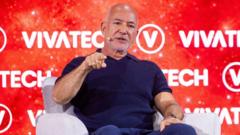
The modern football balance sheet is a fragile beast of debt, commercial spin-offs, and broadcast rights valuations. When a consortium featuring Amazon founder Jeff Bezos and Facebook co-founder Eduardo Saverin moves to secure roughly a one-third equity stake in Liverpool Football Club for an estimated 1.35 billion pounds, the sports industry holds its breath. This is not merely another transaction involving foreign capital flowing into the English Premier League. This represents a structural realignment of power at the absolute apex of global sport, valuing the Merseyside institution at a staggering 6 billion dollars.
Fenway Sports Group, the Boston-based ownership group that rescued the club from the brink of administration in 2010, has mastered the art of sustainable growth. Yet, even a masterclass in financial prudence hits a ceiling when competing against state-backed entities and oligarch-funded treasuries. The inclusion of Bezos via a syndicate led by Amit Bhatia introduces an unprecedented echelon of wealth into the Anfield boardroom.
The Anatomy of the Deal
To understand why this specific partnership matters, look past the initial flash of headlines about mega-transfers and marquee signings. FSG has spent over a decade transforming Liverpool into a commercial powerhouse. They expanded Anfield, modernized training facilities, and balanced books with surgical precision.
However, American sports ownership models rely heavily on self-sustaining loops. Revenue generated by the club must fund its operations and player acquisitions. This approach has yielded domestic titles and European glory, but it also forced agonizing strategic compromises. Rival clubs backed by sovereign wealth funds operate under entirely different mathematical parameters.
A minority acquisition of roughly 30 percent by a consortium of digital royalty changes the equation. It provides an immediate capital injection without stripping control from John Henry and his partners. It installs individuals who understand platform economics, global content distribution, and the monetization of hyper-engaged digital communities at the table.
Beyond the Balance Sheet
Football clubs are no longer traditional athletic organizations. They are global media brands competing for the finite attention span of the consumer. Jeff Bezos built an empire on understanding consumer behavior, supply chain dominance, and frictionless digital experiences.
Imagine applying that infrastructure to Liverpool's commercial footprint across North America and Asia. The traditional revenue model relies on matchday receipts, broadcasting distributions, and regional sponsorships. Under the influence of tech billionaires, those revenue streams can be reimagined through proprietary streaming integrations, direct-to-consumer digital ecosystems, and deep data harvesting that rivals Silicon Valley tech giants.
Critics often worry about the soul of a historic working-class club being swallowed by corporate algorithms. That anxiety is valid. Football culture is rooted in community, shared suffering, and local identity. Yet, the commercial reality of the twenty-first century dictates that sentimentality does not pay multi-million-pound transfer fees or cover escalating wage bills.
The Transfer Market Ripple Effect
Naturally, supporters want to know what this means for the squad. Whispers immediately circulate about targeting elite, world-class talent to rival Real Madrid and Bayern Munich in the market. The financial firepower of the incoming investors means that Liverpool will no longer have to blink during high-stakes financial standoffs for elite players.
Yet, throwing capital at a problem rarely solves it automatically. The history of modern football is littered with ownership groups that spent vast fortunes with zero sporting coherence. What makes Liverpool dangerous is that they already possess the institutional framework, the scouting apparatus, and the technical leadership to spend wisely. Adding capital to an already elite operational engine creates a terrifying prospect for the rest of the Premier League.
The challenge for FSG and their new partners will be maintaining the culture of recruitment that brought success in the first place. Money buys access to the table, but intelligence wins trophies.
The Broader Premier League Arms Race
This transaction signals a broader truth about English football. The era of the billionaire owner is evolving into the era of the tech oligarch and multinational conglomerate. Traditional local ownership has long vanished from the upper tier of the Premier League, replaced by sophisticated portfolios of global entertainment assets.
When digital titans look at football clubs, they see the ultimate engagement engine. Matches are appointment viewing in real time across every time zone on Earth. No television show or streaming series commands the same emotional loyalty or unyielding weekly consistency.
As regulatory frameworks tighten and financial sustainability rules become more complex, owning a premier sports property offers a unique hedge against traditional market volatility. The valuation of 6 billion dollars might seem astronomical today, but in the hyper-inflated ecosystem of global sports media, it may soon look like a bargain.
The ink on the paperwork is drying, but the shockwaves will reverberate through European football for years to come.