Israel is locked in a structural political stalemate because its extreme proportional representation system rewards ideological purity over pragmatic compromise. According to analyses from the Israel Democracy Institute and the Brookings Institution, a deeply fragmented electorate, combined with a low electoral threshold and unresolved constitutional questions, leaves successive governments hostage to small, single-issue parties. What comes next is rarely a decisive breakthrough. Instead, the country faces a recurring cycle of fragile coalitions, legislative paralysis, snap elections, and intense public friction over the balance of power between the elected executive and the judiciary.
To understand why Jerusalem cannot seem to form a stable, long-term government, you have to look past the personalities dominating the nightly news. Pundits love to frame the crisis as a simple referendum on specific leaders. That is a convenient distraction. Even if every current party head retired tomorrow, the underlying machinery of the Knesset would produce the exact same gridlock. Building on this idea, you can find more in: Inside the Deadly Attacks Targeting Christians in Ethiopia That Global Media Keeps Missing.
The Architecture of Dysfunction
The root of the Israeli political deadlock sits inside the mechanics of its electoral system. Unlike countries divided into geographic districts where a candidate must appeal to a broad cross-section of local voters, Israel treats the entire nation as a single electoral district. Voters do not cast ballots for individual representatives. They vote for a party list.
To win seats in the 120-member Knesset, a party only needs to clear a 3.25 percent electoral threshold. Think about what that number means in practice. In a country of roughly nine million people, a faction needs barely more than 140,000 votes to enter parliament. Observers at USA Today have also weighed in on this situation.
This low barrier to entry acts as an incubator for hyper-niche political parties. A faction does not need a comprehensive economic plan, a coherent foreign policy, or a vision for public healthcare. It only needs to keep its core base angry enough to show up on election day. Compromising with rivals becomes political suicide. If a party leader moderates their stance to help pass a national budget, a slightly more extreme rival will immediately peel away their voters in the next election cycle.
Because no single party has ever won an outright majority of 61 seats in Israel's history, every government is a coalition. Historically, one dominant party—first Mapai and Labor, later Likud—was large enough to anchor the coalition and dictate terms to smaller partners. That era is dead. Today, the largest parties routinely struggle to capture even a quarter of the seats.
When a major party holds only 25 or 30 seats, it cannot govern without cobbling together four, five, or even six smaller factions. Every single one of those minor partners holds an effective veto. If a six-seat party threatens to bolt the coalition over a single ministerial appointment or a specific budget allocation, the entire government collapses. The tail does not just wag the dog; the tail holds a gun to the dog's head.
The Four Tribes and the Vanishing Center
Electoral math only explains how the deadlock operates. Demographics explain why the voters themselves are so rigidly divided.
In a landmark 2015 address that remains the most accurate diagnostic of Israeli society, former President Reuven Rivlin described a nation no longer divided into a clear majority and minority. Instead, he argued, Israel had fractured into four roughly equal, mutually suspicious "tribes": secular Israelis, national-religious Israelis, ultra-Orthodox (Haredi) Israelis, and Arab citizens of Israel.
Each of these groups operates largely within its own separate educational system, consumes different media, and often lives in segregated municipalities. A secular tech worker in Tel Aviv, an ultra-Orthodox yeshiva student in Bnei Brak, a national-religious settler in the West Bank, and an Arab citizen in Nazareth share a passport, yet they inhabit entirely different social realities.
For decades, the secular Zionist establishment held enough demographic weight to set the national agenda. High birth rates among the ultra-Orthodox and national-religious populations have permanently altered that balance. According to data from Israel's Central Bureau of Statistics, these shifting demographics mean no single cultural bloc can impose its will on the others without triggering fierce resistance.
Meanwhile, the traditional ideological spectrum of left versus right has been scrambled. Security policy—specifically how to manage the conflict with the Palestinians and confront regional threats—used to be the primary fault line. While security remains the ultimate existential concern, especially following the trauma of October 7 and the ensuing multi-front war, domestic identity issues now drive just as much political friction.
Questions of religion and state, public transportation on the Sabbath, civil marriage, and the distribution of state subsidies have become zero-sum battles. In this environment, building a centrist consensus is agonizingly difficult. Centrist parties frequently surge in the polls by promising "unity" and "normalcy," only to fracture within a few election cycles because their voters agree on what they oppose, not on what they actually want to build.
The Battle Over the Referee
When legislative politics breaks down, power naturally flows elsewhere. In Israel, that vacuum has been filled by the Supreme Court, turning the judiciary itself into the central battleground of the deadlock.
Israel does not have a formal, written constitution. When the state was founded in 1948, the Knesset was supposed to draft one, but deep disagreements between secular and religious factions forced lawmakers to punt. Instead, parliament passed a series of "Basic Laws" intended to serve as chapters of a future constitution.
In the 1990s, under the leadership of Supreme Court Chief Justice Aharon Barak, the court declared that these Basic Laws held constitutional status, granting the judiciary the power to strike down ordinary legislation passed by the Knesset. Over the ensuing decades, the court also expanded its use of the "reasonableness" doctrine, allowing judges to block government appointments and executive decisions they deemed extremely unreasonable, even if no specific law was broken.
To critics on the political right, particularly within the Likud and national-religious camps, this amounted to a judicial coup. They argue that unelected judges, who largely come from a secular, liberal background, routinely override the will of the democratic majority. In their view, the court became an unelected super-legislature that blocked conservative policies on immigration, settlement expansion, and military exemptions.
To defenders of the court, predominantly in the secular center and left, an assertive judiciary is the only guardrail preventing a tyranny of the majority. Because Israel lacks a constitution, a second legislative chamber like a senate, a federal system of states, or a president with veto power, the Knesset and the executive branch are effectively merged. A coalition with a razor-thin 61-seat majority controls both the parliament and the cabinet. Without an independent Supreme Court exercising broad oversight, civil liberties and minority rights would have no institutional protection whatsoever.
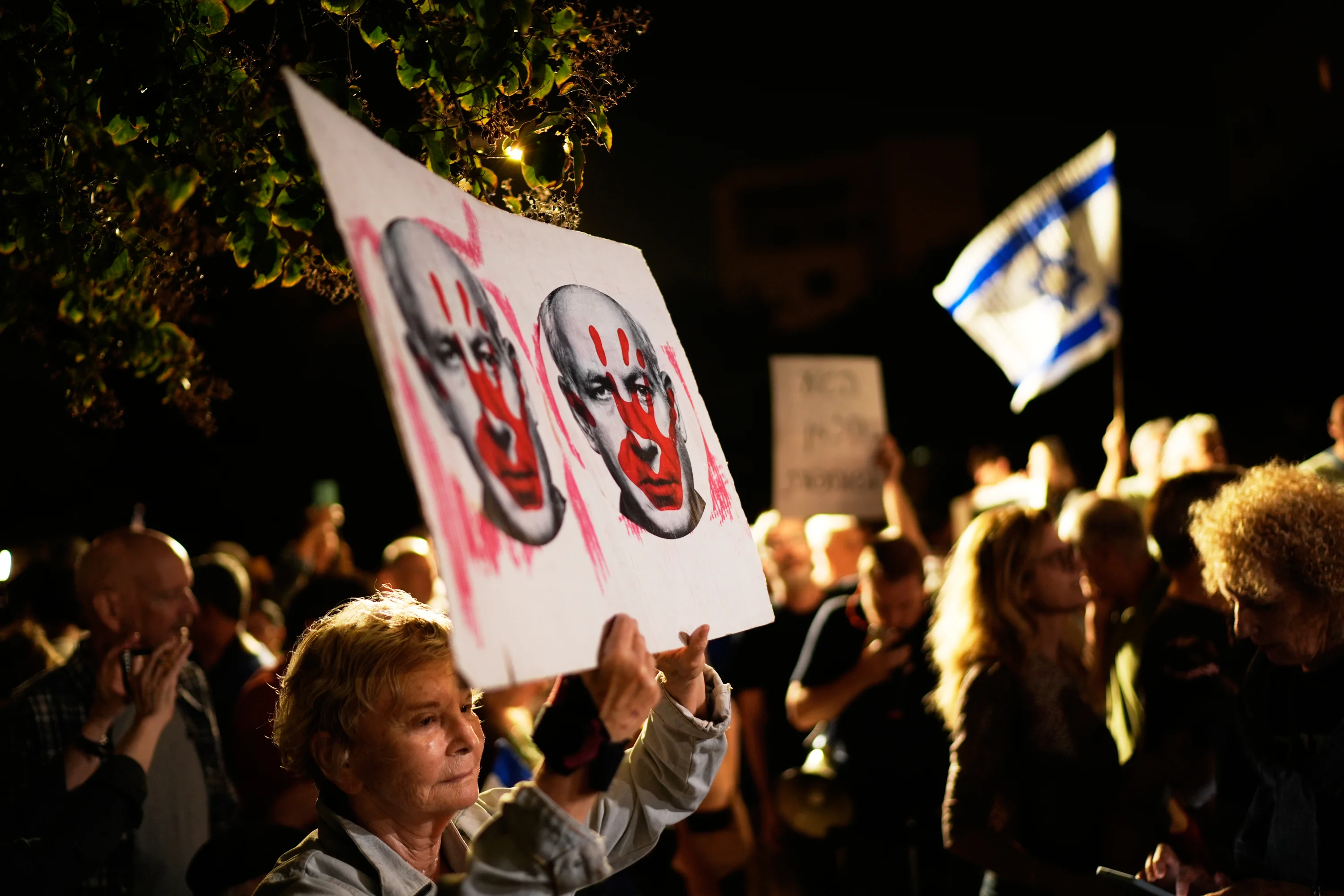
The 2023 attempt by Benjamin Netanyahu's governing coalition to pass a sweeping judicial overhaul brought this institutional war to a boiling point. Hundreds of thousands of Israelis poured into the streets week after week, warning that weakening the court would end Israeli democracy. Military reservists threatened to stop volunteering for duty. International credit rating agencies issued stark warnings about economic instability.
The outbreak of war in Gaza temporarily froze the legislative push, forcing an emergency unity arrangement. Yet the underlying constitutional crisis was merely put on ice, not resolved. As long as there is no agreed-upon set of rules governing the relationship between the Knesset and the Supreme Court, every major policy dispute immediately escalates into an existential fight over the legitimacy of the state's institutions.
The Conscription Fault Line
If you want to see how all these pressures collide in real time, look at the issue of military conscription for ultra-Orthodox men. It is the ultimate third rail of Israeli politics, capable of shattering any coalition on the spectrum.
Since the founding of the state, full-time Haredi yeshiva students have largely been exempted from mandatory military service, an arrangement originally intended for a few hundred scholars that has ballooned to tens of thousands of draft-eligible young men. For decades, secular and national-religious Israelis tolerated this exemption as the political price required to keep Haredi parties aligned with ruling coalitions.
The war that began in October 2023 shattered that tolerance. With hundreds of thousands of reservists pulled away from their jobs and families for months on end, and the military facing severe manpower shortages, the inequality of the burden became impossible for the broader public to ignore. Even within the national-religious community—whose sons serve in combat units at disproportionately high rates—anger over the blanket exemptions boiled over.
In June 2024, Israel's Supreme Court ruled unanimously that the government could no longer legally exempt Haredi men from the draft or continue funding yeshivas whose students ignored conscription orders. That ruling trapped the government in an impossible bind.
If the coalition enforces the draft and cuts funding, the ultra-Orthodox parties—Shas and United Torah Judaism—have vowed to bring down the government. If the coalition passes a new law enshrining the exemptions, it faces massive public backlash, potential rebellion from moderates within its own ranks, and almost certain invalidation by the Supreme Court. Neither path leads to stability.
Why Alternative Coalitions Face the Same Trap
A common argument among international observers is that the deadlock would vanish if only a different set of leaders took power. The historical record suggests otherwise.
Consider the "Change Government" formed in 2021 by Naftali Bennett and Yair Lapid. That coalition was explicitly designed to break the stalemate by uniting eight ideologically incompatible parties—ranging from right-wing nationalists to left-wing social democrats, and, for the first time in Israeli history, an independent Arab Islamist party, Ra'am.
For a brief moment, it looked like a breakthrough. The coalition managed to pass Israel's first state budget in over three years and kept the machinery of government running. Yet the structural flaws quickly reasserted themselves. Because the alliance had no shared ideological core beyond opposing the previous administration, it could not make decisive moves on major strategic questions.
The government survived on a razor-thin 61-seat majority. Within a year, a handful of defections from right-wing members, frustrated by compromises made to keep left-wing and Arab partners on board, stripped the coalition of its majority. The experiment collapsed, triggering Israel's fifth election in less than four years.
Any future alternative coalition faces the exact same arithmetic. To reach 61 seats without relying on the ultra-Orthodox or the far right, a centrist bloc must either persuade major right-wing factions to break decades-old alliances or rely on Arab parties. Bringing Arab parties into a governing coalition remains deeply polarizing for large segments of the Jewish electorate, particularly during periods of heightened security tension, while Arab lawmakers themselves face fierce criticism from their own constituents if they join a government conducting military operations in Gaza or the West Bank.
The Economic and Strategic Toll of Paralysis
Chronic political deadlock is not just a parlor game for parliamentary reporters. It carries tangible, compounding costs for the country's economy and national security.
Long-term strategic planning becomes nearly impossible when ministers treat every day in office as if it could be their last. Major infrastructure projects—such as expanding public transit in the congested Tel Aviv metropolitan area, upgrading the national power grid, and reforming the healthcare system—require multi-year budgets and steady regulatory oversight. When governments fall every 18 months, ministries constantly reset their priorities, freeze initiatives started by predecessors, and divert funds toward short-term political payoffs to keep coalition partners happy.
Economists at the Bank of Israel have repeatedly warned about the long-term fiscal consequences of this dynamic. Coalition agreements frequently direct billions of shekels toward sectoral priorities, such as stipends for non-core educational institutions that do not teach math, English, or science. Investing in human capital that lacks basic workforce skills threatens to drag down Israel's economic productivity over the next two decades, right as the high-tech sector—the primary engine of Israeli tax revenue—demands an ever-larger pool of skilled engineers and researchers.
Internationally, domestic gridlock weakens Israel's diplomatic hand. Foreign allies and regional partners struggle to negotiate long-term security frameworks or normalization agreements with a government whose survival depends on the whims of minor coalition factions. When domestic politics dictates foreign policy, strategic opportunities are routinely sacrificed to prevent a backbencher from bolting the coalition.
Potential Paths Out of the Gridlock
Breaking a structural deadlock requires changing the structure itself, yet the very people empowered to pass those reforms are the ones benefiting from the current system. Still, constitutional scholars and political analysts point to a few mechanisms that could eventually force a realignment.
- Raising the Electoral Threshold: Increasing the threshold from 3.25 percent to 4 or 5 percent would force smaller ideological factions to merge before elections, reducing the number of parties in the Knesset and curbing the blackmail power of tiny splinter groups.
- Introducing Regional Representation: Allocating even a fraction of the Knesset's 120 seats to regional districts would force lawmakers to answer directly to local voters rather than party bosses, creating incentives for pragmatic problem-solving.
- Enacting a Formal Basic Law on Legislation: Establishing clear, supermajority rules for how Basic Laws are passed and amended, alongside defining the precise boundaries of Supreme Court judicial review, could lower the temperature of the constitutional war.
- Crisis-Driven Realignment: Historically, major shifts in Israeli politics have occurred only after profound national shocks—such as the 1973 Yom Kippur War, which eventually ended nearly three decades of Labor dominance, or the collapse of the Oslo peace process in the early 2000s, which decimated the traditional Israeli left.
None of these fixes is guaranteed, and several carry real risks. Raising the electoral threshold too high, for example, could disenfranchise minority communities like Arab citizens if their parties fail to unite, potentially driving political expression out of parliament and into the streets. Similarly, passing constitutional reforms requires a level of broad cross-party trust that simply does not exist in the current Knesset.
The hard reality is that Israel's political system is operating exactly as it was built to operate. Until the electorate demands structural reform over tribal loyalty, or a severe external shock forces rival camps into a genuine grand bargain, every election will remain less of a resolution and more of an intermission.