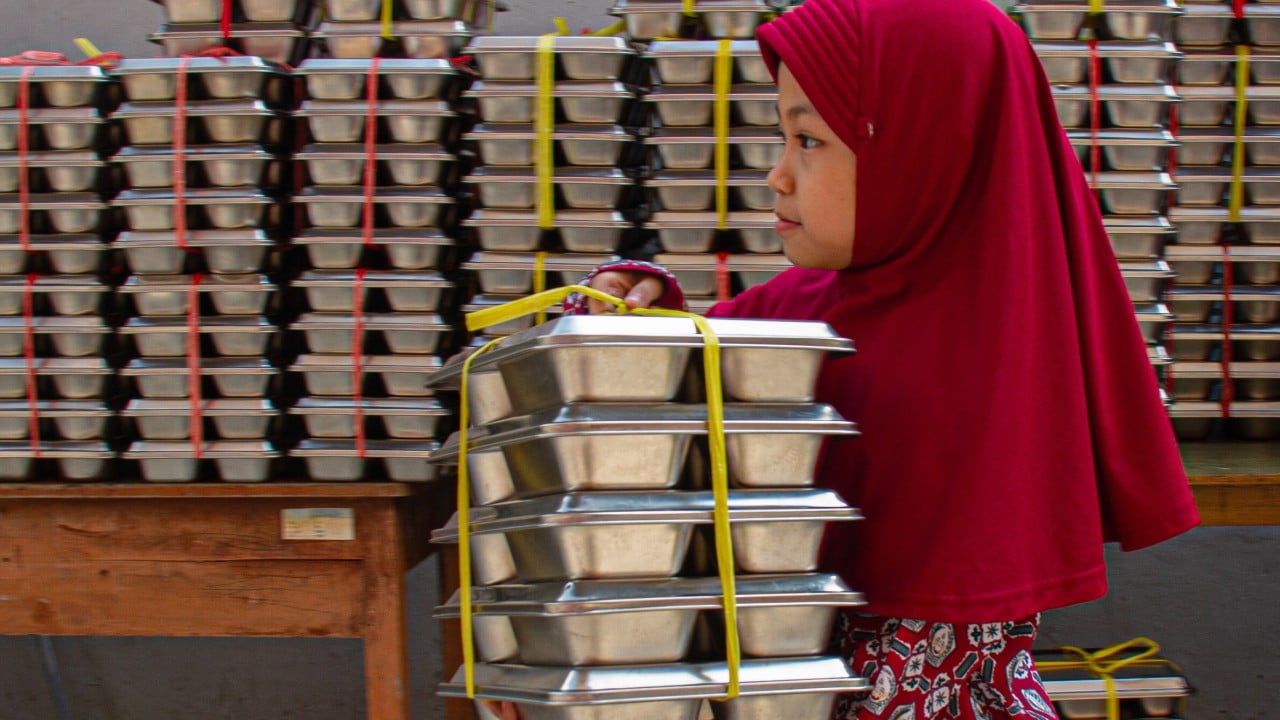
The widening corruption probe into Indonesia's massive free nutritious meals program has now reached active-duty military and police officers, exposing a profound institutional crisis that threatens the core stability of President Prabowo Subianto's administration. State prosecutors from the Attorney General’s Office recently named an active police brigadier general as a key suspect while simultaneously transferring a parallel case involving a high-ranking military officer to the country’s military crimes unit. What was conceptualized as a nationwide social safety net has rapidly turned into an uncontrolled procurement environment where uniform authority has been weaponized to siphon billions of rupiah.
The program was designed to solve a generational challenge. It aimed to feed nearly 90 million schoolchildren and pregnant women across the vast archipelago, serving as the cornerstone of the government's social policy. The scale was staggering, with a projected price tag of approximately $28 billion through 2029 and annual allocations exceeding 80 trillion rupiah. Yet, the rapid expansion of this initiatives has collided with deep-seated structural vulnerabilities, showing that massive state expenditure without independent oversight inevitably creates a feeding frenzy for corrupt networks.
The Institutional Collapse of the National Nutrition Agency
The crisis began at the top. In early June, investigators arrested the leadership of the newly created National Nutrition Agency, including its head, Dadan Hindayana, alongside deputy directors responsible for operational fulfillment and institutional relations. These officials did not merely look the away while petty theft occurred. They systematically re-engineered the administrative architecture of the food delivery apparatus to benefit private associates and hand-picked entities.
The mechanism was calculated. By utilizing direct appointment mechanisms rather than transparent, open public tenders, the agency heads managed to insulate their decisions from standard state audit protocols. Millions of dollars earmarked for local agricultural procurement were diverted toward purchasing highly inflated non-essential items, ranging from fleets of electric motorcycles to tablets and televisions that bore no direct operational relevance to cooking or distributing fresh food to remote villages.
This top-level manipulation trickled down rapidly through the entire system. Instead of empowering local agricultural cooperatives, the agency mandated that food prep units buy raw goods from centralized, politically connected supply companies. Local farmers found themselves entirely shut out of a system that had been publicly marketed as an economic lifesaver for rural areas. The consequence was immediate, forcing kitchens to rely on sub-standard, mass-produced inputs that had to travel across long supply chains, destroying the promise of fresh, localized nutrition.
How Uniforms Masked a Procurement Extravaganza
The entry of police and military figures into the criminal investigation marks a dangerous evolution in the scandal. In Indonesia, the involvement of active-duty security personnel introduces a layer of institutional complexity that often stalls conventional civilian law enforcement. The civilian courts lack jurisdiction over active military personnel, necessitating a hand-off to military prosecutors whose proceedings are shielded from public view.
It was an ideal cover. Corrupt officials understood that placing military and police officers at the center of supply chain logistics would effectively intimidate civilian whistleblowers and local auditors who might otherwise question why a single school lunch cost three times the market rate.
+-----------------------------------------------------------------+
|               FREE NUTRITIOUS MEALS (MBG) CRISIS                |
+-----------------------------------------------------------------+
|  BUDGET REALLOCATION:                                           |
|  - 44.2% of 2026 Education Budget (Rp334.9 Trillion) consumed.  |
|  - Rp24.7 Trillion stripped directly from Health Budgets.       |
+-----------------------------------------------------------------+
|  SYSTEMIC OUTCOMES:                                             |
|  - School Operational Assistance (BOS) payments frozen.         |
|  - At least 33,000 documented pediatric poisoning cases.         |
|  - Active Police & Military personnel indicted as supply ring    |
|    enforcers.                                                   |
+-----------------------------------------------------------------+
The investigation details show that a private sector fixer, recruited by the agency's operational deputy, was granted unauthorized access to override the official verification team for kitchen partners. This individual worked hand-in-hand with the indicted police brigadier general to guarantee that only specific military-affiliated fronts secured the rights to run the Nutrition Fulfillment Service Units. These service units became logistical fortresses where civilian inspectors were denied entry under the guise of national security. The uniforms did not preserve order. They enforced a monopoly.
The Toll on Schools and Local Classrooms
The true cost of this systemic graft is being paid by the educational infrastructure. The funding structure for the free meals program relies on aggressive reallocations from other critical domestic portfolios, most notably the national education budget. In the current fiscal blueprint, almost half of the country's education allocation has been cannibalized to keep the food program afloat.
The money had to come from somewhere. As a direct consequence of this budgetary shift, the government has delayed the distribution of basic School Operational Assistance funds and suspended the salary disbursements of thousands of contract teachers working in remote border regions.
Classrooms are falling apart while the state buys overpriced electronics for administrative offices. Teachers in provinces like Papua and Central Sulawesi have reported going months without their baseline stipends, forcing many to abandon their classrooms to find alternative income. The irony is bitter. Children are arriving at school to receive a free government lunch, only to find that their teachers have left and their classrooms lack basic learning materials because the school's operational budget was sacrificed to pay for the meal.
Public Health Failures and the Safety Void
When a state program prioritizes kickbacks over logistics, the physical quality of the product deteriorates rapidly. Independent non-governmental organizations have documented a shocking spike in food-safety failures tied directly to the state-run kitchens. More than 33,000 cases of food poisoning among schoolchildren have been logged across the country.
The numbers don't lie. Yet, the state has actively tried to minimize these health statistics, offering contradictory public totals that conflict sharply with local hospital admissions data.
This divergence in data highlights a total absence of independent sanitary oversight. In the rush to meet political distribution deadlines, thousands of kitchens were granted operational permits despite lacking basic running water, refrigeration, or food handler certifications. The results were toxic. In several districts, children were hospitalized en masse after consuming contaminated milk and spoiled rice provided by suppliers who had paid premiums to secure their supply contracts without undergoing any health inspections.
The administration’s defense has shifted toward a human rights narrative, with ministers arguing that providing food is a constitutional obligation that overrides minor administrative friction. This rhetorical shield cannot survive the reality on the ground. A state cannot claim it is protecting the right to life and health when its centralized distribution network serves contaminated food to vulnerable children. The high-minded defense of the policy cannot mask the stench of spoiled ingredients processed in unverified facilities.
A System Drifting Without Accountability
The government's current strategy relies on isolating the blame, treating the arrested directors and the single police general as bad actors in an otherwise clean system. This is a profound miscalculation. The issue is not a few corrupt individuals, but a structural framework that lacks independent verification mechanisms, transparent procurement channels, or clear boundaries between state service and commercial enterprise.
The military crimes unit now holds the keys to the most sensitive part of the investigation. If history is any guide, the transfer of military suspects into closed tribunals suggests that a full accounting of the missing billions will remain out of reach for the public. The political stakes are simply too high for a transparent, public reckoning.
The expansion of the free meals program continues despite these revelations, driven forward by executive decrees that prioritize political optics over institutional integrity. The kitchens remain open, the budgets remain massive, and the oversight remains completely compromised. The state has built a multi-billion dollar engine that distributes funds efficiently to corrupt networks while delivering compromised food to the classrooms, leaving the country's most vulnerable populations to bear the ultimate burden of a broken policy.


