Summer mornings in Tokyo no longer arrive with a gentle dawn. Instead, a heavy, suffocating weight descends over the asphalt, pushing temperatures toward records that force meteorological agencies to invent new vocabulary, such as kokushobi, or cruelly hot days.
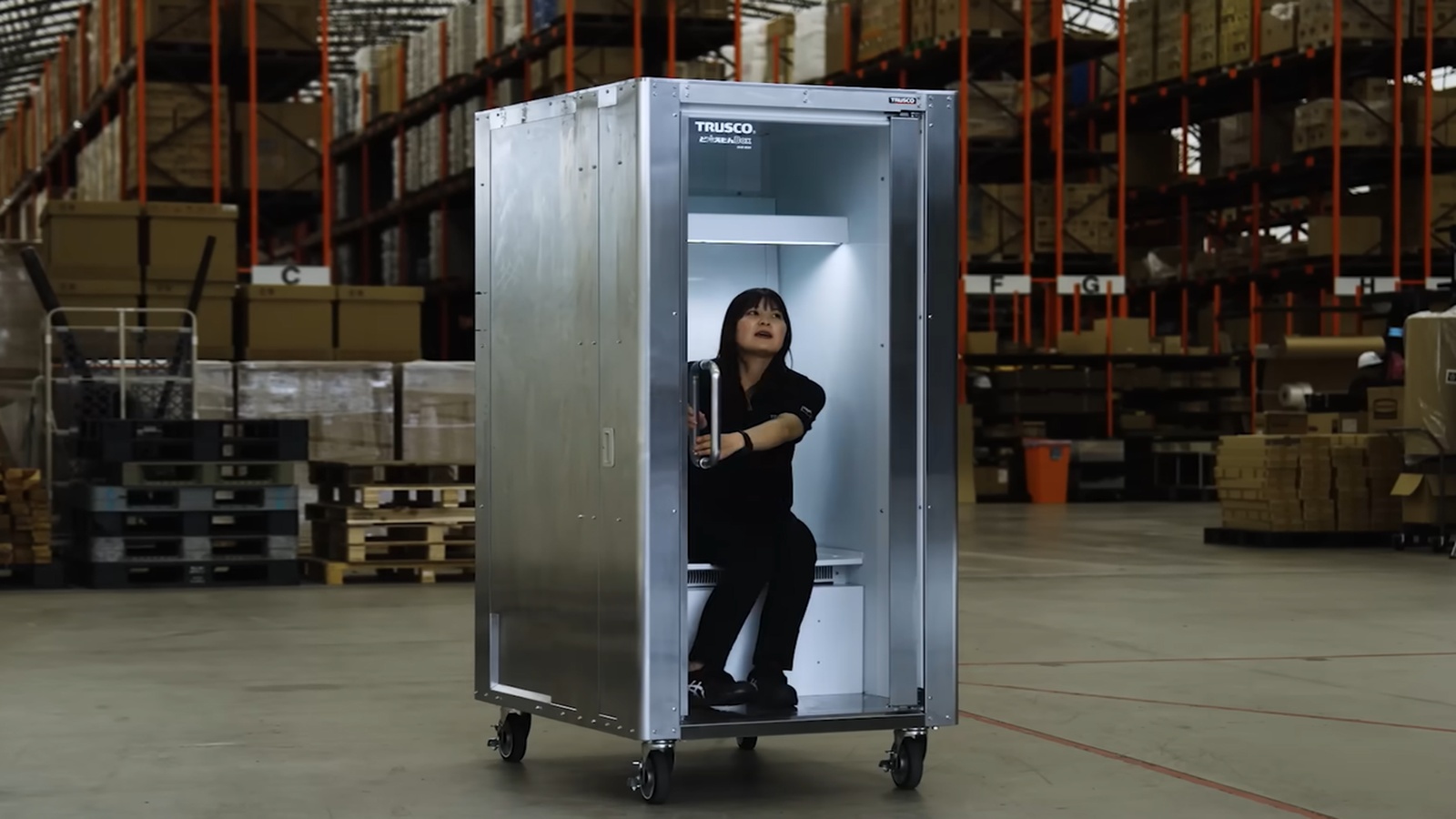
When the mercury consistently clears 40 degrees Celsius, ordinary adaptation strategies fail. Industrial labor becomes a dangerous gamble with organ failure. Enter the latest product of this climatic desperation: a stainless-steel, one-person cooling booth marketed as a human refrigerator. Built by vending machine manufacturer SDRS and distributed by Trusco Nakayama, the Do Hiemon Box invites overheated workers to step inside a confined chamber and subject themselves to five-degree blasts of air for twenty-minute intervals.
It looks absurd. It costs roughly ten thousand US dollars. And it represents a profound psychological surrender to an unlivable environment.
We need to talk about what happens when industrial survival tech starts mimicking kitchen appliances. Beneath the novelty headlines about commercial refrigeration units repurposed for human bodies lies a darker structural failure. Corporations and municipalities are spending fortunes on band-aid engineering because structural mitigation of urban heat islands has stalled.
The Mechanics of Desperation
To understand why a steel box blasting forty-degree Fahrenheit air has become a viable commercial product, look closely at the limits of previous interventions. For years, Japanese construction sites and outdoor operations relied heavily on fan-jackets, battery-powered garments equipped with small external fans circulating ambient air across sweaty skin.
Those wearable systems work fine until ambient temperatures match or exceed core body temperature. Once the surrounding air hits 37 degrees Celsius, blowing it across a worker ceases to cool them down. It acts like a convection oven, accelerating dehydration and heat stress.
The human refrigerator bypasses this thermodynamic wall through brute force. By placing an isolated individual into a chilled enclosure, heat is extracted rapidly via cold conduction and convection. After twenty minutes, an automatic cutoff timer shoves the worker back out into the punishing reality they temporarily escaped.
Critics miss the point when they dismiss these units as mere corporate gimmicks. They are acute medical triage stations. Construction sites, golf courses, and heavy industrial yards across the country are purchasing them because the alternative is mounting worker compensation claims and fatalities.
The Economic Reality of Extreme Microclimates
A technology does not scale without a market failure. The rapid adoption of these cooling booths exposes the deepening fracture between outdoor labor realities and corporate accountability.
Consider a hypothetical mid-sized civil engineering firm managing a highway expansion project in Saitama. The contractor faces strict municipal penalties for project delays, yet labor laws mandate frequent stoppages when WBGT (Wet-Bulb Globe Temperature) indices cross critical thresholds. Every hour a crew stands idle costs thousands of dollars in lost productivity.
Buying a fleet of ten-thousand-dollar cooling boxes is not an environmental luxury; it is an economic hedge. If a laborer can cool down core temperatures inside a refrigerated booth in a fraction of the usual time, downtime shrinks. The machine pays for itself by squeezing more output out of a dangerously compressed workday.
Yet this dynamic creates a perverse incentive structure. Rather than restructuring the entire architecture of urban outdoor labor to avoid peak solar radiation hours—shifting heavy construction to night shifts or mandating widespread architectural shade canopy deployment—industries buy individual accountability units. The burden of climate adaptation shifts entirely onto the individual worker's tolerance levels, managed inside a stainless-steel capsule.
The Thermodynamic Loophole
There is a glaring physical contradiction at the heart of mechanical cooling. Every air conditioner, refrigeration unit, and portable cooling booth functions by moving heat from the inside to the outside, amplifying the ambient thermal load of the immediate surroundings.
When a worker steps out of a Do Hiemon Box, the heat extracted from their body has been vented directly into the surrounding outdoor air, marginally raising the temperature of the very worksite they must return to. It is a closed-loop trap. As more entities deploy localized mechanical cooling to protect workers from outdoor heat, the outdoor air becomes incrementally more hostile.
Urban planners have warned about this feedback loop for decades, yet market pressures consistently prioritize immediate micro-relief over macroscopic sustainability. Air conditioning consumption in dense metropolitan areas already contributes significantly to urban heat island effects. Scaling personal refrigeration units for outdoor laborers accelerates that exact pathology.
Beyond the Steel Capsule
The conversation around these cooling booths reveals a society desperately pivoting toward techno-solutionism while ignoring the hard limits of adaptation. Wearable perspiration sensors, AI-managed hydration warnings, and stainless-steel human fridges share a common philosophy: accept that the environment is ruined, and buy better gear to cope with the ruin.
Municipal leaders in Osaka and Tokyo are beginning to realize that technological workarounds cannot substitute for systemic urban redesign. High-reflectivity pavement coatings, mandatory green space ratios, and deep subterranean airflow corridors are expensive and slow to implement. They require political capital that dwarfs the simple procurement budget of a private construction firm ordering a cooling box online.
Until those structural changes materialize, the human refrigerator will remain a fixture of the modern industrial landscape. Workers will continue to queue up for their twenty-minute intervals of artificial winter, stepping out of a kitchen appliance simulator straight back into the blaze.
The machine shuts off, the timer clicks, and the door swings open to the same relentless heat.
Inside Japan's 'Human Fridge' Built To Battle Extreme Heat
This short video provides a firsthand look at the physical scale and design of the human-sized cooling booth used by workers in Japan.
http://googleusercontent.com/youtube_content/1