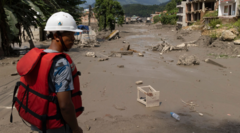
Catastrophic flash floods along the rugged border region of Nepal and China have left at least 160 people dead and hundreds unaccounted for, including 47 American citizens and 24 Canadians. The disaster, centered heavily around the volatile Bhotekoshi and Trishuli river corridors, caught thousands of foreign nationals, local trekkers, and pilgrims completely unawares. Governments in Washington and Ottawa have scrambled to offer emergency assistance, but the scale of the physical destruction—sweeping away nearly forty kilometers of critical highway, multiple bridges, and vital infrastructure projects—has turned rescue operations into an uphill battle against time and geography.
The Anatomy of a Himalayan Catastrophe
The immediate trigger for the devastation was a sudden, violent surge of water and mud that barreled down mountain channels without warning. Disaster management specialists point to a combination of heavy seasonal monsoon pressures and localized glacial instability near the Tibetan border. When an ice-rock avalanche or slope failure blocks high-altitude watercourses, natural dams form temporarily. The eventual rupture of these barriers unleashes a wall of water capable of obliterating everything in its path.
Entire communities along the riverbanks vanished within minutes. Thirteen commercial hydropower installations suffered catastrophic structural failures, and approximately two hundred transport trucks were swallowed by the rushing torrents. For foreign travelers drawn to the region, the timing could not have been more tragic. Although traditional lowland trekking dips during the peak monsoon period, the mountain tracks leading toward the Tibetan border remain heavily traveled corridors for pilgrims and high-altitude adventurers aiming for sacred sites such as Mount Kailash.
The Foreign Toll and Diplomatic Response
Local authorities confirmed that out of hundreds of missing individuals, foreign nationals make up a staggering portion of the casualty and disappearance statistics. Alongside the 47 Americans and 24 Canadians, citizens from India, Britain, Australia, Malaysia, South Korea, and Russia are also listed as out of contact.
Diplomatic missions have activated emergency protocols. In Ottawa, Global Affairs Canada noted that hundreds of citizens were registered as being within Nepal, though voluntary registration lists rarely capture the precise location of independent travelers. In Washington, the State Department acknowledged active coordination with local emergency management agencies to verify the status and safety of affected citizens.
Yet, translating diplomatic concern into physical rescue remains immensely difficult. Road networks are fractured. Communication lines are down. Rescue helicopters are frequently grounded by low cloud cover and continuous heavy rainstorms sweeping across the Himalayan foothills.
Infrastructure Vulnerability in a Warming Climate
This disaster is far from an isolated anomaly. The same fragile corridors experienced severe flooding events only months prior, highlighting an escalating trend of climate-driven hazards across High Mountain Asia. As regional temperatures rise, glacial retreat accelerates, leaving behind unstable moraine dams and swelling glacial lakes prone to sudden outbursts.
Communities and commercial developers have continuously pushed deeper into narrow river valleys to construct vital economic lifelines like hydropower stations and roadways. These narrow gorges offer few escape routes when a glacial outburst or extreme cloudburst occurs. The destruction of nineteen bridges in a single afternoon demonstrates how poorly traditional infrastructure holds up against high-energy debris flows.
Search and rescue teams continue to comb the mud-choked banks of the Trishuli and Bhotekoshi rivers. Heavy earthmovers claw through massive piles of boulders and timber, looking for survivors among the wreckage. Time is evaporating for anyone trapped in air pockets beneath the debris or stranded on isolated patches of high ground as rain continues to lash the valleys