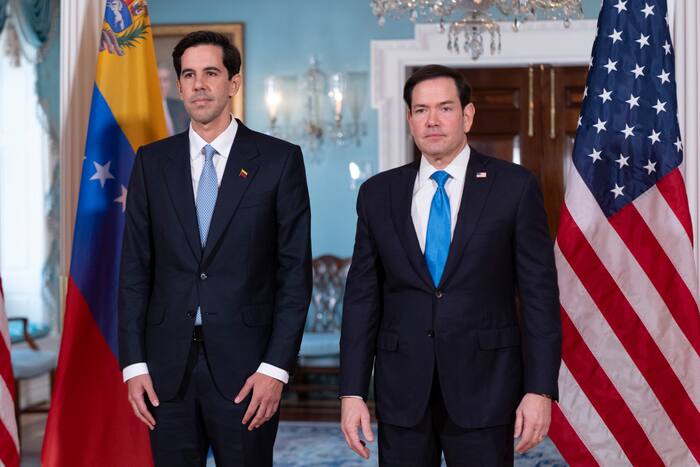
When U.S. Secretary of State Marco Rubio sits down with his Venezuelan counterpart to demand progress on election preparations, the diplomatic choreography looks straightforward on its face. Washington wants verifiable democratic benchmarks, a clear electoral calendar, and the release of political prisoners before easing economic pressure on Caracas. Yet behind closed doors, this encounter represents something far more complex than a routine diplomatic check-in. It is the collision of two incompatible survival strategies—one driven by domestic American political imperatives and regional migration pressures, and the other by an entrenched authoritarian apparatus that views a genuinely free vote as an existential threat.
For years, observers of Latin American geopolitics have watched this exact cycle repeat with exhausting predictability. A senior U.S. official applies pressure, Caracas offers incremental procedural concessions, and the international community debates whether the glass is half full or shattered on the floor. Understanding what actually happens when Rubio engages Venezuelan leadership requires stripping away the diplomatic boilerplate and examining the hard mechanics of leverage, oil licenses, and institutional control. If you found value in this piece, you should read: this related article.
The Anatomy of Electoral Leverage
Diplomacy without teeth is just conversation. When the U.S. State Department presses Caracas on election preparations, the primary currency on the table is sanctions relief—specifically, the general licenses issued by the Treasury Department's Office of Foreign Assets Control (OFAC) that allow Venezuela’s state-run oil company, Petróleos de Venezuela (PDVSA), to transact in global markets.
Caracas needs hard currency to keep its patronage networks funded and its security forces loyal. Washington knows this. Conversely, the United States faces two competing domestic pressures that blunt its own coercive tools. First, aggressive oil sanctions tighten global crude supplies, risking price spikes at American gas pumps. Second, economic collapse inside Venezuela directly fuels hemispheric migration, pushing hundreds of thousands of desperate citizens north toward the U.S.-Mexico border. For another angle on this development, refer to the latest update from Associated Press.
This creates a narrow, treacherous corridor for U.S. negotiators. Push too hard, and Caracas walks away from the negotiating table, reverting to deeper economic alignment with Russia, Iran, and China while migration numbers climb. Concede too early, and the Maduro government pockets the financial windfall while systematically dismantling the opposition's ability to compete.
What Washington Actually Demands
When U.S. diplomats talk about "election preparations," they are not referring to vague promises of fairness. They are looking at specific, technical friction points where Venezuelan authorities historically manipulate the playing field months before a single ballot is cast:
- Candidate Disqualifications: The arbitrary use of the Comptroller General’s office to ban popular opposition figures from holding public office, effectively allowing the ruling party to hand-pick its opponents.
- Electoral Registry Audits: Millions of Venezuelans living abroad remain disenfranchised due to deliberately Byzantine consular registration requirements, while domestic voters face sudden, unannounced relocations of their polling centers.
- International Observation: The presence of credible, independent monitoring missions—such as those from the European Union or the Carter Center—with unrestricted access to voting machines, tally sheets, and transmission centers.
- Media Access and Campaign Finance: State monopoly over broadcast airwaves paired with the criminalization of independent campaign funding.
Why Caracas Plays for Time
To understand why Venezuelan officials agree to meet with figures like Rubio—a longtime, uncompromising critic of the socialist government in Caracas—one has to look at the internal calculus of the ruling United Socialist Party of Venezuela (PSUV). For the leadership in Miraflores Palace, dialogue is not a pathway to a peaceful transfer of power. It is a pressure-release valve.
Time is Caracas's greatest asset. Every month spent debating the technicalities of an electoral timeline is another month in which opposition coalitions fracture under the weight of state repression, financial exhaustion, and internal rivalries. Venezuelan negotiators have mastered the art of asymmetric compliance. They will release a handful of low-profile detainees or announce a preliminary meeting of the National Electoral Council (CNE) just hours before a diplomatic summit, giving foreign counterparts just enough movement to justify keeping talks alive without surrendering a shred of actual institutional power.
Consider a hypothetical example of how this plays out in practice. Imagine a regional negotiations framework where Caracas agrees to update the voter registry within ninety days in exchange for a six-month suspension of specific banking restrictions. On day eighty-nine, electoral authorities open registration centers—but only in rural districts loyal to the ruling party, while urban opposition strongholds receive a fraction of the necessary biometric machines. Technically, the regime fulfilled the letter of the agreement. Practically, the outcome remains rigged.
The Structural Flaws in the U.S. Playbook
Critics of Washington’s approach—both from hawkish factions in Congress and disillusioned Venezuelan civil society groups—point out a glaring vulnerability in relying on high-level diplomatic pressure to force electoral reform. The strategy assumes that the Venezuelan leadership responds to rational economic incentives in the same way a traditional democratic government would.
It does not.
When a ruling elite faces the prospect of international criminal investigations, asset seizures, and domestic prosecution upon leaving office, no amount of foreign investment or lifted tariffs outweighs the existential risk of losing power. Money cannot buy immunity from the International Criminal Court. Therefore, expecting Caracas to willingly construct the democratic mechanisms of its own removal misreads the fundamental nature of the state.
Furthermore, the U.S. diplomatic posture suffers from an inherent credibility gap. Over the past decade, Washington has swung violently between "maximum pressure" campaigns—including recognizing an interim opposition government and imposing sweeping sectoral sanctions—and pragmatic engagement aimed at stabilizing regional energy markets and migration flows. Venezuelan officials have watched multiple U.S. administrations come and go. They have learned to outwait American political cycles, betting that shifting priorities in Washington will eventually erode the focus on Caracas.
The Regional Variable
Rubio’s engagement does not happen in a vacuum; it unfolds against a shifting Latin American diplomatic backdrop. Neighboring nations, particularly Brazil and Colombia, have massive stakes in Venezuela's stability. A botched election or renewed violent crackdown triggers immediate spillover effects across porous borders—from guerrilla activity to humanitarian crises.
Yet regional leaders frequently diverge from Washington on tactics. While the U.S. favors conditional sanctions and strict democratic benchmarks, left-leaning governments in South America often advocate for unconditional reintegration of Caracas into regional bodies, arguing that isolation only hardens authoritarian behavior. This diplomatic split gives Venezuelan negotiators room to maneuver, allowing them to play Washington off against Brasília and Bogotá whenever U.S. demands become uncomfortable.
The Illusion of the Technical Fix
A persistent blind spot in international reporting on these talks is the obsession with electoral mechanics over institutional reality. Pundits dissect the appointment of CNE rectors or the exact date of a presidential vote as if these administrative details exist independently of the broader state apparatus.
In Venezuela, the judiciary, the military high command, and the intelligence services operate as unified extensions of the ruling party. Even if international monitors were granted unfettered access on election day, and even if the automated voting machines recorded an indisputable opposition victory, the actual transfer of power requires the acquiescence of the armed forces. Without parallel guarantees addressing the future of the military leadership and the dismantling of state-backed paramilitary groups known as colectivos, a clean ballot box is merely a prelude to a constitutional crisis.
What Real Progress Would Actually Look Like
If the meeting between Rubio and his Venezuelan counterpart is to produce anything beyond recycled press releases, observers must look past diplomatic rhetoric and track concrete, irreversible actions on the ground. True progress cannot be measured by the scheduling of future working groups or the signing of non-binding memorandums of understanding.
Genuine movement requires the immediate, unconditional lifting of administrative bans on major opposition leaders, verified by the restoration of their legal standing to register as candidates. It demands the accreditation of full-scale, independent international observation missions with the explicit legal authority to publish preliminary findings without prior government censorship. Most critically, it requires a verifiable halt to the arbitrary detention of campaign workers, journalists, and human rights defenders—because an election conducted under the shadow of state terror is not an election at all.
Until those baseline conditions materialize in verifiable detail on the ground in Caracas, high-level diplomatic encounters remain exactly what they have been for years: a high-stakes poker game where one player is betting with sanctions and rhetoric, and the other is holding all the cards inside the house.