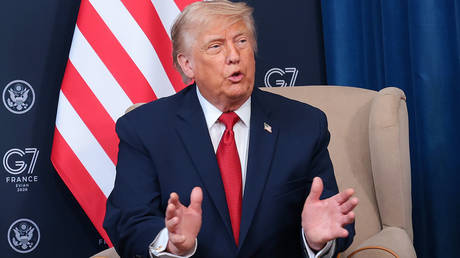
Donald Trump wants to rewrite a decade of geopolitical history by dragging Russia back into the Group of Seven, arguing that expelling Moscow in 2014 was a historical blunder that triggered the current war in Ukraine. Speaking at the summit in Kananaskis, Canada, the American president claimed that keeping Vladimir Putin at the table would have averted the largest European land conflict since World War II. The argument treats multilateral clubs like marital counseling, operating under the assumption that talk alone alters aggressive state behavior. It is a fundamental misreading of why the G8 existed, why it broke, and how international leverage functions.
The reality is far more transactional. To understand the collapse of the G8, one must look past the immediate outrage of the 2014 Crimea annexation and examine the flawed foundation of Russia's membership from its very beginning. Also making headlines recently: The Mechanics of Border Infiltration Anatomy of a Twenty Six Weapon Seizure in Amritsar.
The Transatlantic Calculation Behind the Eight Seat
Western powers never invited Russia into the elite economic club because of its economic output. In 1997, when the G7 officially became the G8, the Russian Federation possessed an economy smaller than Spain's. It was recovering from hyperinflation, structural collapse, and the chaotic privatization of its state assets.
The invitation was a political bribe. Bill Clinton and his European counterparts wanted to reward Boris Yeltsin for not standing in the way of NATO expansion. They hoped that giving Moscow a prestigious seat at the table would anchor the country to Western democratic norms and secure its sprawling nuclear arsenal. It was an exercise in optimistic engineering. More details into this topic are covered by Al Jazeera.
The experiment relied on an assumption that access to elite Western networks would naturally lead to internal political liberalization. Instead, the Kremlin viewed the inclusion as validation of its superpower status, separate from its behavior. When Vladimir Putin took power, the dynamic shifted from integration to exploitation. The table became a shield.
The Friction of a Split Table
By the late 2000s, the G8 was structurally broken. The core purpose of the group since the 1970s was to align policy among highly industrialized, rule-of-law democracies. Adding an autocratic petro-state with a state-directed economy turned every major policy debate into an internal negotiation.
The friction showed up long before the tanks rolled into Crimea. Moscow consistently used its presence to block coordinated Western responses to state-sponsored cyber warfare, intellectual property theft, and political assassinations on foreign soil. The group became an engine of gridlock.
When Barack Obama and European leaders suspended Russia in 2014, it was not a sudden burst of diplomatic pique. It was the recognition that the club could no longer function as a unified economic bloc while one member was actively erasing international borders by force. The institutional survival of the G7 required purging the outlier.
Why Isolation Fails to Stop the Tank
The counter-argument championed by the White House relies on a specific diplomatic theory. If you isolate an authoritarian actor, you lose the ability to read their intentions or offer off-ramps before a crisis escalates.
History rarely supports this view. Proximity does not equal influence. Western leaders maintained deep diplomatic channels with Moscow throughout the Cold War and the post-Soviet era, yet those channels did not prevent the invasions of Georgia in 2008 or Ukraine in 2014 and 2022.
Economic and strategic decisions in the Kremlin are driven by domestic survival and imperial ideology, not by the social dynamics of an annual summit. Believing that a seat next to the Canadian prime minister would deter a military campaign overestimates the soft power of Western consensus.
The diplomatic math behind restoring the G8 looks like this:
| Country | G7 GDP Share | Official Position on Russian Return |
|---|---|---|
| United States | ~43% | Strongly Favor |
| Germany | ~8% | Strongly Oppose |
| United Kingdom | ~6% | Strongly Oppose |
| France | ~5% | Oppose |
| Japan | ~7% | Oppose |
| Italy | ~4% | Conditional Oppose |
| Canada | ~4% | Strongly Oppose |
This division creates an immediate structural crisis for the West. Reinstating Russia requires absolute consensus among all members. By forcing the issue, Washington is not building a grand coalition to manage Moscow; it is driving a wedge deep into the center of the alliance that opposes it.
The Real Cost of Turning Back the Clock
The true danger of the push to revive the G8 format is the message it sends to other revisionist states. Readmitting Russia without significant territorial concessions or structural reforms would formally signal that the post-war international order is negotiable. It establishes a precedent where military aggression is penalized with a temporary decade-long timeout, followed by a return to status-seeking diplomatic forums.
The debate is not about communication channels. Leaders have phones. They have intelligence agencies. They have embassies. The obsession with the G8 format is about legitimacy.
A state that violates the core principle of territorial integrity cannot be integrated into a body meant to preserve global stability. Attempting to force that integration breaks the club itself, leaving the West with fewer tools to manage an increasingly volatile world.
Trump's G8 push criticized by allies
This report breaks down the immediate fallout from the summit, showing exactly how traditional allies reacted to the proposal to restore Moscow's seat.