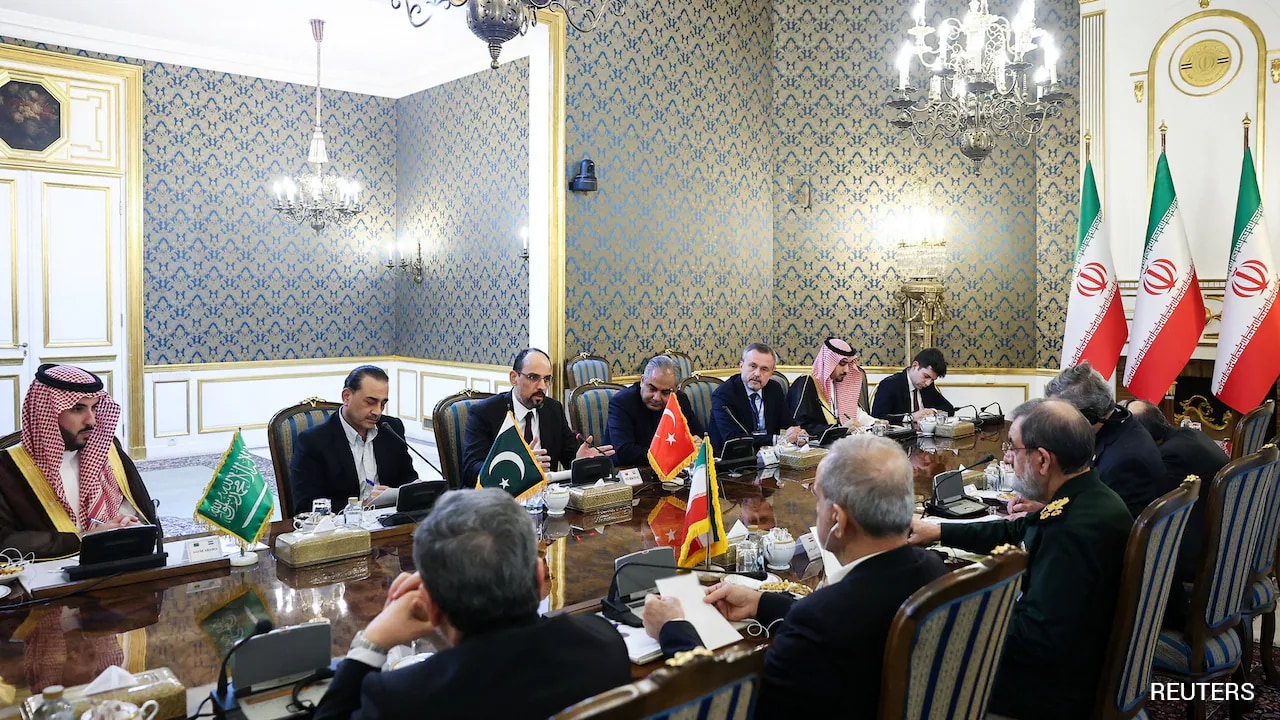
Senior diplomats and intelligence officials from Pakistan, Saudi Arabia, and Turkey have engaged in urgent, high-level consultations with Iranian leaders to prevent a renewed outbreak of direct military conflict across the Middle East. This rare convergence of three distinct regional powers stems from a shared calculation: a full-scale war involving Iran would trigger severe economic shocks, destabilize domestic security, and overwhelm existing containment mechanisms from the Persian Gulf to South Asia. While Washington and European capitals maintain pressure through sanctions and military deterrence, Islamabad, Riyadh, and Ankara are utilizing direct bilateral channels to establish red lines, manage proxy escalation, and keep fragile ceasefires intact.
The stakes are immediate. A collapse of current restraint would not remain confined to isolated border skirmishes or maritime harassment.
Why Three Historical Rivals Are Suddenly Moving in Lockstep
For decades, the foreign policies of Saudi Arabia, Turkey, and Pakistan operated along competing, and often contradictory, fault lines regarding Tehran. Riyadh viewed the Islamic Republic as its primary ideological and security adversary across Yemen, Iraq, Syria, and Lebanon. Ankara balanced pragmatic energy and trade ties with Iran against fierce proxy rivalries in the South Caucasus and northern Syria. Islamabad, meanwhile, walked a precarious tightrope—dependent on Saudi financial lifelines while sharing a volatile, 900-kilometer border with Iran that frequently erupted into cross-border militant strikes.
That old playbook no longer works. According to diplomatic assessments and regional policy analysts, the shift toward coordinated de-escalation is driven by acute economic vulnerability and the realization that military containment alone has reached its limit.
Saudi Arabia’s Vision 2030 requires prolonged regional stability to attract foreign direct investment, secure Red Sea shipping lanes, and insulate energy infrastructure from drone and missile retaliation. The 2023 Beijing-brokered normalization agreement between Riyadh and Tehran established a baseline of diplomatic communication, yet Saudi officials recognize that bilateral détente cannot survive a broader regional conflagration. When missiles fly across the Levant or the Persian Gulf, capital flees regardless of who fired first.
Turkey faces a different set of pressures. Grappling with persistent inflation and the long-term economic fallout of domestic crises, Ankara cannot absorb another wave of refugees or the disruption of overland trade corridors linking Anatolia to Central Asia and the Gulf. Turkish foreign policy strategists have increasingly emphasized regional ownership—the idea that Middle Eastern and neighboring powers must resolve security crises before external military interventions spiral out of control.
Pakistan’s calculus is perhaps the most urgent of the three. Confronting severe fiscal constraints, IMF restructuring requirements, and rising insurgent violence along its western frontier with Afghanistan, Islamabad cannot afford a two-front security crisis. The brief, tit-for-tat missile and drone strikes exchanged between Iran and Pakistan in January 2024 served as a stark warning of how rapidly miscalculation along the Balochistan border can escalate. Since then, Pakistani military and civilian leaders have prioritized institutionalizing border security mechanisms and positioning themselves as a credible interlocutor between Tehran and Sunni-majority states.
The Mechanics of Backchannel Diplomacy in Tehran
Public communiqués following high-level visits to Tehran routinely rely on familiar diplomatic boilerplate—emphasizing Islamic solidarity, territorial integrity, and mutual respect. Behind closed doors, however, the conversations are transactional and blunt.
Diplomats involved in regional mediation note that engagements with Iranian leadership must account for the dual structure of power in Tehran. While the Ministry of Foreign Affairs manages official diplomatic messaging and international negotiations, strategic security decisions—particularly those involving regional deterrence, missile deployment, and allied militias—rest squarely with the Supreme National Security Council, the Islamic Revolutionary Guard Corps (IRGC), and the office of the Supreme Leader.
Consequently, envoys from Islamabad, Riyadh, and Ankara have avoided relying solely on ceremonial diplomatic tracks. Instead, outreach has combined ministerial visits with direct intelligence-to-intelligence channels and military-level hotlines.
The core objectives of these engagements break down into three operational priorities:
- Establishing clear escalation thresholds: Mediators seek to clarify what specific actions—such as strikes on sovereign territory, assassinations of senior commanders, or blockades of maritime chokepoints—would force an automatic military response from Tehran, and what off-ramps remain viable.
- De-conflicting border and maritime zones: For Pakistan, this means joint intelligence sharing on separatist militant groups operating in Sistan-Baluchestan and Balochistan. For Saudi Arabia, it involves strict assurances regarding freedom of navigation in the Strait of Hormuz and the Red Sea.
- Managing proxy autonomy: One of the hardest variables in Middle Eastern security is the degree of operational independence exercised by armed groups aligned with Iran. Regional intermediaries press Tehran to exert restraint over allied factions whose local attacks risk triggering massive retaliatory strikes that draw the entire region into war.
What Critics and Skeptics Get Right About This Coalition
To treat this diplomatic push as a guaranteed firewall against war would be a serious misreading of regional power dynamics. Analysts and former diplomats point to structural limitations that constrain what Pakistan, Saudi Arabia, and Turkey can realistically achieve in Tehran.
First, none of these three nations possesses the leverage to alter Iran’s core strategic doctrine. Tehran’s reliance on asymmetric deterrence—built around ballistic missiles, unmanned aerial vehicles, and a network of regional partners—was developed over four decades specifically to offset conventional military inferiority against the United States and Israel. Envoys from Ankara or Islamabad cannot offer security guarantees equivalent to Washington’s military umbrella, nor can they unilaterally lift Western financial sanctions that continue to throttle the Iranian economy.
Second, competing national interests regularly resurface beneath the surface of diplomatic unity. Turkey and Iran remain locked in a quiet struggle over influence in Iraq and the future of transit routes in the South Caucasus, particularly surrounding the Zangezur corridor. Saudi Arabia remains deeply wary of Iran’s nuclear advancements and continues to deepen its own defense ties with the United States. Pakistan, reliant on Gulf financial support and Western multilateral lenders, must carefully calibrate its outreach to Tehran so as not to trigger secondary sanctions from Washington—a tension highlighted repeatedly over the stalled Iran-Pakistan gas pipeline project.
Third, diplomacy in Tehran faces internal friction. Hardline factions within Iran’s political and security establishment frequently view regional intermediaries with suspicion, arguing that concessions made under the threat of military escalation only invite further pressure. When external crises intensify, domestic political space for compromise inside Tehran narrows sharply.
The Overlooked Factor of Economic Interdependence and Transit Security
Much of the international coverage surrounding Middle East diplomacy focuses exclusively on military hardware, nuclear enrichment percentages, and ceasefire lines. That lens misses a powerful quiet driver behind the current diplomatic sprint: infrastructure and trade survival.
Over the past several years, Riyadh, Ankara, and Islamabad have staked their long-term economic recoveries on becoming indispensable transit and logistics hubs.
- Turkey has invested heavily in the Development Road Project, a multibillion-dollar rail and highway initiative intended to connect Iraq’s Grand Faw Port to Turkish border crossings and European markets. A major regional war turns that corridor into an uninsurable liability.
- Saudi Arabia is pouring sovereign wealth into Red Sea tourism, coastal industrial cities, and non-oil supply chains that depend on uninterrupted maritime insurance and commercial shipping confidence.
- Pakistan relies on the China-Pakistan Economic Corridor (CPEC) and maritime trade through Karachi and Gwadar—ports located mere miles from the Gulf of Oman and vulnerable to any naval blockade or insurance spike in the Arabian Sea.
For these governments, preventing war is not an abstract humanitarian exercise. It is an immediate balance-sheet necessity. An extended conflict involving Iran would drive up global freight insurance premiums, disrupt energy exports, trigger capital outflows, and spark domestic inflation across emerging markets already walking a fiscal tightrope.
How Washington and Beijing View the Regional Mediation
The diplomatic activism of Pakistan, Saudi Arabia, and Turkey unfolds within a shifting global power balance. Both the United States and China watch these regional maneuvers closely, though for starkly different reasons.
For Washington, direct communication between regional partners and Tehran serves a useful tactical purpose: it relays deterrence warnings through messengers whom Iranian officials are willing to receive. Because the United States lacks formal diplomatic relations with Iran, third-party intermediaries have historically functioned as vital conduits for crisis management. At the same time, U.S. policymakers remain cautious about diplomatic arrangements that might normalize Iranian regional influence or weaken the enforcement of sanctions without verifiable concessions on nuclear activities and militia support.
Beijing, by contrast, has actively encouraged regional conflict resolution that reduces the likelihood of U.S. military intervention and protects Chinese energy imports. China remains the largest buyer of Iranian crude oil while simultaneously serving as the top trading partner for Saudi Arabia and the primary infrastructure financier for Pakistan. A regional war threatens Beijing’s energy security and Belt and Road investments simultaneously, giving Chinese diplomats strong incentives to quietly back de-escalation efforts led by local powers.
The Limits of Crisis Management Without Political Resolution
The core vulnerability of the current diplomatic effort is that it focuses almost entirely on crisis management rather than conflict resolution.
Preventing an immediate exchange of missiles buys time. It lowers the temperature in regional capitals, reassures financial markets, and keeps diplomatic channels open. Yet none of the underlying disputes driving Middle Eastern instability—unresolved territorial conflicts, contested nuclear thresholds, economic isolation, and competing visions of regional order—are being settled at the negotiating table in Tehran.
Diplomats with decades of experience in the region warn that temporary understandings built on mutual fear of escalation tend to erode the moment a tactical incident occurs on the ground. A single misdirected strike, a rogue militia operation, or a miscalculated intelligence assessment can instantly override weeks of careful backchannel diplomacy. Without durable institutional frameworks or broader international agreements to address the root causes of insecurity, Pakistan, Saudi Arabia, and Turkey are effectively working as emergency firefighters in a building where the wiring remains exposed.