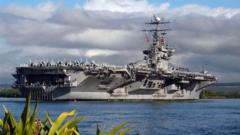
The weight of a city hits you long before you ever step foot on the deck. It is not merely the tonnage of steel, though fifty thousand tons of gray armor and electronics tend to command a certain physical respect. It is the weight of a living, breathing city condensed into a floating sliver of isolation, adrift in a salt-crusted ocean where the nearest grocery store is a thousand miles of vertical water away.
Think of a small town. The local baker, the diesel mechanic, the tired medic, the kid who just learned how to wire a breaker box. Now, compress that town until every doorway requires ducking, every corridor smells perpetually of fresh coffee and heavy machine grease, and the entire ecosystem is hurtling through the pitch-black night at thirty knots. That is life aboard a nuclear-powered aircraft carrier like the USS Abraham Lincoln. Learn more on a similar topic: this related article.
Most people picture the flight deck. They see the Hollywood cuts. The roaring F-18 Super Hornets spitting blue fire, the yellow-shirted shooters waving their arms like symphony conductors, the violent snap of the arresting gear catching a tailhook with enough kinetic fury to tear internal organs. It is cinematic. It is loud. It is terrifying.
It is also about five percent of the actual experience. More reporting by Cosmopolitan highlights comparable views on this issue.
The Architecture of Quiet
To understand what it is actually like inside the hull, you have to look past the ordnance and the radar domes. You have to look at the geometry of survival.
The ship is divided by massive, watertight steel doors that clang shut with a finality that echoes down the passageways like a church bell. Each sailor carries a designated badge, a keycard to their specific universe. If you wander too far off your rating, you are lost. The corridors are a dizzying maze of gray paint, vertical ladder wells that require both hands and a complete disregard for your shins, and overhead conduits labeled in faded stenciled lettering.
Space is the ultimate currency. There are no corner offices. There are no king-size beds. In the berthing compartments, sailors sleep in "racks"—stacked three high in aluminum coffins of personal privacy, curtained off from a room packed with forty other people. You learn to sleep through the concussive thump of catapults launching aircraft directly over your head at two in the morning. You learn to sleep while the ship rolls in a heavy sea, sliding back and forth against the canvas strap meant to keep you from hitting the deck.
Privacy is a myth you stop believing in by week two. Your mail arrives in batches when a supply ship pulls alongside in a precarious ballet known as an underway replenishment. Your news comes delayed, filtered through low-bandwidth email terminals. Your clock is entirely artificial, regulated by twenty-four-hour fluorescent lighting that never quite knows whether it is noon or midnight.
The Invisible Engine
Deep down below the waterline, past the point where the roar of the flight deck becomes a dull, rhythmic thrum in the soles of your feet, lives the engineering plant.
This is where the hypothetical scenario becomes a terrifyingly mundane reality. Imagine standing in a room so loud you have to communicate through hand signals, surrounded by pipes that carry steam hot enough to melt skin instantly. Nuclear reactors do not sleep. They do not take a coffee break because the sea state is rough.
A young machinist's mate—let's call him Martinez, nineteen years old, straight out of a recruiter's office in Ohio—stands before a massive bank of analog gauges. He is watching needles twitch. He is listening for the slight harmonic shift in a turbine that tells him a bearing is starting to pit. If Martinez misses that shift, if he gets complacent because he has checked those gauges four hundred times this week, the consequences ripple upward through five thousand lives.
That is the hidden psychological toll of naval service. The stakes are always maximum, even when the immediate task is cleaning a grease trap or updating a maintenance logbook. You are trusting strangers with your life, and they are trusting you with theirs, and the glue holding that trust together is routine. Endless, grinding, meticulous routine.
The Kitchen That Never Closes
To keep five thousand young adults operating at peak efficiency requires an industrial logistical miracle. The ship's galley is a subterranean factory operating around the clock.
Tens of thousands of meals are served daily. Flour comes in pallet-sized sacks. Eggs arrive by the crate. The bakers start their shifts while the rest of the ship is dreaming of home, wrestling with massive dough mixers that pitch and yaw with the ocean swells.
Sitting in the mess decks is an anthropological study in human adaptation. Here, senior officers in crisp khaki uniforms sit elbow-to-elbow with grease-stained airmen, sharing the same institutional tables, eating the same beef stew or mystery taco meat. The noise is deafening—a chaotic symphony of clattering trays, laughter, shouting over the din, and the occasional blast of a ship-wide announcement interrupting a conversation about football scores back home.
For a eighteen-year-old away from home for the very first time, this mess hall is both a sanctuary and a cage. You can find family here. You can find someone who will listen when the homesickness presses down harder than the steel hull. But you can never truly escape.
The Long Haul
Months blur together in a dizzying sequence of watch-standing, maintenance, drills, and more drills. On a deployment that stretches past half a year, time loses its linear quality. Days are no longer measured by Tuesday or Thursday, but by "left-side launch cycles" or "mids watch."
The ocean itself becomes an antagonist. Sometimes it is a flat, gray mirror stretching to an infinite horizon, so calm it feels as though the ship is suspended in amber. Other times, it is a ferocious monster. Waves the size of apartment buildings slam into the bow, sending tremors through the entire frame of the ship until the steel groans in protest. On the flight deck, the wind whips across at gale force, turning a routine movement into a life-or-death calculation where a single misstep means the dark, cold embrace of the open sea.
And yet, in the quiet moments—the rare hours off watch when a sailor leans against a weather deck railing under a blanket of stars untainted by city light pollution—something shifts.
The horizon is empty. There are no lights except the phosphorescent churn of the wake trailing off into the dark. In that vast, terrifying emptiness, you realize the true magnitude of what is happening. You are part of a floating island of humanity, holding back the dark with sheer willpower, electricity, and discipline.
The anchor drops eventually. The pier comes into view, lined with waving hands, blurred banners, and crying children. The ramp goes down.
The city steps ashore. But the city never really leaves them.