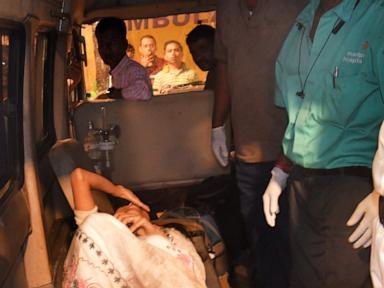
Nineteen people died in a single night during a Durga Puja celebration in Kolkata, West Bengal, when sudden rain sent crowds rushing toward shelter and people fell on a slick road. Another two dozen were hurt.
That is the headline summary you see on the wire. Most reports treat a crowd crush like a bolt from the blue, a freak accident caused by bad weather and bad luck. After decades covering public safety failures and urban infrastructure breakdowns, I can tell you it almost never starts with bad luck. Weather is a trigger, not the root cause. A slick road only turns fatal when thousands of bodies are already packed past their physical tolerance inside a space with nowhere to bleed off pressure. If you liked this post, you might want to check out: this related article.
When a crowd reaches high density, people stop behaving like independent walkers and start acting like fluid inside a narrow pipe. One person trips. The wave behind them does not stop because the people ten rows back cannot see the fall or hear the screams. Within seconds, horizontal force builds up across chests and ribs, making it nearly impossible to draw a breath even before anyone is trampled underfoot.
What Wire Reports Miss About Crowd Crushes
Standard breaking news follows a familiar script. Officials announce a death toll, express sorrow, blame a sudden rush or a rumor, detain a few local staff or organizers, and promise an inquiry. For another angle on this story, refer to the latest coverage from Associated Press.
That script lets everyone off the hook too easily. Calling a deadly crush a "stampede" is often the first mistake. In ordinary speech, a stampede implies panic-stricken people running wild in every direction. In reality, most mass-gathering fatalities happen in high-density stationary or slow-moving crowds where people cannot run at all. They are pressed together until shock waves propagate through the mass.
Rain changes the physics of those gatherings in quiet, brutal ways. First, it shrinks available space instantly. People who were spread out across open lanes or plazas pack tightly under tarps, awnings, overhangs, and narrow pavilion approaches. Second, wet pavement, mud, and discarded footwear turn minor stumbles into chain-reaction falls. Third, umbrellas and raincoats block sightlines and widen each person's footprint, cutting effective capacity without anyone realizing the bottleneck has tightened.
A crowd does not need panic to turn lethal. High density, a narrow throat, and a single fall are enough.
Investigations into mass gatherings across South Asia repeatedly point to the same structural pattern rather than isolated bad actors. Temporary structures go up quickly in dense neighborhoods. Access roads were laid out for ordinary traffic decades ago, not tens of thousands of festival-goers arriving in compressed waves. When thousands of visitors surge toward a limited number of covered spots at once, physics takes over from crowd control.
Why Urban Festivals Strain Old Streets
Major festivals in eastern India operate on a scale that baffles planners used to conventional ticketed events. A stadium has fixed gates, numbered seats, and clear capacity caps. A neighborhood festival stretched across winding city streets, temporary canopies, and transit corridors has porous edges and surging peaks.
Durga Puja in Kolkata is a prime example of how cultural vibrancy collides with urban geometry. Hundreds of elaborately built temporary pavilions draw massive evening foot traffic. Families, elders, children, and young visitors move through narrow lanes, often switching between open streets and cramped entryways.
Bottlenecks Built Into Temporary Layouts
Temporary event setups are built fast and taken down just as fast. That speed creates blind spots.
Barricades meant to channel foot traffic often double as traps when crowds reverse direction or surge sideways. If a lane narrows from thirty feet to eight feet near a pavilion entrance or shelter overhang, flow drops sharply while arrival pressure stays high. Anyone near the front takes the brunt of the squeeze.
Lighting and noise add another layer of risk. Festive lights create glare and deep shadows at the same time. Loud music, generators, and chanting drown out whistles or megaphone warnings. Even trained marshals struggle to spot a person down on the ground until a pileup has already formed.
The Transit and Weather Multiplier
Transit schedules and weather compress movement into dangerous spikes. Trains and buses dump waves of arrivals at predictable intervals, while sudden downpours force thousands to seek cover within a matter of minutes.
Consider a hypothetical example of a neighborhood lane holding four people per square meter during a light drizzle. That is already tight; people can still shuffle forward slowly. Add a sudden heavy shower, and hundreds of walkers push toward a single covered arcade or canopy entrance. Density jumps past six or seven people per square meter at the threshold. At that point, individuals lose control of their own balance. If someone slips on wet stone, the people right behind them cannot step around the fall.
That hypothetical scenario mirrors the exact mechanics seen in real-world crushes when weather hits an already crowded approach. There is rarely a single villain in that moment. There is a chain of small design and management choices that left zero margin for error.
The Accountability Gap After Tragedy
Whenever a mass-gathering disaster kills nineteen people, public anger naturally demands immediate arrests and tough speeches. Politicians trade blame, opposition leaders point to administrative lapses or special VIP arrangements at large events, and police detain organizers or security staff while opening a formal probe.
Detentions and committee reports satisfy the immediate need for visible action. They rarely fix the underlying system.
| Common Post-Crush Response | What It Addresses | What It Leaves Untouched |
|---|---|---|
| Detaining local staff or organizers | Immediate public demand for accountability | Street widths, drainage, and shelter layout |
| Cash aid and hospital support | Urgent relief for grieving families | Pre-event crowd density limits and surge routing |
| Promises of stricter police deployment | Visible security presence at major gates | Bottlenecks away from main checkpoints |
| Inquiry committees | Public record of events | Binding pre-opening engineering sign-offs |
Over decades of watching inquiries come and go, I have noticed a stubborn blind spot. Authorities tend to focus on behavioral blame—claiming people rushed, panicked, or ignored instructions—rather than spatial engineering. Telling a dense, squeezed crowd to stay calm does not create physical room to breathe.
At the same time, fairness requires acknowledging how hard these events are to police. No city can place an armed officer or crowd marshal every two feet across hundreds of sprawling festival sites during peak hours. Over-relying on last-minute police crackdowns after a crowd is already packed often makes things worse by blocking exits or creating sudden surges.
What Actually Prevents the Next Crush
Preventing deaths at massive public festivals does not require magic or futuristic surveillance alone. It requires treating crowd safety as a physical flow problem long before the first drumbeat or first raindrop.
First, organizers and municipal engineers have to design pressure-relief zones and wide egress paths. If a site has covered shelter areas, those shelters need multiple entry and exit sides so people do not funnel into a single narrow mouth when rain starts. One-way flow systems only work if exits are wide enough to clear people faster than entrances feed them in.
Second, authorities need hard density triggers rather than vague warnings. When crowd density climbs past safe thresholds in a narrow approach lane, marshals must hold incoming traffic further back in wider streets before the bottleneck locks up. Holding people fifty yards back in an open avenue is vastly safer than letting them pile up at a choked doorway.
Third, weather contingencies belong in every permit from day one. If rain is forecast during peak evening hours, slip-prone surfaces near approaches need gritty mats or drainage clearing, and covered waiting areas must be dispersed rather than clustered at one choke point.
None of these fixes is glamorous. None of them makes for a neat thirty-second press conference. Yet every single one respects how human bodies actually behave when space runs out.
Inspect every narrow approach lane, shelter overhang, and rain-slicked choke point before the gates open—because once a crowd loses room to move, no whistle or inquiry can give it back.