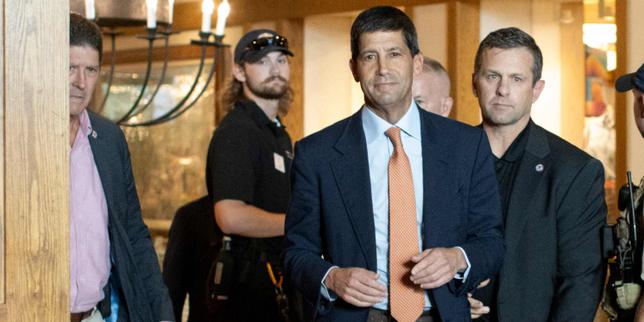
Federal Reserve Chair Kevin Warsh stepped to the podium in Jackson Hole knowing that his silence had become a macroeconomic hazard. For months, financial markets had misread his tight-lipped composure as passive indifference toward a Consumer Price Index stubbornly hovering at 3.4 percent and a Personal Consumption Expenditures index printing at 3.7 percent. The headline out of Wyoming was stark. Inflation is no longer just a lagging statistical nuisance; it is an active threat to institutional credibility.
When Warsh declared that policymakers have "work to do" if underlying price pressures fail to decelerate, he shattered weeks of market ambiguity. Wall Street traders immediately repriced federal funds futures, pushing the implied probability of a September rate hike past fifty percent. Yet focusing solely on the immediate pivot from dovish complacency to hawkish warning misses the deeper structural mechanics currently fracturing central bank orthodoxy.
The Anatomy of Sticky Prices
The core economic engine of the United States is running hot on borrowed time. Employment figures remain resilient at 4.1 percent, and corporate investment has refused to buckle under the weight of current borrowing costs. This resilience has inverted traditional textbook models. High interest rates were supposed to choke off aggregate demand by now. Instead, structural fiscal spending and massive capital deployment into artificial intelligence infrastructure have created a persistent price floor.
Consider a hypothetical example to illustrate this transmission failure. When a trillion dollars pours into building advanced computing data centers, it bids up local wages, specialized semiconductor components, and heavy construction materials simultaneously. Monetary policy managed via short-term benchmark rates struggles to cool localized sector expansions driven by secular technological shifts. Warsh acknowledged this exact tension by labeling artificial intelligence a hinge point in history. He noted that while long-term productivity will surge, the immediate capital expenditure cycle acts as an inflationary accelerant.
Central bankers are fighting a twentieth-century war with twenty-first-century variables. Traditional monetary transmission channels rely on cooling housing markets and consumer credit lines. When government outlays remain expansionary and corporate balance sheets are flush with cash, raising the federal funds rate by twenty-five basis points functions more like a gentle tax on the broader economy than a targeted brake on speculative excess.
The Political Trap and the Quiet Fed
Warsh inherited an institution caught between mathematical reality and intense political gravity. Appointed under an administration vocally demanding lower borrowing costs, the Federal Reserve chair faces a hostile environment where any tightening move invites open confrontation from the executive branch. Inflation is the most regressive tax in the modern fiscal architecture. It penalizes fixed-income earners and hourly wage laborers while asset owners insulate themselves behind appreciating equities and real estate holdings. Warsh explicitly highlighted this dynamic, pointing out that hardworking citizens bear the brunt of administrative policy errors while financial highfliers escape unscathed.
To regain control, Warsh is attempting a radical stylistic shift. He wants a quieter central bank. Forward guidance—the decade-old practice of telegraphing future policy adjustments down to the decimal point—has been benched. Warsh argues that offering explicit roadmaps strips the central bank of its operational agility and crowds out independent market pricing.
This philosophy sounds academically pristine in a seminar room. In practice, it creates a high-stakes guessing game. Markets hate a vacuum. When the central bank refuses to hand out clear directional maps, asset prices become hyper-sensitive to every syllable uttered at annual economic symposia. The violent repricing of short-term Treasury yields following his Jackson Hole address proved that a quieter Fed does not produce calmer markets; it produces sharper, more volatile reactions.
The Credibility Threshold
The Federal Reserve now stands at a dangerous historical crossroads. Having missed its formal two percent inflation target for over five years, the institution's anchor on long-term price expectations is fraying at the edges. If the Federal Open Market Committee holds borrowing costs steady at its upcoming meeting while core inflation prints remain entrenched above three percent, public trust in the central bank's mandate will take permanent structural damage.
The strategy moving forward requires an unyielding commitment to observable data over theoretical models. Economic forecasting remains an imperfect science of aspiration rather than precision. Warsh knows that if price pressures do not break downward voluntarily, he will have to use the blunt instrument of higher rates, regardless of political fallout or market tantrums. The era of cheap money and predictable central bank hand-holding is over. The coming months will test whether the architect of the quiet Fed possesses the political iron required to finish the job.