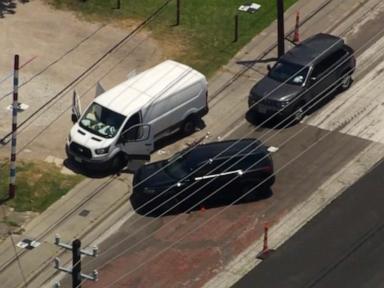
A federal judge has halted the immediate deportation of a key witness to a fatal shooting involving Immigration and Customs Enforcement agents in Houston. The emergency ruling temporarily freezes enforcement action against the individual, whose testimony could determine whether federal officers acted lawfully or executed an unwarranted use of lethal force. By stepping in, the court exposed a glaring structural conflict within the federal justice system. Executive branch agencies retain the authority to quietly remove critical eyewitnesses before independent oversight can fully evaluate their statements or present them to a grand jury.
The power dynamic here is stark. When federal law enforcement officers fire their weapons during domestic operations, the local law enforcement agencies and state prosecutors responsible for investigating homicide face an uphill battle. They must secure access to evidence and physical witnesses before federal immigration authorities initiate administrative removals. In the Houston case, the immediate move to deport a sole or primary witness raised red flags for defense attorneys and civil rights advocates alike, prompting a midnight court filing that narrowly kept the witness on American soil.
How Administrative Removal Threatens Criminal Investigations
The mechanics of deportation operate on a parallel track distinct from the state and federal criminal justice systems. While criminal prosecutions require months of discovery, depositions, and grand jury proceedings, administrative immigration enforcement moves at blinding speed. An individual holding crucial eyewitness information can be processed, placed on a flight, and rendered unreachable within forty-eight hours.
This creates a structural blind spot. Local prosecutors hunting for the truth behind a fatal discharge of a firearm often find themselves locked out of federal detention facilities. By the time state investigators draft subpoenas or request interviews, the witness may already be residing in a foreign jurisdiction beyond the reach of domestic court orders.
State Criminal Investigation <---> Subpoena Authority
                                         |
                                         v
                      [ Eyewitness in Federal Custody ]
                                         |
                                         v
Federal Immigration System  ---> Fast-Track Deportation (Deprives State of Witness)
Systemic delays in inter-agency cooperation frequently work to the advantage of the agency under investigation. When federal tactical units operate within local communities, civil rights statutes guarantee that citizens and non-citizens alike are protected from unreasonable force under the Fourth Amendment. Yet, when the only non-officer witness is an undocumented immigrant, the agency holding the gun also holds the authority to remove the witness from the country.
The federal judge’s temporary injunction serves as a emergency brake on this practice. It forces the Department of Homeland Security to pause administrative machinery while judicial officers assess whether the witness's presence is essential to the administration of justice.
The Conflict Between Enforcement Priorities and Constitutional Oversight
Federal law provides specific mechanisms, such as S visas or deferred action status, designed to protect victims and witnesses of serious crimes. These tools exist precisely so individuals can testify without fearing immediate retaliation or deportation. However, the application of these protections remains largely discretionary. The very agency under scrutiny often holds significant sway over whether a witness receives temporary legal status to remain in the nation.
When an ICE operation turns fatal, independent oversight relies entirely on physical evidence, body-worn camera footage, and third-party testimony. Ballistics and forensic reconstructions offer vital technical data. Yet, physical evidence rarely captures the exact verbal exchanges, subtle movements, or spatial dynamics that precede a fatal shot.
A witness provides the human context. Without that perspective, investigators are left with a one-sided narrative constructed almost exclusively by the officers involved in the discharge.
State and federal prosecutors frequently find themselves at odds over access to these individuals. Local district attorneys, tasked with enforcing state homicide laws, have no direct authority over federal immigration detainers. If a federal judge does not intervene through an injunction, the state's capacity to conduct a thorough homicide investigation is fundamentally compromised.
Historical Precedents of Witness Removal
This situation is far from unprecedented. Over the past two decades, civil rights attorneys have repeatedly fought to halt the deportation of individuals who witnessed severe misconduct, police shootings, or abuse inside federal detention centers.
In numerous instances across the country, witnesses were deported before grand juries could hear their testimonies. Once removed across an international border, getting an undocumented individual back into the United States to testify in a criminal trial requires an extraordinary measure known as humanitarian parole. Federal agencies rarely grant this remedy to individuals whose testimonies might expose operational failures or criminal liability within executive branch departments.
- 1997: Early legal challenges established that the government cannot deliberately deport a witness solely to suppress evidence favorable to a defense.
- 2014: Federal courts emphasized that deporting key witnesses creates a substantial risk of violating due process rights during subsequent trials.
- Present Day: Emergency injunctions remain the primary operational mechanism used by defense attorneys to lock witnesses in place before enforcement flights depart.
The burden placed on legal advocates is extreme. Defense attorneys must locate the witness within the federal detention apparatus, draft emergency motions, and persuade a federal judge that irreparable harm will occur if the deportation proceeds—often within a matter of hours.
The Legal Threshold for Halting a Deportation Order
Federal judges do not issue temporary restraining orders against executive agencies lightly. To secure an emergency stay, attorneys representing the witness must satisfy a strict four-part legal standard.
First, they must demonstrate a likelihood of success on the merits regarding the underlying constitutional or procedural claim. Second, they must prove that the witness will suffer irreparable harm if removed. In cases involving fatal shootings, deportation can expose witnesses to physical danger in their home countries, particularly if their involvement in a high-profile U.S. investigation becomes public knowledge.
Third, the balance of equities must favor the witness over the government's interest in swift immigration enforcement. Finally, attorneys must establish that granting the stay serves the broader public interest. Protecting the integrity of a fatal shooting investigation almost always aligns with the public interest, as public trust in law enforcement hinges on transparent, uncompromised inquiries.
The temporary stay issued in Houston does not grant the witness permanent residence or immunity. It simply freezes the status quo. It allows state and federal investigators to conduct formal depositions, secure sworn affidavits, and determine whether the witness must be subpoenaed for future court proceedings.
Reforming Inter-Agency Protocols for Fatal Encounters
The recurring friction between immigration enforcement and judicial oversight highlights a critical flaw in current policy. Allowing an agency involved in a fatal shooting to retain administrative control over critical witnesses creates an inherent conflict of interest.
To ensure complete impartiality, the protocol for handling witnesses to federal officer-involved shootings requires structural reform.
- Mandatory Stay of Removal: An automatic, thirty-day administrative hold should apply to any detainee who witnesses a fatal force event involving federal personnel.
- Independent Custody Transfer: Oversight of the witness's detention status should immediately transfer to the U.S. Marshals Service or an independent judicial officer to eliminate conflicts of interest.
- Guaranteed Access for Investigators: Civil rights investigators and local homicide units must receive immediate, unmonitored access to interview witnesses before any deportation processing continues.
Without these concrete structural safeguards, the integrity of investigations into federal officer-involved shootings remains entirely dependent on emergency court filings and the swift intervention of individual federal judges. The Houston order prevented a potential miscarriage of justice today, but the systemic loophole that required judicial intervention in the first place remains wide open.


