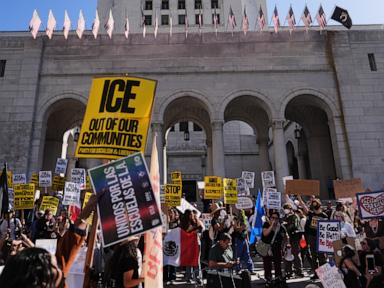
A federal judge has placed strict limitations on federal immigration enforcement across seven Southern California counties, ruling that immigration agents can no longer carry out warrantless arrests without first establishing and documenting a legitimate flight risk.
U.S. District Judge Maame Ewusi-Mensah Frimpong granted the preliminary injunction, targeting a core operational method used by Immigration and Customs Enforcement and U.S. Customs and Border Protection. The ruling covers Los Angeles, Orange, Riverside, San Bernardino, Ventura, Santa Barbara, and San Luis Obispo counties. It forces a confrontation between judicial oversight and federal enforcement strategies that have long relied on swift, on-the-spot field interrogations and detentions.
For years, civil rights advocates argued that agents routinely operated outside constitutional boundaries. They claimed field agents treated mere physical presence or demographic characteristics as automatic probable cause for civil immigration violations. The recent court action formalizes these concerns into a binding judicial command. It forces agents to prove that an individual is actually likely to escape before taking them into custody without a warrant.
The legal challenge hinges on the interpretation of federal immigration statutes and the Fourth Amendment. Federal law allows for warrantless civil arrests under specific conditions, but courts have increasingly wrestled with how those powers are exercised on the ground. Plaintiffs in the lawsuit presented internal records and field documentation that painted a troubling picture of systemic shortcuts.
Body camera footage and arrest reports evaluated during the litigation revealed significant discrepancies between official agency narratives and reality. In one notable incident scrutinized by the court, an agent claimed a worker made sudden movements indicating an intent to flee, yet video evidence failed to support the assertion. Other reports showed agents citing vague behavioral cues, such as looking confused when questioned about citizenship, to justify immediate detention without checking basic identification first.
These discrepancies formed the backbone of the judge's reasoning. The court found that the government failed to demonstrate proper adherence to statutory limits, routinely bypassing the required individual assessment of escape risk. By certifying the case as a class action, the ruling expands its reach beyond individual plaintiffs, offering blanket protections to residents across the region.
The Department of Homeland Security faced immediate scrutiny following the order. Attorneys for the federal government pushed for a delay, arguing that the restrictions would disrupt ongoing operations. Judge Frimpong rejected the request out of hand, noting that the government cannot claim legal harm simply from being ordered to follow constitutional parameters.
The implications for daily enforcement operations are immediate. Field agents must now fundamentally alter how they approach targets in public spaces, workplaces, and neighborhoods. Instead of relying on rapid detentions followed by retroactive justifications, agents face a paper trail requirement. Every warrantless stop must now include a documented, legally defensible rationale regarding why the subject presented an imminent flight risk.
Immigration advocacy groups hailed the decision as a vital check on executive overreach. Legal representatives noted that the injunction should curb hundreds of unlawful detentions that disproportionately impacted working-class communities of color. At the same time, critics of the ruling argue it ties the hands of law enforcement officers tasked with enforcing federal code in a high-pressure environment. They contend that requiring a formalized escape assessment before taking action introduces bureaucratic friction into rapidly evolving field situations.
As the litigation moves forward, compliance monitoring will become the central battleground. Civil rights organizations have pledged to track field operations closely, ensuring that federal agencies translate the court order into actual behavioral changes on the street. Meanwhile, legal analysts expect the federal government to test the boundaries of the injunction through higher appellate courts, setting up a high-stakes legal showdown over the scope of executive authority in immigration enforcement.