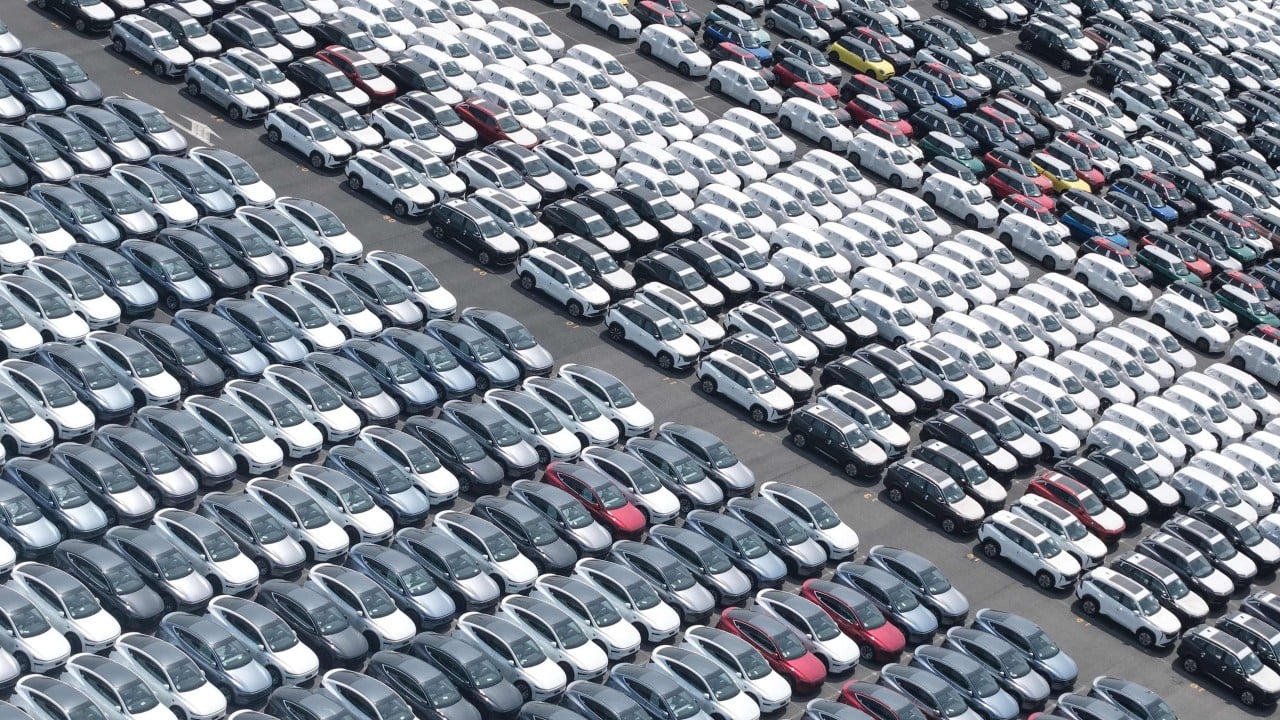
China’s two most aggressive private automakers are pulling off a financial magic trick. While domestic showrooms across mainland China bleed cash in an endless race to the bottom, both BYD and Geely Automobile Holdings have posted surging profits by turning to foreign buyers. The mechanism is straightforward even if the execution is brutal. At home, relentless discounting has gutted vehicle margins, forcing these manufacturers to rely on overseas markets—where identical electric and hybrid cars command drastically higher sticker prices—to pad their bottom lines.
This divergence defines the modern Chinese auto sector. For years, analysts assumed that scale inside China would naturally translate into domestic profitability. Instead, the opposite happened. Overcapacity turned the world’s largest car market into a war of attrition, leaving even the winners with razor-thin local returns. Exports stopped being a secondary growth project and became the primary profit engine. Discover more on a related subject: this related article.
The Domestic Trap That Forced the Pivot
To understand why BYD and Geely are shipping cars across oceans at breakneck speed, you first have to look at the wreckage on their home turf. China’s automotive industry spent the past decade building factory capacity far beyond what domestic consumers can absorb. Government subsidies, cheap municipal land, and aggressive venture capital created dozens of electric vehicle brands competing for the exact same middle-class buyer.
When demand began to cool, nobody blinked. Nobody shut down factories. Instead, they slashed prices. Further reporting by Financial Times highlights comparable views on the subject.
BYD fired the loudest shots in this campaign, repeatedly cutting prices across its Dynasty and Ocean lineups to bury rival gas-powered cars and weaker EV startups. Geely followed suit, pushing its Galaxy and Zeekr sub-brands into fierce discounting battles just to defend market share. Winning volume in China now requires sacrificing profit on almost every unit sold.
A mid-size electric crossover that sells for the equivalent of $18,000 in Shenzhen or Chengdu leaves almost nothing on the table after battery costs, software engineering, and dealer incentives are factored in. Scale keeps the assembly lines humming and suppliers paid, which is critical for surviving a prolonged downturn. It does not, however, generate the cash reserves needed to fund next-generation battery research or autonomous driving platforms.
The Export Arbitrage Engine
Cross a border, and the math changes overnight.
The core financial engine driving the profit jumps at both BYD and Geely is geographic price arbitrage. In markets across Southeast Asia, Latin America, the Middle East, and Europe, local legacy automakers have been slow to offer affordable electric and plug-in hybrid vehicles. Consumers in Brazil, Thailand, or Australia are accustomed to paying Western or Japanese prices for new cars.
When BYD ships an Atto 3 or a Seal abroad, it does not price the vehicle at its rock-bottom Chinese domestic rate. It prices the car just below comparable offerings from Toyota, Volkswagen, or Hyundai. That gap—often $10,000 to $15,000 higher than the Chinese sticker price—flows straight toward the bottom line, even after accounting for ocean freight, local homologation, and import duties.
Geely executes a similar playbook, though with a slightly different structural advantage. Through its ownership of Volvo Cars, its deep ties to Polestar, and its joint ventures with Renault, Geely already possessed international distribution networks, engineering centers, and brand recognition that pure domestic rivals had to build from scratch. While BYD had to commission its own fleet of roll-on, roll-off car carriers to break shipping bottlenecks, Geely could lean on established global supply chains to push its Lynk & Co, Zeekr, and Geely-badged models into foreign dealerships.
Why Hybrids Are Doing the Heavy Lifting
A common misconception among casual observers is that China’s export boom is purely about battery-electric vehicles. The reality on the docks tells a different story.
In many emerging markets, charging infrastructure remains sparse and electrical grids are fragile. Pure battery-electric cars hit a ceiling fast in places like rural Brazil, Mexico, or parts of the Middle East. Both BYD and Geely recognized this friction early and flooded these regions with plug-in hybrids (PHEVs) and high-efficiency internal combustion models.
BYD’s DM-i hybrid system allows drivers to commute on electric power while relying on a gasoline engine for long highway trips, removing range anxiety entirely. Geely has leaned heavily on its NordThor hybrid powertrain and conventional gasoline exports in regions where electrification is still nascent. These vehicles are cheaper to build than long-range battery-electric cars because they require smaller battery packs, yet they still command premium pricing abroad compared to aging, low-tech competitors.
Vertical Integration as a Shield
High overseas sticker prices only translate into net profit if a company controls its underlying manufacturing costs. This is where BYD’s decade-long obsession with vertical integration pays off.
Unlike legacy Western automakers that act primarily as assemblers of third-party components, BYD manufactures its own lithium-iron-phosphate Blade batteries, its own electric motors, its own power semiconductors, and even its own seats and headlights. When lithium prices swung wildly over the past few years, BYD absorbed the shock internally rather than watching tier-one suppliers eat its margins.
Geely has pursued a parallel strategy, though through corporate alliances and targeted acquisitions rather than pure in-house manufacturing. By pooling procurement across Geely Auto, Volvo, Zeekr, and Lotus—using shared vehicle architectures like the Sustainable Experience Architecture (SEA)—Geely spreads research and development expenses over millions of global units. Developing a new chassis or software stack once and deploying it across five brands in thirty countries drastically lowers the per-car engineering burden.
When these cost-controlled vehicles hit international markets where competition is weak, the resulting gross margins look wildly superior to anything achievable inside mainland China.
The Tariff Wall and the Localization Scramble
relying on exports to subsidize a domestic price war carries an obvious, looming vulnerability. Importing nations are not going to watch their domestic auto industries get wiped out without fighting back.
The pushback has already moved from rhetoric to hard policy. The European Union imposed steep countervailing duties on Chinese-built electric vehicles after concluding that state-backed financing and subsidies distorted market competition. The United States effectively locked Chinese passenger cars out of its market entirely with 100 percent tariffs. Brazil, Turkey, and several other developing economies have rolled back tax exemptions for imported EVs to protect local assembly jobs.
If BYD and Geely simply keep building cars in China and putting them on boats, tariffs will eventually erase their arbitrage advantage.
Both companies saw this wall coming and are racing to build factories inside their target markets before the gates slam shut. Localizing production is expensive, slow, and messy, representing the biggest test to their current profit streak.
BYD is pouring capital into assembly plants in Thailand, Brazil, Hungary, and Uzbekistan. Geely is expanding manufacturing footprints in Malaysia through Proton, leveraging European facilities via Volvo, and exploring regional assembly hubs across Latin America and Eastern Europe.
Building cars outside China introduces entirely new cost structures. Labor in Hungary or Brazil is more expensive and less flexible than in Guangdong. Local content rules require automakers to source parts from regional suppliers rather than simply shipping knocked-down kits from China for final bolt-together assembly. Early overseas factories almost always run at a loss until volume scales up and local supply chains mature.
Can Foreign Profits Outrun Domestic Decay?
The central tension facing investors and industry analysts is a race against time. Right now, the surge in high-margin overseas volume is more than enough to offset the margin compression happening inside China. Financial statements look strong, cash flows are healthy, and both companies are gaining global market share at the expense of legacy Japanese, Korean, and European brands.
Yet the domestic Chinese market shows zero signs of rationalizing. Dozens of loss-making EV brands continue to survive on local government lifelines, refusing to exit the market and keeping downward pressure on prices. Every yuan cut from a vehicle's price in Shanghai forces BYD and Geely to sell more cars abroad just to keep corporate earnings moving upward.
At the same time, international competition is waking up. Legacy automakers are finally slashing costs on their own electric platforms, while regulators in Brussels, Brasilia, and Bangkok are scrutinizing every loophole Chinese exporters try to use.
The export boom gave BYD and Geely the financial oxygen they needed to survive China’s brutal automotive shakeout. Maintaining those profits will require transforming from Chinese exporters into true multinational manufacturers—a transition that has broken plenty of ambitious automakers before them.