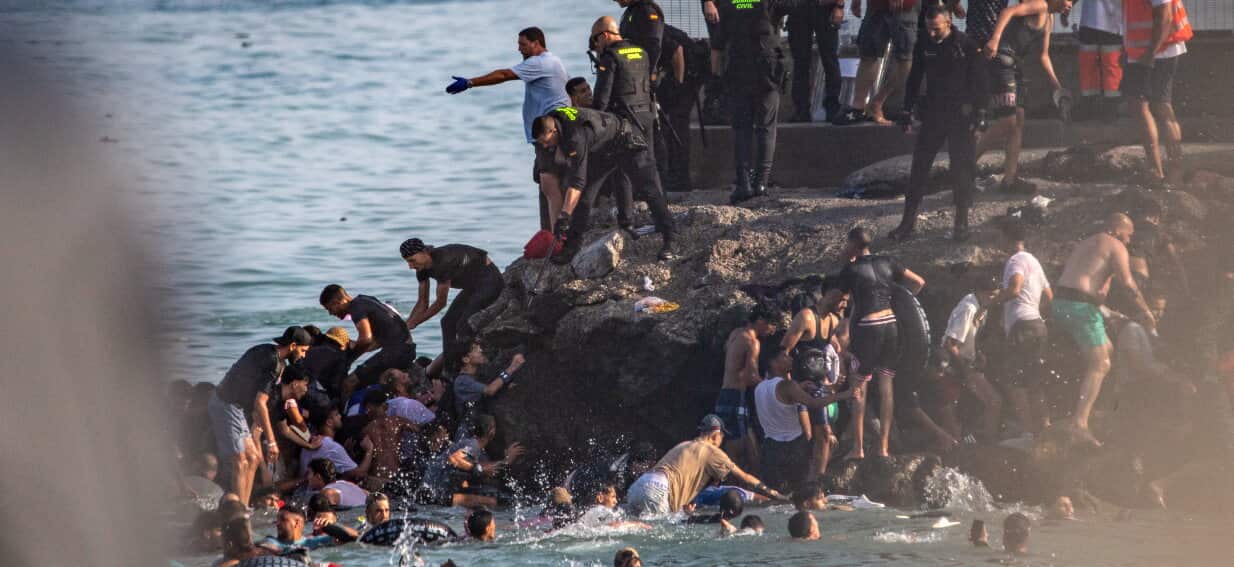
The Gates of Europe Are Built on Concrete and Contradiction
Ceuta and Melilla are geographic anomalies that mock the neat definitions of modern geopolitics. These two Spanish exclaves sit firmly on the northern coast of Africa, surrounded by Morocco, bordered by the Mediterranean Sea, and governed entirely from Madrid. They represent the only physical land borders shared between the European Union and the African continent. This unique positioning turns a few square kilometers of Spanish soil into a pressure cooker for global migration dynamics.
Millions look toward these razor-wire fences not as mere boundaries, but as the final, desperate threshold of the European dream. Behind those barriers lie European healthcare, legal protections, and the promise of economic mobility. Ahead of them stand double-layered fences towering over six meters high, equipped with noise sensors, thermal cameras, and anti-climbing mesh. Meanwhile, you can read similar stories here: Inside the Quiet Battleground of Cross-Border Aid Where Concrete Speaks Louder Than Diplomacy.
Yet, physical deterrents only shift human desperation rather than resolve it. When authorities heighten security at the land borders, smuggling rings simply adapt, pivoting toward treacherous maritime routes or finding cracks in the bureaucratic machinery governing asylum applications. The migration challenge here is not a sudden emergency or an unforeseen accident of history. It is a permanent structural friction point between the developing world and fortress Europe, managed through temporary band-aids and political theatre.
The Geography of Exclusion
To understand why Ceuta and Melilla function as perpetual flashpoints, you have to look at the map with cold realism. Ceuta spans just eighteen square kilometers, while Melilla is even smaller at roughly twelve. Both are densely populated enclaves where land is scarce and economic opportunities outside of cross-border trade, fishing, and public administration are virtually nonexistent. To explore the full picture, check out the excellent analysis by BBC News.
For decades, an informal economy thrived on what local authorities euphemistically called atypical commerce. Thousands of Moroccan porters crossed the borders daily carrying massive bales of goods on their backs, exploiting customs exemptions that turned blind eyes to wholesale smuggling. When Rabat unilaterally closed these commercial customs posts, thousands lost their livelihoods overnight, instantly transforming a stable, if illicit, economic ecosystem into an engine of acute desperation.
When people have nothing left to lose, physical architecture loses its intimidation factor. Migrants do not calculate risk using actuarial tables; they measure it against the absolute certainty of poverty at home. Six-meter fences topped with non-cutting steel mesh only invite more inventive methods of circumvention. People swim around the breakwaters in freezing currents, hide beneath car chassis, or use homemade grappling hooks under the cover of dense maritime fog.
[Moroccan Territory] ---> [Double Perimeter Fences] ---> [Spanish/EU Soil (Ceuta/Melilla)]
          |                         |                               |
  Economic Despair           Thermal Cameras &                 Temporary Holding
  & Smuggling Networks       Anti-Climbing Mesh                 Centers (CETI)
The Bureaucratic Trap Inside the CETI
Those who manage to scale the fences or round the breakwaters rarely find freedom on the other side. Instead, they enter the CETI, the Spanish acronym for the Temporary Immigrant Stay Centers. These facilities were designed to process individuals quickly before transferring them to the European mainland.
In reality, the CETIs routinely operate far beyond their intended capacity. Beds fill up, sanitation strains, and legal limbo stretches from weeks into grueling months. Under Spanish law, undocumented arrivals cannot be summarily expelled without due process, yet they are prohibited from leaving the exclaves for the mainland while their cases are pending.
This creates a surreal administrative purgatory. Migrants sit in overcrowded compounds, staring across the strait at the Spanish mainland, knowing that a ferry ride separates them from their destination, yet legally trapped by a wall of red tape. Local authorities complain of abandonment by Madrid, while human rights organizations document systemic bottlenecks that violate basic standards of dignity. The central government walks a precarious tightrope, trying to appease EU partners who demand strict border enforcement while dodging domestic criticism over human rights abuses.
Rabat as the Gatekeeper
No analysis of Ceuta and Melilla can ignore the geopolitical shadow cast by Morocco. The kingdom holds a unique kind of diplomatic leverage over Spain and the wider European Union. Migration control is not maintained solely through European funding or Spanish police coordination; it is modulated in real time by the royal palace in Rabat.
Whenever diplomatic tensions flare between Madrid and Rabat over issues like Western Sahara or fishing rights, the surveillance along the Moroccan perimeter mysteriously softens. Border guards look away. Social media algorithms fill with coordinated calls for mass rushes on the fences.
This dynamic turns human beings into geopolitical bargaining chips. Europe pays billions in developmental aid and security subsidies to North African states, outsourcing its border enforcement to regimes with questionable democratic credentials. It is a transactional arrangement built on mutual distrust. Spain relies on Moroccan security forces to do the dirty work of batons and tear gas, while Rabat uses the threat of migratory flows to extract diplomatic concessions and economic packages from Brussels.
The Myth of the Quick Fix
Politicians on both sides of the ideological divide love simple narratives. The right calls for heavier militarization, deeper trenches, and immediate pushbacks that bypass international asylum laws. The left demands open doors, immediate legalization, and an end to physical barriers, framing the issue purely through humanitarian lenses.
Both approaches ignore the grinding mechanical reality on the ground. Walls do not stop desperation; they merely redirect it into more dangerous channels. Open borders, enacted unilaterally without comprehensive structural reforms in both origin and transit countries, would collapse local infrastructure within weeks.
The truth is messier and far less marketable during an election cycle. Managing this frontier requires acknowledging that human mobility cannot be halted by concrete alone, nor can it be absorbed without institutional capacity. Until Europe addresses the deep economic divides driving young Africans toward these razor-wire fences, Ceuta and Melilla will remain the canary in the coal mine for a continent struggling to reconcile its professed values with its physical boundaries.
The waves will keep hitting the breakwaters. The young men and women will keep running toward the fences. And the politicians in Madrid and Brussels will keep drafting white papers, pretending that the next security upgrade will finally solve a crisis born of global inequality.

/GettyImages-157526585-93425538070d4422ad42d22af28c0758.jpg)