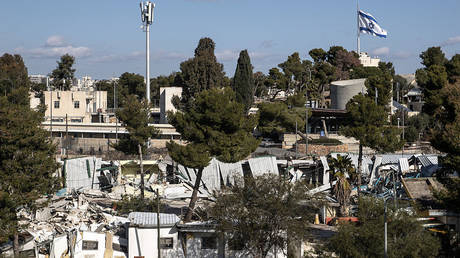
The Israeli cabinet has formalised a move that reshapes the geopolitical architecture of East Jerusalem. By approving the construction of a major military and defense complex on the exact site of the recently demolished United Nations Relief and Works Agency (UNRWA) headquarters in Sheikh Jarrah, Israel has moved from a war of words with the international body to concrete, permanent physical replacement.
The decision represents far more than a standard municipal zoning update. It is a calculated bureaucratic and symbolic maneuver designed to lock in sovereign control over contested territory, disable the machinery of Palestinian refugee status at its administrative core, and signal an irreversible break with the United Nations framework.
Concrete over Diplomacy
The newly approved defense compound is designed to be sprawling and highly visible. Spanning roughly 36 dunams, near the historic Ammunition Hill flashpoint, the complex will feature a new advanced military recruitment office, an expansive Israel Defense Forces (IDF) heritage museum, and an official office for Defense Minister Israel Katz.
The choice of location is deliberately confrontational. For decades, this site served as the administrative nerve center for UNRWA operations in East Jerusalem, overseeing essential services, schools, and aid distribution for hundreds of thousands of Palestinian refugees.
By replacing an international humanitarian compound with an army enlistment center and a military museum, the state is physically anchoring its security apparatus into a neighborhood that the international community recognizes as occupied territory. This is urban planning weaponized to establish permanent facts on the ground.
The speed of the transition underscores its political urgency. Israeli bulldozers dismantled the remaining UNRWA structures in January, erecting the Israeli flag over the rubble. Now, the cabinet has bypassed traditional bureaucratic hurdles, allocating the land to the Defense Ministry without a public tender. The official justification—that the existing Jerusalem military recruitment offices no longer meet the needs of the army—serves as a thin logistical veneer for a profound geopolitical shift.
The Broader Strategy to Erase UNRWA
To view this development solely as a real estate seizure is to miss the strategic forest for the trees. This construction project is the structural climax of a multi-year, multi-front campaign to completely dismantle UNRWA.
Israeli officials have long argued that the agency perpetuates the Israeli-Palestinian conflict by granting hereditary refugee status to millions of descendants of those displaced in 1948. The political objective is straightforward: if you eliminate the agency that registers the refugees, you effectively dissolve the political potency of the "right of return" in future negotiations.
The strategy shifted into overdrive following the October 7 attacks, as Israel accused a small fraction of UNRWA’s vast staff of direct complicity with Hamas. While the UN investigated and severed ties with specific individuals, Israel leveraged the political momentum to pass sweeping Knesset legislation late last year that effectively outlawed UNRWA operations within territory under Israeli control.
The physical destruction of the headquarters, followed by the immediate approval of an IDF base on its ruins, serves as the exclamation point on this policy. Defense Minister Israel Katz made the ideological underpinnings explicit, declaring the move a decision of "sovereignty, Zionism, and security." Katz remarked that there is nothing more symbolic or just than establishing defense institutions on the ruins of the compound.
The Legal and International Fallout
Unsurprisingly, the cabinet's decision has triggered intense diplomatic condemnation, though Israeli policymakers appear increasingly indifferent to rhetorical pushback from foreign ministries.
The Jerusalem Governorate immediately condemned the approval, calling it a flagrant violation of international law, specifically the Fourth Geneva Convention, which governs how an occupying power must manage public property and humanitarian infrastructure. Palestinian officials have urged UN Secretary-General Antonio Guterres to refer the matter to the International Court of Justice, arguing that the seizure sets a catastrophic precedent regarding the immunity and privileges historically granted to UN facilities worldwide.
UN officials privately worry about the systemic implications. If a UN member state can unilaterally declare a UN compound illegal, evict its staff, bulldoze the property, and construct a military base on the site, the foundational legal protections that shield global humanitarian operations in conflict zones are fundamentally compromised.
Embedding the Military Narrative
The inclusion of an IDF heritage museum within the planned complex is a crucial component of the broader plan for East Jerusalem. It represents a deliberate effort to reshape the cultural and historical narrative of the area.
Sheikh Jarrah and the surrounding tracts near Ammunition Hill have been at the heart of intense demographic and legal battles for decades, characterized by eviction notices, property disputes, and nationalist marches. By inserting a state-run military museum into this specific landscape, the government is linking Palestinian historical spaces directly to an Israeli military timeline.
The museum will draw thousands of young recruits, school groups, and tourists into a deeply contested sector of East Jerusalem, normalizing the presence of the defense establishment in an area where international consensus still demands a negotiated two-state solution. It transforms a neighborhood defined by its Palestinian identity and international diplomatic presence into a hub of state-sponsored military pride.
A One-Two Punch for Jerusalem's Status
The timing of the defense compound approval coincided with another critical cabinet decision, revealing a coordinated push to solidify Jerusalem's status as Israel's exclusive, undivided capital.
Concurrently with the military base approval, the government greenlighted a proposal spearheaded by Foreign Minister Gideon Sa'ar and Deputy Prime Minister Yariv Levin to offer substantial financial assistance to foreign countries willing to relocate their embassies to Jerusalem. The state will cover expenses related to establishing offices, acquiring accommodation, and building out necessary infrastructure.
This dual approach combines aggressive physical sovereignty on the ground with financial incentives for diplomatic recognition abroad. It is a clear statement to the international community: the debate over East Jerusalem's status is closed, the UN infrastructure has been cleared away, and the physical and diplomatic reality of the city has been fundamentally rewritten.
The strategy carries immense friction, but the current political alignment in Jerusalem calculates that the domestic political rewards and the long-term territorial gains far outweigh the cost of international censure. The bulldozers have cleared the path, the capital has been allocated, and where the blue-and-white UN flag once flew, the concrete foundations of a military complex are already being poured.