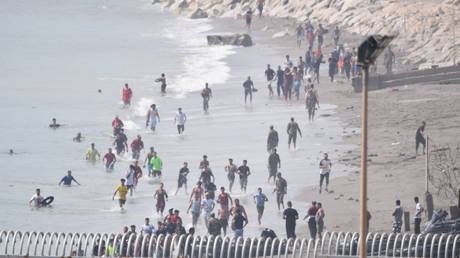
Mass migrant crossings into Ceuta do not happen in a vacuum. When thousands of people swam past breakwaters or scaled double-layer border fences into Spanish territory, surface-level reports pointed toward economic desperation or relaxed border enforcement. That explanation is incomplete. The sudden surge of over ten thousand arrivals across the Moroccan border into the tiny Spanish exclave of Ceuta was a manufactured crisis. It was a calculated diplomatic weapon deployed by Rabat to punish Madrid for hosting a dissident leader.
Understanding why the borders cracked open requires examining the intersection of North African geopolitics, European Union migration management, and long-standing territorial disputes. This is the anatomy of a border breakdown.
The Geopolitical Powder Keg
Borders are physical manifestations of political agreements. When those agreements fracture, the physical barriers suddenly matter very little. Ceuta and Melilla, Spain's two North African exclaves, represent unique anomalies. They are the only land borders shared between the European Union and the African continent. This geographic reality makes them perpetual pressure points for migration.
For years, Morocco acted as a functional gendarme for southern Europe. Rabat suppressed departures, patrolled its coastline, and managed its borders in exchange for billions of euros in aid, agricultural trade concessions, and diplomatic deference from Madrid and Brussels.
Diplomacy is transactional. When the underlying transaction breaks down, the border controls break down with it.
The immediate trigger for the mass crossings involved the medical treatment of Brahim Ghali. Ghali serves as the leader of the Polisario Front, the movement fighting for the independence of Western Sahara from Moroccan control. Morocco views the Polisario Front as an existential threat to its territorial integrity.
When Madrid admitted Ghali under a false identity for cancer treatment in the spring of 2021, Rabat viewed the act as a profound betrayal. Spain chose humanitarian cover over strategic alignment. Morocco responded by opening the floodgates.
The Mechanics of a State-Facilitated Surge
Borders do not simply open by accident. Intelligence reports and eyewitness accounts from the ground confirmed a sudden, unexplained laxity among Moroccan security forces stationed near the Fnideq border crossing adjacent to Ceuta.
Suddenly, checkpoints were unmanned. Police officers looked the other way. Word traveled with algorithmic speed across social media channels and messaging applications. Thousands of young men, families, and unaccompanied minors walked toward the beach unchecked.
Security forces in Morocco did not just step aside. In many instances, they actively directed people toward the shoreline.
This tactic transformed human bodies into diplomatic leverage. By weaponizing migration, Rabat demonstrated to Madrid and the broader European Union a fundamental truth. European border security relies almost entirely on the cooperation of third-party transit countries. If those countries decide to withdraw their police presence, millions of euros worth of razor wire, thermal cameras, and patrol boats become entirely obsolete.
The human cost of this geopolitical standoff was immediate. Swimmers faced treacherous currents, hypothermia, and exhaustion. Families arrived on Spanish beaches in shock. Meanwhile, local authorities in Ceuta, a city of roughly eighty thousand residents, found municipal services overwhelmed within hours. Schools closed, hospitals filled, and emergency shelters reached maximum capacity overnight.
The Broader European Vulnerability
Ceuta serves as a stress test for the migration architecture of the entire European bloc. The European Union relies heavily on externalization strategies. Brussels pays transit states to keep migrants away from European shores, effectively outsourcing border enforcement to regimes with questionable human rights records.
This model creates a dangerous structural vulnerability.
When an external partner has a bilateral grievance with an individual EU member state, the entire union becomes hostage to that dispute. Morocco used Ceuta to send a message to Berlin as well, recalling its ambassador over German positions on Western Sahara prior to the Spanish border crisis.
Migration diplomacy is an effective coercive tool precisely because European nations are politically paralyzed by the issue. Domestic political polarization across the continent ensures that any sudden influx of arrivals immediately triggers populist backlash, internal EU friction, and institutional panic. Authoritarian and semi-authoritarian governments understand this dynamic completely. They can dial migration flows up or down like a valve to extract financial aid, diplomatic recognition, or silence on domestic governance issues.
The Failure of Deterrence Politics
Physical infrastructure alone cannot stop desperate people when state actors facilitate movement, nor can it withstand deliberate political pressure. Spain spent decades fortifying Ceuta. The perimeter features a six-meter-high double fence equipped with anti-climbing mesh, surveillance cameras, closed-circuit television, and tear gas launchers.
Yet, when the Moroccan police abandoned their posts, thousands bypassed the fences entirely by swimming around the sea breakwaters at Tarajal and Benzú.
Technology and steel failed because the crisis was never a failure of tactical hardware. It was a failure of strategic diplomacy. Building higher fences does nothing to address the structural incentives that cause transit states to weaponize migration in the first place. As long as Europe treats migration management as a purely police matter rather than a complex foreign policy challenge, these flashpoints will repeat.
Moving Beyond the Breaking Point
The aftermath of the Ceuta crisis saw frantic diplomatic repair work. Spain increased development aid, re-established high-level diplomatic channels, and eventually shifted its official stance on Western Sahara to align closer with Moroccan autonomy proposals, much to the anger of the Polisario Front and Algeria.
Borders closed again. Security patrols resumed. The diplomatic price of reopening the valve proved steep.
Yet nothing fundamental has changed in the underlying architecture. The next diplomatic dispute between Madrid and Rabat, or between Brussels and any other Mediterranean partner, carries the exact same risk. The geopolitical playbook has been written, tested, and proven effective.
Every border is only as secure as the political relationship behind it. When nations rely on coercion to manage human movement, the physical barriers are nothing more than stage props waiting for the next crisis to expose their illusion.