When Xi Jinping and Peng Liyuan appear side by side at high-profile summits—whether hosting foreign dignitaries in Shenzhen, walking the tarmac in Moscow, or strolling through manicured gardens in Paris—they are executing a deliberate geopolitical strategy designed to soften Beijing’s rigid authoritarian image through first-couple diplomacy. For decades, Chinese leadership projected power through monochrome suits, stern party congresses, and collective bureaucracy. By elevating Peng Liyuan from a celebrated folk soprano into a visible, globally fluent diplomatic partner, Beijing created a calculated soft-power instrument meant to humanize the Chinese state, build personal rapport with foreign leaders, and project stability to both domestic and international audiences.
Yet beneath the polished choreography lies a complex political balancing act. Unlike Western first ladies, whose roles are shaped by electoral politics, independent media scrutiny, and autonomous charitable foundations, Peng operates entirely within the strict boundaries of the Chinese Communist Party’s (CCP) propaganda and foreign policy apparatus. Her appearances are never spontaneous. Every outfit, handshake, museum visit, and musical reference is calibrated to reinforce Xi’s political authority while counterbalancing the sharper edges of China’s assertive foreign policy.
Breaking the Mold of Chinese Political Optics
To understand why Peng Liyuan’s public role matters, you have to look at the history she disrupted. Before 2012, the wives of China’s paramount leaders were virtually invisible. Deng Xiaoping’s wife, Zhuo Lin, rarely appeared in public. Jiang Zemin’s wife, Wang Yeping, kept a low profile, often appearing frail and reluctant in the rare moments she accompanied him abroad. Hu Jintao’s wife, Liu Yongqing, followed the same quiet template, strictly adhering to an unwritten rule that spouses of top cadres should remain behind the curtain to avoid evoking memories of Jiang Qing, Mao Zedong’s politically ambitious wife and a central figure in the Cultural Revolution.
The shadow of the Gang of Four haunted Zhongnanhai for over three decades. Party elders feared that any spouse who stepped too far into the limelight risked triggering internal suspicion about nepotism, factionalism, or improper interference in state affairs.
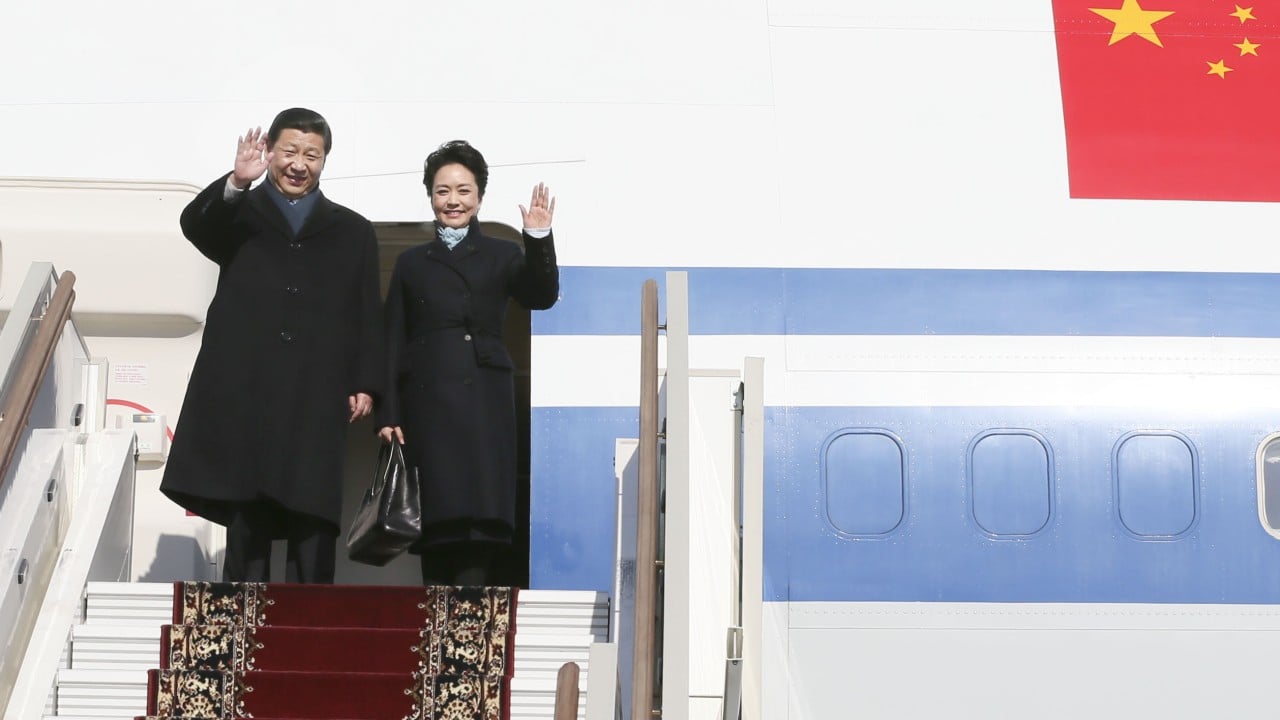
Xi Jinping overturned that precedent almost immediately after taking power. In March 2013, on his very first foreign trip as president to Russia and Africa, Peng stepped off the Air China plane in Moscow wearing a tailored dark trench coat and carrying a structured handbag, holding Xi’s arm. The images went viral across Chinese social media within hours. Domestic fashion brands she wore sold out overnight. Foreign diplomats took immediate notice.
Beijing had suddenly discovered the utility of soft-power statecraft. Peng was already a household name in China long before Xi rose to the top of the Politburo Standing Committee. As a decorated People’s Liberation Army (PLA) soprano who performed annually on the CCTV New Year’s Gala, she possessed an organic public charisma that Xi, a career party bureaucrat, initially lacked. Pairing Xi’s stern ideological authority with Peng’s artistic warmth gave the leadership duo an immediate visual appeal that previous administrations could never manufacture.
Why Shenzhen Matters as a Diplomatic Stage
When Beijing chooses Shenzhen as the backdrop for high-level diplomatic choreography, the location carries immense symbolic weight. Shenzhen is not merely a coastal metropolis bordering Hong Kong. It is the physical monument to China’s economic miracle, transforming from a collection of fishing villages in 1980 into a global powerhouse of hardware manufacturing, telecommunications, and artificial intelligence.
Hosting foreign leaders or staging joint appearances in Shenzhen sends a dual message. First, it signals that China remains committed to technological modernization and commercial engagement, even when geopolitical tensions with Washington and Brussels run high. Second, it frames Xi Jinping as the rightful heir to Deng Xiaoping’s reform legacy, while subtly rewriting that legacy to emphasize state-guided innovation and national self-reliance.
In this setting, first-couple diplomacy operates on two levels simultaneously:
- The Hard Signal: Xi projects absolute command over China’s economic and technological future, showcasing industrial prowess and strategic confidence.
- The Soft Signal: Peng provides cultural continuity, gracious hospitality, and interpersonal warmth, signaling to visiting delegations that China is a refined, approachable civilization rather than a purely transactional superpower.
Consider how high-stakes summits in southern China typically unfold. While Xi conducts closed-door negotiations over trade tariffs, semiconductor supply chains, or regional security, Peng hosts parallel cultural engagements. She visits local arts centers, interacts with students, or attends traditional musical performances alongside visiting spouses. These moments generate positive, non-confrontational media coverage that softens the framing of difficult bilateral talks.
The Mechanics of Spousal Statecraft
In international relations, personal chemistry between leaders often acts as a shock absorber during periods of structural rivalry. Diplomats refer to this as track-two or personal diplomacy—informal interactions that build trust outside rigid negotiating scripts. Peng Liyuan has become one of Beijing’s most effective tools in this arena, particularly in relationships where formal diplomacy faces steep hurdles.
Navigating Washington and European Capitals
During the Obama administration, Peng’s rapport with Michelle Obama became a centerpiece of bilateral optics. When Michelle Obama visited Beijing in 2014 without the president, Peng personally guided her through the Forbidden City and treated her to calligraphy demonstrations, creating a rare window of warm press coverage amid growing disputes over cyber espionage and the South China Sea. Later, during Xi’s 2015 state visit to Washington, the two women jointly named a giant panda cub at the National Zoo, a classic exercise in panda diplomacy reinforced by spousal camaraderie.
In Europe, where Beijing works tirelessly to prevent a unified transatlantic front against Chinese industrial policy, Peng’s cultural credentials carry distinct weight. During state visits to France, she and Brigitte Macron have visited museums, discussed arts education, and highlighted Sino-French cultural exchanges. For European leaders trying to justify continued economic engagement with China to skeptical domestic audiences, these cultural moments provide convenient political cover. They allow visiting dignitaries to frame their trips around heritage, climate cooperation, and people-to-people ties rather than controversial trade deficits or security disagreements.
Strengthening Ties Across the Global South
Peng’s diplomatic role is arguably even more impactful in Africa, Southeast Asia, and Latin America. As a World Health Organization (WHO) Goodwill Ambassador for Tuberculosis and HIV/AIDS since 2011, and a UNESCO Special Envoy for the Advancement of Girls’ and Women’s Education, she holds international titles that allow her to engage on humanitarian and development issues without sounding like a party spokesman.
When accompanying Xi to capitals across the Global South, Peng frequently visits local hospitals, women’s vocational schools, and community health centers. These visits align seamlessly with Beijing’s broader diplomatic narrative—portraying China as a benevolent development partner that cares about public health, education, and poverty alleviation, in contrast to what Beijing characterizes as Western lecturing on governance and human rights.
The Strict Boundaries of Power
It would be a serious analytical mistake, however, to equate Peng Liyuan’s visibility with independent political power. Observers who look at her through the lens of Eleanor Roosevelt, Hillary Clinton, or even Jill Biden fundamentally misunderstand how the Chinese political system works.
In the CCP hierarchy, power flows strictly through formal institutional positions—the General Secretary of the Party, the Chairman of the Central Military Commission, and the President of the State. Peng holds no seat on the Central Committee, no Politburo rank, and no formal policymaking authority. Her influence is entirely derivative of her marriage to Xi, and her public profile is tightly managed by the General Office of the CCP and the Ministry of Foreign Affairs.
This distinction explains several glaring omissions in her public schedule:
- Zero Policy Advocacy: Peng never comments on domestic economic policy, legislative debates, or sensitive social controversies. Even on issues close to her UNESCO mandate, such as rural girls’ education, her remarks remain strictly aligned with official state poverty-alleviation slogans.
- Absence During Domestic Crises: When China faces acute internal turbulence—whether during the strict Zero-COVID lockdowns of 2022, severe flooding in northern provinces, or sudden economic downturns—Peng largely recedes from public view. Unlike Western first ladies who routinely visit disaster zones to console citizens and project national empathy, the CCP reserves crisis management optics almost exclusively for uniformed officials and state cadres.
- Controlled Domestic Media: Inside China, discussion of Peng is heavily curated. State media celebrates her elegance, musical achievements, and diplomatic grace, using affectionate nicknames like Peng Mama (Mother Peng) alongside Xi Dada (Uncle Xi) in earlier years of Xi’s tenure. Yet online commentary is strictly censored to prevent any unauthorized speculation about her family, personal wealth, or internal party standing.
Every couple of years, rumors surface in overseas Chinese-language media speculating that Peng might be appointed to a formal political post, such as a seat on the Politburo or a senior cultural ministry role. Veteran China watchers treat these rumors with deep skepticism. Elevating Peng to a formal party office would shatter the very consensus Xi spent years building—that his administration represents centralized discipline rather than family rule. Her value lies precisely in remaining outside the formal bureaucratic chain of command.
When Soft Power Meets Hard Reality
Despite the sophistication of Beijing’s diplomatic choreography, first-couple diplomacy has clear structural limits. Soft power cannot paper over fundamental geopolitical conflicts forever.
Over the past decade, as China’s foreign policy shifted toward more assertive postures—ranging from "Wolf Warrior" diplomatic rhetoric to military pressure around Taiwan and industrial overcapacity flooding global markets—the effectiveness of Peng’s charm offensive has noticeably diminished in Western capitals. When foreign governments view China as a systemic rival or an economic threat to domestic manufacturing, a graceful museum tour or a bespoke qipao dress no longer shifts public opinion.
Look at the shifting media reception in Europe and North America. In 2013 and 2014, international outlets devoted glowing columns to Peng’s fashion sense and musical background, debating whether she represented a more open, modernizing China. Today, coverage of Xi and Peng’s joint appearances is far more guarded. Journalists and analysts treat the visuals not as signs of political liberalization, but as carefully produced state theater designed to mask tightening ideological control at home.
There is also an inherent tension between the image Peng projects abroad and the social climate inside China. While she champions women’s education on the global stage through UNESCO, feminist activism inside China has faced severe crackdowns, and women remain starkly underrepresented at the highest levels of the CCP. In 2022, for the first time in 25 years, the 24-member Politburo was composed entirely of men. That contradiction is not lost on international observers, limiting how far Peng’s diplomatic persona can bridge the ideological divide between Beijing and democratic societies.
The Domestic Audience Always Comes First
To truly understand why Xi and Peng maintain this rigorous diplomatic choreography, you have to stop looking at Washington, Paris, or Shenzhen through foreign eyes and look at them through the lens of Zhongnanhai. In Chinese politics, foreign policy is almost always an extension of domestic legitimacy.
When Chinese state television broadcasts footage of Xi and Peng walking side by side down a red carpet, greeted by honor guards and foreign heads of state, the primary target audience is not the foreign public. It is the 1.4 billion citizens watching the evening news broadcast, Xinwen Lianbo, inside China.
Those images serve a vital domestic political function. They validate Xi Jinping’s stature as a respected global statesman who commands deference on the world stage. Seeing China’s first couple treated as equals—or superiors—by major world powers reinforces the central narrative of the CCP: that under Xi’s leadership, China has overcome its "century of humiliation" and reclaimed its rightful place at the center of global affairs.
Furthermore, the visual partnership projects traditional Confucian ideals of family harmony and moral order. In a political culture that places immense value on stability and hierarchy, presenting a united, dignified, and culturally refined first couple reinforces the image of a steady hand at the helm of the state. Even when international headlines are filled with trade wars, sanctions, and diplomatic friction, the domestic broadcast presents a picture of calm, confident leadership.
Peng Liyuan’s transformation of the Chinese first-spouse role is permanent. No future Chinese leader will easily return to the era of invisible wives hidden behind palace walls, because the visual grammar of modern global diplomacy demands a human face alongside state power. Yet as geopolitical competition hardens, the gap between what soft-power theater promises and what hard-power politics delivers continues to widen—leaving Peng’s graceful diplomacy to carry an ever-heavier burden for a state that increasingly relies on strength rather than charm.