California Democrats are facing an existential crisis disguised as an election. With the June 2, 2026, primary just days away, the state's jungle primary system has triggered a massive, multi-candidate fracture among progressives, threatening to lock the ruling party out of the general election entirely or force a grueling civil war through November.
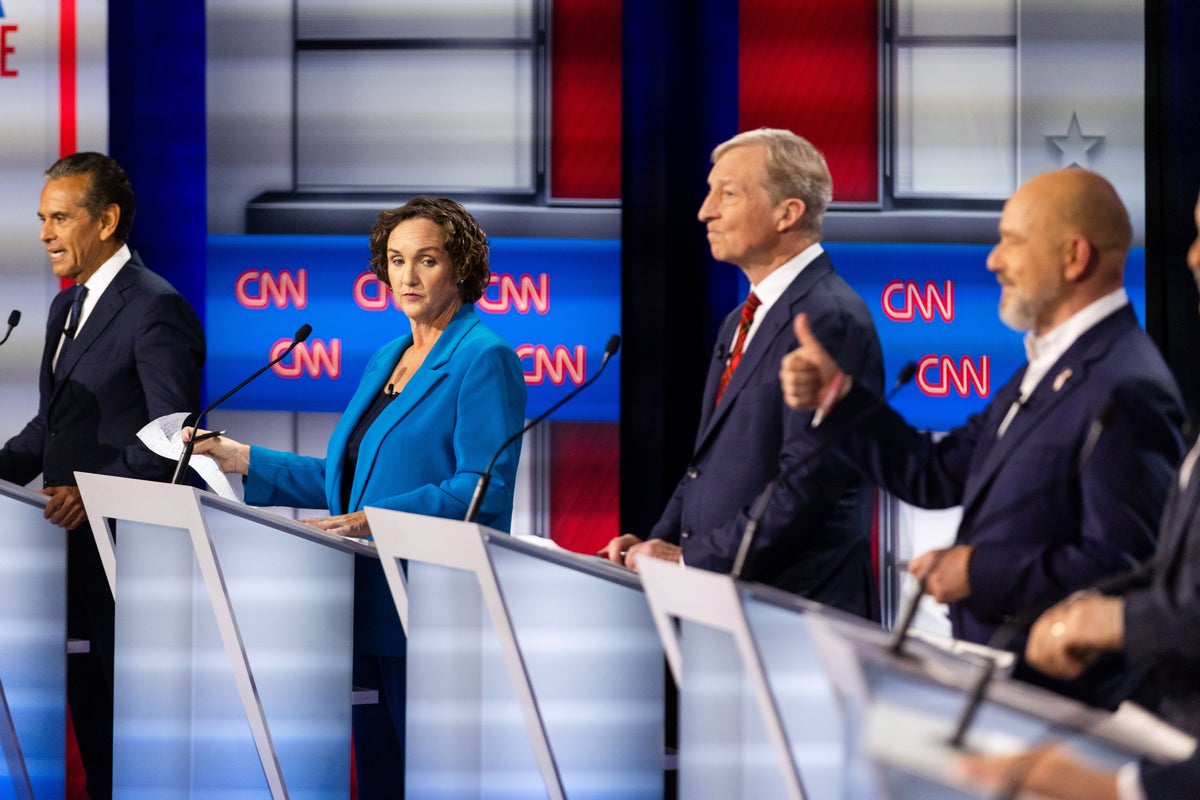
The chaos stems from a fundamental failure of leadership and party coordination. When former Representative Eric Swalwell abruptly withdrew from the race this spring amid misconduct allegations, he left behind a power vacuum that a crowded field of second-tier candidates has rushed to fill. Instead of coalescing behind a single standard-bearer to protect their supermajority, Democratic voters are splintered among former Health and Human Services Secretary Xavier Becerra, billionaire climate activist Tom Steyer, and former Representative Katie Porter.
This internal fracturing has allowed conservative outsiders to seize the narrative in a state where Republicans have long been left for dead. Republican small business owner and former Fox News host Steve Hilton has surged into a statistical tie at the top of the ticket. Alongside him, conservative Riverside County Sheriff Chad Bianco is vacuuming up law-and-order voters.
Under California's top-two system, the two candidates with the most votes advance to November, regardless of party. If the progressive vote remains evenly divided among three or four candidates while Republicans consolidate behind Hilton and Bianco, the Democratic Party could find itself completely locked out of the governor's mansion in America’s largest blue state.
The Structural Trap of Proposition 14
The current panic is the direct result of a structural trap the state set for itself sixteen years ago. Passed by voters in 2010, Proposition 14 established the nonpartisan, top-two open primary. Proponents sold it as a cure for partisan gridlock, promising it would force candidates to appeal to moderate, cross-party voters.
Instead, it transformed California elections into a high-stakes game of political roulette.
When one party fails to clear the field, the mathematical fallout is brutal. If three Democratic candidates each take 15 percent of the vote, they combine for a powerful 45 percent of the electorate. However, if two Republican candidates capture 18 percent each, those two Republicans advance to the general election. The party representing nearly half the state is rendered mathematically invisible overnight.
Party insiders are fully aware of this vulnerability. Yet, the California Democratic Party chose not to issue an official endorsement for the primary, effectively abandoning its role as a gatekeeper. This lack of intervention allowed multiple high-profile egos to stay in the race, banking on name recognition and individual fundraising machines rather than a coordinated strategy.
The Swalwell Vacuum and the Three-Way Split
The race was not supposed to look this volatile. Until his sudden exit, Eric Swalwell held a commanding lead in early polling, functioning as the default choice for the establishment and labor unions. His departure did not just reset the race; it scattered his supporters in three distinct, incompatible directions.
Xavier Becerra has emerged as the nominal frontrunner, drawing his strength from Latino voters and older establishment loyalists. Relying heavily on his record as the state's former attorney general, Becerra regularly reminds voters that he sued the first Trump administration 122 times. It is a message calculated to evoke nostalgia for the state's resistance era, but it does little to address contemporary local anxieties.
Tom Steyer is running a self-funded campaign built almost entirely on the state’s worsening climate realities. Steyer’s massive personal fortune allows him to bypass traditional party machinery, flooding the airwaves with ads focused on green jobs and corporate accountability. While his message resonates with suburban progressives, working-class voters view his climate-first platform as an expensive luxury they cannot afford during an economic downturn.
Then there is Katie Porter, whose consumer-advocate brand has struggled to recapture the national momentum of her congressional years. Porter’s signature whiteboards and corporate-grilling persona have failed to translate effectively to a statewide executive race. Without a distinct geographic or demographic anchor, her campaign is pulling just enough progressive and young voters away from Becerra and Steyer to keep all three stuck in the mid-teens.
The following table demonstrates how deeply fragmented the electorate remains, according to mid-May data from Emerson College Polling.
| Candidate | Party Affiliation | Voter Support (%) | Primary Base |
|---|---|---|---|
| Xavier Becerra | Democratic | 19% | Establishment, Latino voters |
| Steve Hilton | Republican | 17% | Inland conservatives, small businesses |
| Tom Steyer | Democratic | 17% | Environmentalists, wealthy progressives |
| Katie Porter | Democratic | 10% | Progressive activists, young voters |
| Chad Bianco | Republican | 8% | Law enforcement, rural voters |
| Undecided | Nonpartisan / Varies | 12% | Suburbs, independents |
The Working-Class Revolt on Affordability
The primary disconnect in this election lies between the rhetoric of the leading Democratic candidates and the daily realities of California voters. While the candidates debate national policy, constitutional amendments, and global climate targets, voters are responding to a starker reality.
The economy is the dominant issue for 41 percent of the electorate. Housing affordability follows closely behind at 20 percent. For nearly two-thirds of the state, the core issue is simply the crushing cost of living in California.
The state's major metropolitan areas have seen retail theft, visible homelessness, and utility rates skyrocket over the past three years. Progressive policies that seemed visionary in times of economic surplus are now viewed through a lens of exhaustion. By focusing their platforms on national political battles rather than municipal competence, the leading Democrats have created a massive opening for conservative counter-arguments.
Steve Hilton has capitalized on this fatigue by running a campaign centered on economic populism. Rather than leaning into national culture-war rhetoric, Hilton focuses on small business regulations, high gas taxes, and the state's multi-billion-dollar budget deficit. It is a strategy designed to peel away moderate independents and conservative Democrats in the Central Valley and the Inland Empire who feel abandoned by Sacramento.
The Strategic Failure of Late Voting
Sensing the danger of a total lockout, panicked Democratic strategists spent the final weeks of May pushing an incredibly risky narrative: advising voters to hold onto their mail-in ballots until the absolute last minute.
The theory behind this strategy is tactical voting. Democratic operatives hoped that by waiting for late-breaking polls, voters could collectively identify which Democratic candidate had the best chance of beating Hilton or Bianco, then surge their votes toward that single candidate at the final hour.
It is a strategy born of desperation, and it is likely to backfire.
Relying on a highly atomized, uncoordinated electorate to execute a complex, late-stage tactical pivot is wishful thinking. In reality, late voting simply slows down the counting process, creates massive lines at physical drop boxes, and increases the likelihood that casual voters miss the postmark deadline entirely. More importantly, it ignores the structural discipline of the Republican base. Conservative voters in California have historically shown higher rates of early ballot returns and a more uniform alignment behind their chosen candidates.
A Party Without a Narrative
The mess in California is not just a failure of candidate coordination; it is a symptom of an intellectual vacuum within the state's dominant party. For nearly a decade, California Democrats defined themselves by what they were against.
Now, facing an electorate that is deeply frustrated by deteriorating public infrastructure and a prohibitive cost of living, the old playbook is failing. Voters are no longer satisfied with promises of resistance; they want to know why a state controlled entirely by one party cannot build housing, lower electricity bills, or keep retail corridors safe.
The June 2 primary will not solve this problem. If Becerra and Hilton advance, the state faces a conventional partisan showdown that will force Democrats to spend hundreds of millions of dollars defending a seat they should have locked down months ago. If Steyer and Becerra manage to squeeze through, the general election will turn into a bitter civil war over the future of the state's economy, pitting establishment liberalism against wealthy progressivism.
The worst-case scenario—a Hilton-Bianco runoff—remains a distinct mathematical possibility. Should that happen, the California Democratic Party will have achieved the impossible: engineering their own total irrelevance in the capital city they spent decades conquering.