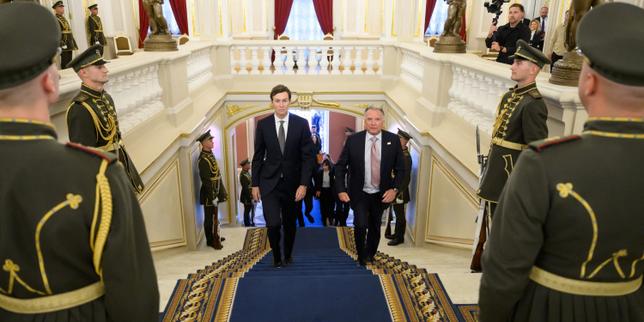
The diplomatic machinery of Washington has shifted gears on the Eastern European front. American envoys Steve Witkoff and Jared Kushner recently touched down in Kyiv carrying what a high-ranking official within the Ukrainian presidency described as new proposals that are structurally "more efficaces" than previous iterations. These diplomatic maneuvers follow an intense, multi-hour meeting in Moscow with Russian leadership, setting off a frantic scramble among European security partners who find themselves increasingly sidelined in their own backyard. Behind closed doors, the substance of these American-backed peace parameters remains heavily guarded, yet the mere suggestion of an accelerated compromise path has exposed deep fractures in the coalition supporting Ukraine.
To understand why these fresh terms are generating both cautious optimism in government corridors and cold dread among military tacticians, one must examine the mechanics of how foreign policy is currently being outsourced. Diplomacy by special envoy bypasses conventional State Department channels. It relies heavily on personalistic diplomacy, a style favored by Washington's current administration that reduces complex geopolitical sovereignty to transactional bargaining. When presidential emissaries sit across from Vladimir Putin for three hours before flying directly to brief Volodymyr Zelensky, the speed of the operation deliberately outpaces institutional oversight.
The Anatomy of the New Framework
What makes a diplomatic framework more effective in the eyes of Washington's negotiators usually boils down to one metric: velocity. Traditional multilateral negotiations involving European Union stakeholders, NATO bureaucracy, and fragmented parliamentary approvals move at a glacial pace. The White House emissaries have sought to compress these timelines by presenting terms that lean heavily on immediate territorial freezes and resource-sharing compromises.
According to intelligence leaks and briefings shared with select European national security advisors in Kyiv, the propositions focus on separating military disengagement zones from economic rebuilding corridors. Crucially, the blueprint attempts to sidestep the intractable legal status of occupied territories by introducing temporary administrative zones. This is not a novel concept in international conflict resolution. History shows that frozen boundaries often outlast political regimes, frequently transforming temporary armistices into permanent scars.
Yet, the Ukrainian leadership faces an existential dilemma. Rejecting American-backed terms outright risks alienating the primary financial and military benefactor standing between the state's survival and total collapse. Conversely, accepting a hurried framework drafted without full European consensus or security guarantees invites strategic vulnerability.
The European Blind Spot
While Washington and Moscow chew over maps, European capitals are reacting with unconcealed alarm. Continental leaders learned of the specifics through secondary channels, a diplomatic snub that underscores a broader reality. The architecture of European security is being renegotiated by actors who answer primarily to domestic political clocks rather than continental defense realities.
France, Germany, and the United Kingdom have spent years aligning their industrial capacities to support a protracted defense. A sudden diplomatic pivot driven by American realpolitik threatens to render those long-term commitments obsolete overnight. If Washington forces a compromise by leveraging its military aid spigot, European nations will be left holding the financial and humanitarian bag for a fragmented reconstruction process they did not design.
Furthermore, the timing of these proposals coincides with the approach of winter. Energy infrastructure remains a primary theater of indirect warfare. Reports from recent closed-door sessions in Kyiv indicate that allied security officials spent significant time addressing grid fortification alongside the political roadmap. Energy resilience directly dictates civilian morale. Any peace proposal that fails to guarantee absolute protection against seasonal infrastructural collapse is dead on arrival domestically.
The Cost of Speed
Speed in diplomacy invariably sacrifices depth. By framing these proposals as superior purely due to their efficiency, the architects of this initiative ignore the structural grievances that ignited the conflict in 2022. Treaties built on sand rarely weather the changing tides of regional ambition.
A lasting settlement requires enforceable verification mechanisms, not merely promises whispered in presidential suites. When enforcement relies on goodwill rather than hard power projection, deterrence evaporates the moment political winds shift in Washington or Moscow. The Ukrainian public understands this calculus intimately, having witnessed previous memorandums of security assurances dissolved into smoke.
As the diplomatic shuttle between capitals continues, the core question is not whether a deal can be forced onto paper, but whether that paper is worth more than the desk it is signed on. The pressure applied by American emissaries is absolute, leaving local leadership caught between the hammer of immediate military necessity and the anvil of long-term national dissolution. The outcome of these closed-door deliberations will define not just the borders of a nation, but the credibility of international order for a generation. The envoys have flown home, leaving behind a fragile text and a ticking clock.


