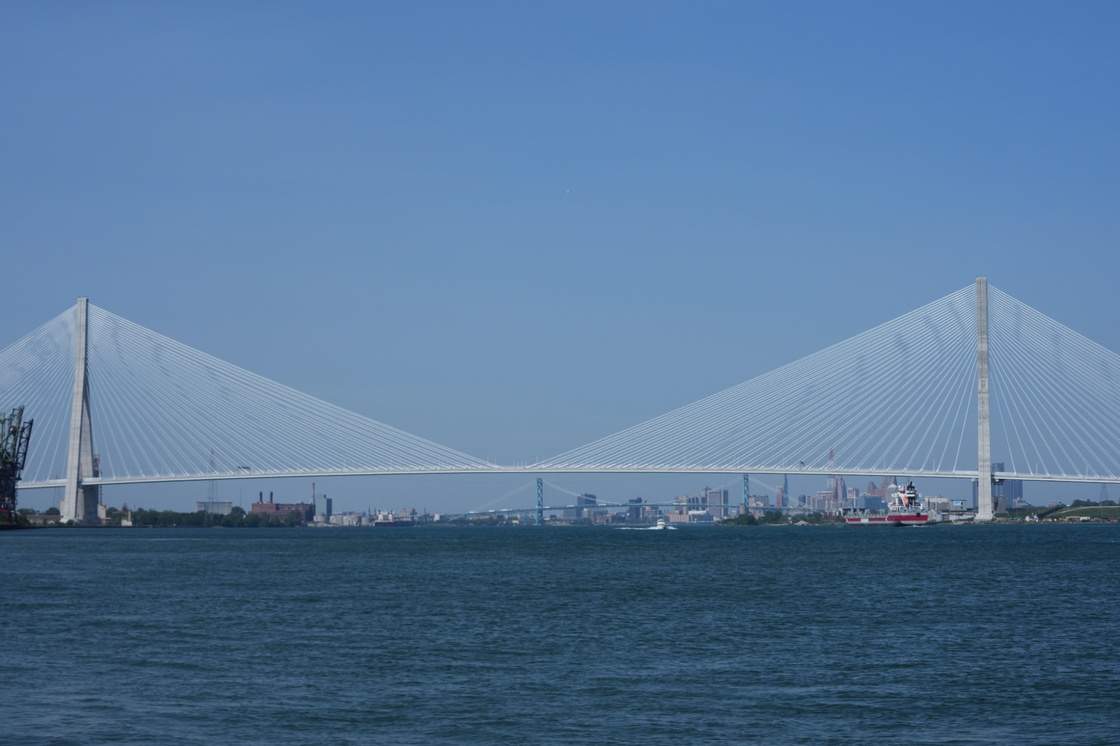
The commissioning of physical infrastructure can rarely be separated from the prevailing geopolitical climate, but the opening of the Gordie Howe International Bridge presents an extreme case study in bilateral supply chain vulnerability. Connecting Windsor, Ontario to Detroit, Michigan, this single 2.4-kilometer cable-stayed span represents a $6.4 billion Canadian capital commitment designed to relieve systemic choke points along North America’s highest-value trade artery. Yet, the convergence of immediate trade disputes, tariff escalation under Section 338 of the 1930 Tariff Act, and renegotiated toll-revenue distributions reveals how physical assets become leverage in broader economic standoffs.
Understanding the strategic necessity of this crossing requires dissecting the structural limitations of the legacy infrastructure, the capital financing model deployed, and the broader economic friction threatening cross-border integration.
Structural Bottlenecks of the Legacy Gateway
For decades, the commercial velocity of the Detroit-Windsor corridor relied disproportionately on a single privately owned asset: the Ambassador Bridge, completed in 1929. Handling approximately 25% of all surface trade between Canada and the United States, this legacy point of failure suffered from three distinct structural vulnerabilities:
- Geographic and Urban Routing Inefficiencies: Commercial freight exiting Canada via the Ambassador Bridge is routed through municipal streets in Windsor, requiring heavy transport trucks to navigate numerous traffic signals before reaching highway networks. This design imposes a measurable drag on transit times, accelerating vehicle depreciation and fuel consumption.
- Monopolistic Risk Concentration: Ownership of the Ambassador Bridge by a private entity created a single point of commercial failure, leaving international freight traffic subject to private toll structuring, localized congestion delays, and zero competitive redundancy.
- Capacity Constraints on Integrated Supply Chains: Just-in-time manufacturing networks, particularly within the automotive sector across Ontario and Michigan, operate on precise delivery windows. Interruption at the Ambassador Bridge directly stalls assembly plants on both sides of the border within hours, creating supply chain fragility across North American manufacturing hubs.
The Gordie Howe International Bridge addresses these mechanical defects by offering direct, highway-to-highway access linking Ontario’s Highway 401 directly to Interstate 75 in Michigan. This direct link eliminates municipal arterial routing entirely, reducing crossing times and standardizing customs throughput.
Capital Financing Mechanics and Revenue Sharing Conflicts
The political friction surrounding the asset stems directly from its fiscal architecture. Under the initial framework established by the Canadian government, Canada assumed the full financial burden of construction, committing $6.4 billion to cover design, land acquisition, and engineering costs.
The original economic model was straightforward:
- Debt Capital Recovery: The Canadian federal government would collect 100% of crossing tolls to service and amortize the initial $6.4 billion construction debt.
- Long-Term Revenue Distribution: Once capital costs and interest were fully recovered—a timeline projected across several decades—net toll revenues would be divided equally between Canadian authorities and the State of Michigan.
This model encountered severe friction following administrative pressure from Washington. The U.S. executive branch demanded immediate economic concessions, challenging Canada’s exclusive debt-recovery rights prior to revenue splitting.
The Modified Agreement in Principle
To secure operational approval and avoid administrative blockades at customs checkpoints, Ottawa agreed to a revised revenue-sharing framework. Under the updated terms, Canada will allocate 50% of "net bridge and crossing-related revenues" over a 15-year period to a U.S.-controlled economic development fund before capital debt repayment is completed.
This structural shift creates two long-term economic outcomes:
- Extended Amortization Timeline: Diverting 50% of net operational revenues toward U.S. development funds doubles the timeline required for Canadian taxpayers to recoup the original capital outlay.
- Operational Cost Ambigiuties: The current agreement in principle leaves the precise definition of operational deductions—such as ongoing structural maintenance, snow clearing, and border security staffing—undefined, introducing legal exposure regarding what constitutes "net" revenue.
Macroeconomic Friction and Tariff Overlays
The operational launch of the bridge coincides with an escalation in trade conflict. The deployment of 50% tariffs on Canadian exports under Section 338 of the Tariff Act of 1930 targeting automobiles, dairy, and agricultural products fundamentally alters the volume calculations upon which the bridge’s traffic models were built.
Trade friction directly impacts infrastructure utility through specific economic mechanics:
[Tariff Escalation (50% Levy)]
       │
       ▼
[Increased Cost per Unit for Integrated Goods]
       │
       ▼
[Reduced Cross-Border Freight Volumes]
       │
       ▼
[Lower Toll Revenue Collection] ──► [Extended Debt Payback Period]
When trade barriers rise, inter-company shipments within supply chains decrease. Because automobile manufacturing relies on components crossing the U.S.-Canada border up to seven times before final assembly, a 50% tariff compounding at each crossing halts freight throughput. As freight volumes contract, toll revenue declines, directly impairing the asset’s ability to generate the yields required to service its capital construction debt.
Strategic Execution Strategy
To maximize the economic return of the new crossing despite macro-environmental headwinds, logistics operators and regional policymakers must adjust their operational postures across three strategic fronts:
- Customs Processing Synchronization: Logistics firms operating across the corridor must migrate freight documentation entirely to automated pre-clearance protocols (such as FAST and C-TPAT) prior to dispatch. Minimizing dwell time at customs booths is essential to unlocking the time-savings value proposition of the direct I-75/Highway 401 connection.
- Contractual Hedging for Revenue Risk: Infrastructure managers must rapidly establish precise definitions for operational expenditures within the bilateral revenue-sharing agreement. Clarifying allowable deductions for maintenance and security prior to net revenue splits prevents future litigation that could stall asset operations.
- Supply Chain Re-Routing Optimization: Fleet operators currently utilizing secondary crossings (such as the Blue Water Bridge in Sarnia-Port Huron) should audit real-time transit metrics. Where toll differentials permit, rerouting heavy freight through the Gordie Howe span bypasses regional congestion bottlenecks and optimizes fuel efficiency metrics.
Capital efficiency along high-volume trade corridors relies on frictionless movement and predictable legal frameworks. While the physical completion of the Gordie Howe International Bridge solves a decades-old logistics bottleneck, its long-term yield remains tied to how effectively bilateral policymakers navigate the financial contracts and trade tariffs governing its operations.