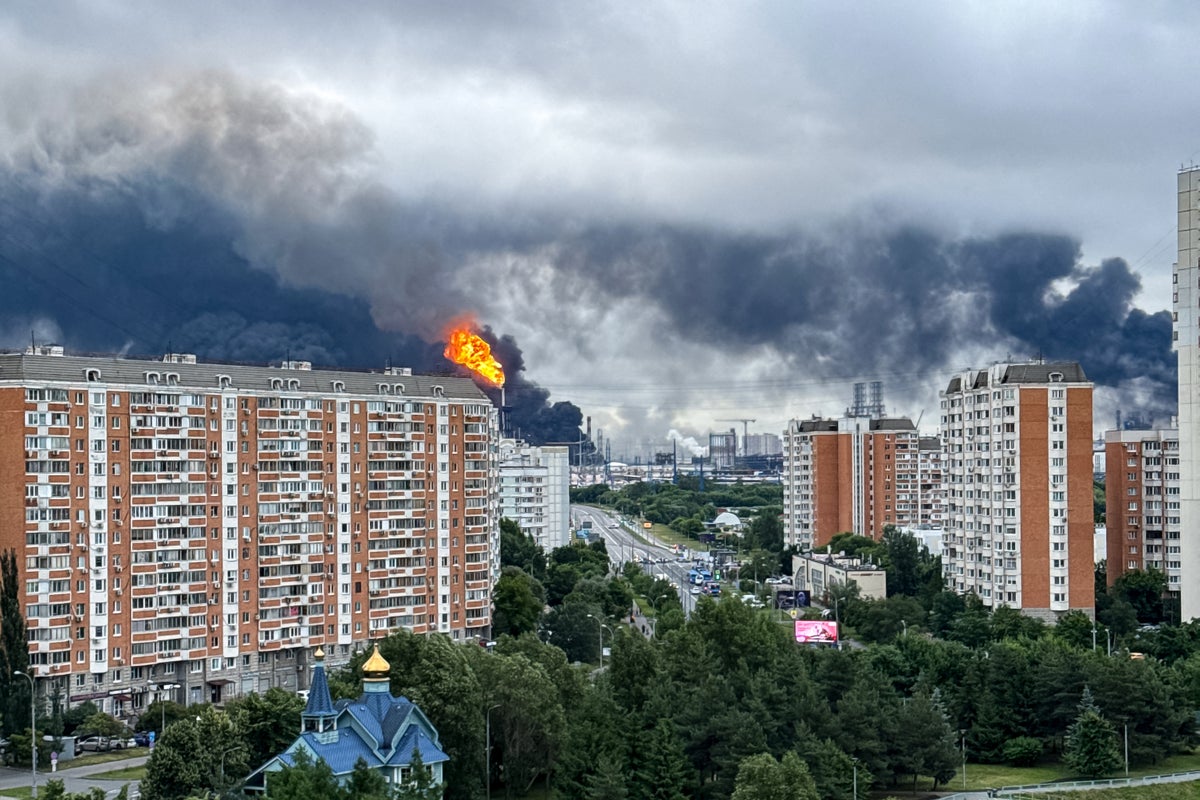
The escalation of long-range drone strikes targeting the Moscow Oil Refinery exposes a fundamental shift in the cost asymmetry of the European theater. Strategic depth is no longer a guaranteed shield against economic disruption. By deploying over 500 autonomous aerial systems in a coordinated wave, Ukrainian forces have forced an inflection point in Russia’s domestic air defense equation. This operation highlights the strategic mechanism of infrastructure warfare: forcing an opponent to choose between defending high-value industrial assets in the interior or maintaining tactical air defense coverage on the front lines.
The Friction in Domestic Air Defense Equations
The deployment of approximately 555 Ukrainian uncrewed aerial vehicles (UAVs) over a single multi-regional operation reveals a calculated attempt to oversaturate Russian surface-to-air missile (SAM) networks. When nearly 200 systems converge on a localized airspace like the Kapotnya district—just 15 kilometers from the Kremlin—the primary bottleneck changes from target identification to ammunition depletion.
This dynamic operates under three structural constraints:
- Interceptor Depletion Ratios: Standard short-to-medium-range defense systems, such as the Pantsir-S1, rely on finite missile magazines. When tracking a mass deployment of low-cost, fixed-wing assets like the FP-1 drone, the defender faces a negative cost-exchange ratio. Firing complex interceptors at mass-produced carbon-fiber frames results in a rapid draw-down of strategic stockpiles.
- Geographic Displacement: Protecting critical national infrastructure inside the Russian interior requires the relocation of mobile air defense assets away from occupied territories. Removing tactical systems from the line of contact creates localized vulnerabilities that ground forces can exploit.
- The Refining Bottleneck: The Moscow Oil Refinery supplies over a third of the fuel market for the capital region. Industrial damage here does not merely represent a localized property loss; it introduces immediate friction into the civil and military supply chains of western Russia.
The Mechanics of Kinetic Attrition
The Kremlin’s response—vowing regular, coordinated counter-strikes targeting Ukrainian decision-making centers and energy assets—follows a standard doctrine of reciprocal deterrence. Yet, the economic inputs required to sustain these competing campaigns are highly unequal.
[Ukrainian Mass UAV Waves] ──> [Oversaturation of Radar/Engagements] ──> [Air Defense Interceptor Depletion]
                                                                                      │
[Refinery Supply Deficit] <── [Refining Infrastructure Degradation] <───────────────┘
The underlying mechanism driving Ukraine's cross-border campaign is the exploitation of industrial manufacturing limits. Intelligence assessments indicate that Russia faces acute shortages of specific interceptor missile variants. This shortage is driven by the sheer frequency and volume of low-cost long-range strike operations. The production cycle of a high-altitude interceptor involves complex electronics and specialized solid rocket propellants, making it impossible to scale at the same velocity as commercialized drone manufacturing.
The economic cost function of this campaign favors the attacker. Developing a fleet of long-range composite drones requires an order of magnitude less capital and technical infrastructure than manufacturing the radar-guided munitions needed to destroy them. Over time, this imbalance erodes the defensive posture of the state under attack, regardless of its total industrial scale.
Strategic Interdependencies and Foreign Policy Links
This shift in kinetic capability aligns with recent diplomatic updates. The timing of the strike coincided with the conclusion of the G7 summit in France, alongside high-level coordination calls involving Washington, Paris, and Kyiv. These engagements signal structural alignment among Ukraine's external suppliers regarding the legitimacy of interior infrastructure targeting as a component of territorial self-defense.
The geopolitical risks associated with this trajectory include:
- Refining Capacity Degradation: As Russia transitions to importing refined fuel by sea to manage localized shortages, its maritime logistics networks become a critical single point of failure.
- Escalation Thresholds: The growing pressure from hardline internal factions calling for disproportionate retaliation increases the volatility of the conflict. The integration of advanced technical systems into the theater reduces the time window available for crisis communication between major powers.
The primary limitation of an infrastructure-centric strategy is its delayed effect on frontline operations. While disabling a major refinery stresses the domestic economy and disrupts regional fuel distribution, the military apparatus possesses dedicated fuel reserves designed to insulate tactical units from immediate commercial market shocks. Therefore, long-range attrition cannot substitute for conventional territorial defense; it serves strictly to impose an unsustainable operational tax on the adversary’s broader state apparatus.
The execution of high-volume interior strikes establishes a precedent where domestic economic stability is directly tied to frontline military actions. The strategic play for the defending coalition involves accelerating the domestic production of low-cost electronic warfare systems and rapid-reload point defenses to rebalance the interceptor-to-target cost curve. Failing to adjust this economic equation will allow persistent, distributed production networks to systematically degrade centralized industrial nodes.