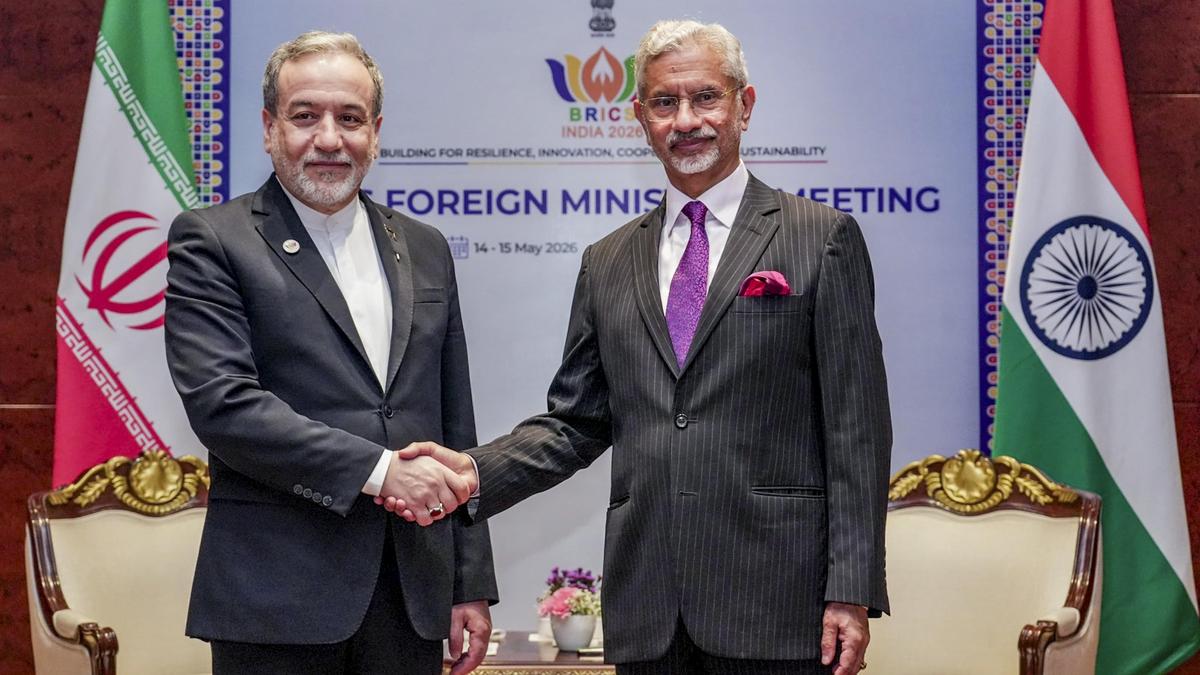
Diplomacy is often just a high-stakes performance of polite fictions. When External Affairs Minister S. Jaishankar meets with Iran’s Abbas Araghchi to discuss "maritime stability" and "energy security," the mainstream press laps it up as a strategic masterstroke. They see a balancing act. They see India playing the "Global South" card to perfection.
They are wrong.
The consensus view suggests that India can somehow insulate its energy interests from the chaos of West Asia while holding hands with a regime under crippling sanctions. This isn't strategy; it’s a holding pattern. We need to stop pretending that diplomatic press releases equate to regional influence. The reality is that the North-South Transport Corridor (INSTC) is a ghost road, and the "strategic depth" we claim to have in Iran is actually a liability that hampers India’s integration into the more lucrative Western-aligned trade blocs.
The Chabahar Delusion
For a decade, the media has treated the Chabahar port as India’s answer to China’s Gwadar. It’s the centerpiece of every bilateral meeting. Yet, if you look at the actual tonnage moving through that port compared to the massive volumes at Jebel Ali or even Mundra, the comparison is laughable.
India has spent years navigating U.S. sanctions waivers just to keep the lights on at a project that remains perpetually "on the verge" of transformative success. We call it a gateway to Central Asia. In practice, it’s a geopolitical vanity project.
- The Reality Check: Iran’s internal economic instability and the constant threat of "snapback" sanctions make long-term capital investment a fool’s errand for private Indian firms.
- The Nuance: While the government touts the port for its strategic value, the private sector—the people who actually move goods—is terrified of the compliance nightmare. You can’t build a world-class trade hub when every shipping line is looking over its shoulder for a Treasury Department notification.
I have watched dozens of logistics firms pivot away from the Iranian route because the "maritime stability" discussed in these meetings doesn't exist on a balance sheet. True stability is predictable. There is nothing predictable about the Strait of Hormuz when Tehran feels backed into a corner.
Energy Security is a 1970s Fever Dream
The phrase "energy security" is used as a shield to justify outdated foreign policy. The narrative is that India needs Iran’s oil to keep its economy humming. This ignores the massive shift in global energy markets.
India’s oil imports from Russia have fundamentally altered the math. We are no longer beholden to the traditional Middle Eastern supply chains in the same way. By clinging to the idea that Iran is a "critical" energy partner, New Delhi is essentially paying a diplomatic tax for a commodity it can find elsewhere with far fewer headaches.
Furthermore, the "security" part of energy security is increasingly about the protection of sea lanes from non-state actors and proxy forces. When Jaishankar and Araghchi talk about "stability," they are ignoring the elephant in the room: Iran’s own role in the very volatility that threatens Indian shipping. You cannot ask the person fueling the fire to help you design a better fire extinguisher.
The Maritime Stability Paradox
The most egregious bit of diplomatic theater is the discussion of maritime stability. We are told that India and Iran share a common interest in keeping the Red Sea and the Persian Gulf open.
This is a logical fallacy.
India’s interests are fundamentally aligned with the status quo—unhindered, globalized trade. Iran’s leverage, conversely, is its ability to disrupt that status quo. When the Houthis—widely recognized as Iranian proxies—target merchant vessels, it directly harms Indian crew members and Indian exports. To sit across a table and discuss "maritime stability" with the primary patron of regional disruption is not "deft diplomacy." It is an admission of powerlessness.
We need to stop asking "How do we cooperate with Iran?" and start asking "What is the cost of our perceived neutrality?"
The False Promise of the INSTC
The International North-South Transport Corridor is the "fetch" of the geopolitical world—it’s never going to happen the way the boosters say it will.
The idea: Bypass the Suez Canal by shipping goods through Iran to Russia and Europe.
The reality:
- Infrastructure Gaps: Massive sections of the rail link are still incomplete or operate at Victorian-era speeds.
- Bureaucratic Friction: Crossing borders in this region involves a level of red tape that makes the Suez Canal look like a drive-thru.
- The Russia Factor: The northern end of the corridor terminates in a country currently under the most extensive sanctions regime in history.
By tying its regional connectivity dreams to the INSTC, India is betting on a horse that has been stuck in the starting gate since 2002. Imagine a scenario where India diverted even 20% of the diplomatic capital spent on the INSTC toward the India-Middle East-Europe Economic Corridor (IMEC). The latter, despite the current regional conflict, aligns with the world’s largest economies. The former aligns with the world’s largest outcasts.
Stop Trying to "Balance" (Pick a Side)
The "Strategic Autonomy" crowd will tell you that India’s strength lies in being able to talk to everyone. They claim that by maintaining a relationship with Iran, India keeps a foot in the door of West Asia.
This is a misunderstanding of how modern power works. In a fragmented world, "neutrality" is often interpreted as "unreliability."
Our engagement with Iran provides us with very little actual leverage over Tehran’s actions. Does Iran stop its proxies from harassing ships because Jaishankar visited? No. Does Iran offer India preferential oil prices that offset the risk of sanctions? No.
What it does do is create friction with the I2U2 (India, Israel, USA, UAE) partnership. It complicates our growing defense ties with the West. It makes us look like a country that is more interested in its history as a leader of the Non-Aligned Movement than its future as a leading global power.
The Actionable Pivot
If India wants actual maritime stability and energy security, it must stop treating these bilateral meetings as meaningful progress. Here is what a "superior" strategy looks like:
- Weaponize Realism: Treat Chabahar as a commercial port, not a civilizational bridge. If it doesn't make a profit without government subsidies, let it languish.
- Harden the Navy: Maritime stability isn't discussed; it's enforced. India should increase its independent naval presence in the Arabian Sea to protect its own flagged vessels, regardless of whose "sphere of influence" they are in.
- Energy Diversification via Tech, Not Treaties: Security comes from domestic green hydrogen and nuclear expansion, not from signing memorandums with oil ministers in Tehran.
The "lazy consensus" is that India is a bridge-builder. The truth is that bridges are only useful if they lead somewhere people actually want to go. Iran, in its current state, is a cul-de-sac.
We are currently witnessing the slow-motion collapse of the post-WWII security architecture in West Asia. In this environment, a "productive exchange of views" is the diplomatic equivalent of rearranging deck chairs on the Titanic. India needs to stop playing the role of the polite guest and start acting like the regional hegemon it claims to be. That means recognizing that our interests and Iran's interests are not just different—they are increasingly irreconcilable.
The era of the "balancing act" is over. It’s time to start leaning.
Stop reading the communiqués. Look at the shipping lanes. The maps don't lie, even if the ministers do.