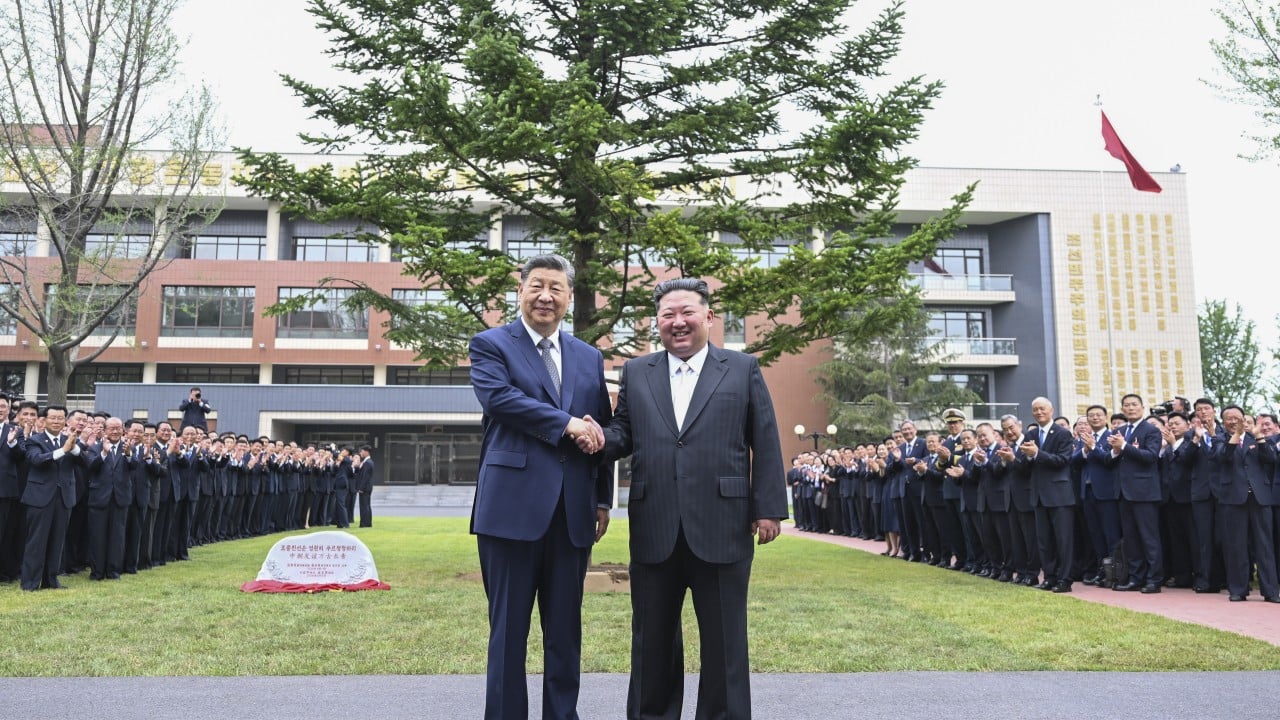
The recent diplomatic pageantry in Beijing between Donald Trump and Xi Jinping was designed to project a stabilizing global order, but the reality on the ground tells an entirely different story. Behind the handshakes, the geopolitical chess board is seeing its most aggressive reordering to date. Washington just proved that trade summits are merely theatre by dropping a massive bureaucratic hammer on Beijing's prized corporate entities, blacklisting champions like Alibaba, Baidu, and BYD over alleged military ties. Simultaneously, Xi Jinping traveled to Pyongyang to deepen structural, law-enforcement, and military cooperation with Kim Jong-un.
The primary takeaway is clear: the United States and China have moved past simple tariff disputes and entered a structural cold war where civilian commercial success is no longer viewed as separate from military capability. For a different perspective, see: this related article.
By adding China’s crown jewel technology, artificial intelligence, and electric vehicle firms to the Section 1260H Chinese Military Companies list, the Pentagon is moving to systematically decouple the foundational infrastructure of the future global economy. The timing of Xi’s concurrent embrace of North Korea signals that Beijing is responding not with defensive posturing, but by fortifying its own hard-security bloc.
The 1260H Expansion is a Structural Cleaver
For years, the Pentagon's military blacklist was a niche index. It mostly contained state-owned defense conglomerates, missile manufacturers, and shipbuilders that obviously served the People’s Liberation Army (PLA). That era is over. The inclusion of consumer-facing powerhouses like Alibaba, Baidu, and EV pioneer BYD reveals that Washington now views China’s concept of military-civil fusion as an absolute, blanket reality. Similar coverage on the subject has been published by Associated Press.
The mechanisms of this blacklist are often misunderstood as mere symbolic slaps on the wrist. Critics point out that it does not immediately trigger the devastating financial freezes associated with Treasury Department sanctions. This misses the strategic intent.
Beginning June 30, the Department of Defense is legally barred from contracting directly with any entity on this list. Far more critical is the secondary clock now ticking: by June 30, 2027, the Pentagon will be entirely prohibited from purchasing any products or services that utilize components from these blacklisted firms through third-party vendors or subcontractors.
Consider the operational reality for a standard American enterprise or logistics provider holding federal contracts. If your cloud architecture touches an Alibaba service, or if your autonomous fleet research relies on Baidu-adjacent AI frameworks, your federal revenue stream is in jeopardy. The corporate reputational damage acts as a highly effective private-sector boycott.
Memory chipmakers like Yangtze Memory Technologies (YMTC) and ChangXin Memory Technologies (CXMT)—which were briefly removed from a draft version of the list earlier this year—have been officially reinstated. This underscores a deliberate strategy to choke off China's domestic semiconductor runway, forcing global supply chains to choose a side.
| Company | Core Sector Targeted | Primary U.S. National Security Concern |
|---|---|---|
| Alibaba | Cloud Infrastructure & AI | Data storage access and dual-use compute power |
| Baidu | Artificial Intelligence & Search | Autonomous driving algorithms and large language modeling |
| BYD | Electric Vehicles & Batteries | Fleet data harvesting and transport grid vulnerability |
| YMTC / CXMT | Semiconductor Memory | Domestic hardware independence and hardware supply chains |
| Unitree | Humanoid Robotics | Kinetic autonomous systems and field robotics |
The Real Objective of Xi's Pyongyang Pilgrimage
While the Pentagon was codifying its corporate target list, Xi Jinping was on the tarmac in Pyongyang. Mainstream commentary focused on the optics of a traditional socialist alliance, but the true substance lies in the specific language used by the Chinese leader. Xi explicitly called for both regimes to "enhance exchanges in diplomacy, law enforcement, and military affairs."
This is a notable departure from Beijing's historic ambivalence. For decades, China treated North Korea as a volatile buffer state—an erratic neighbor to be managed via economic lifelines but kept at arm's length to avoid provoking a premature conflict with the West. That calculation has shifted entirely. Facing an aggressive, bipartisan U.S. campaign to encircle China technologically and militarily, Beijing now views North Korea as a vital component of its broader counter-containment strategy.
By elevating "law enforcement and military affairs" alongside diplomacy, Xi is signaling a tolerance for a more integrated eastern security axis. This development alarms Tokyo and Seoul far more than it impacts Washington directly. It directly undermines the trilateral security architecture the U.S. has spent years building with Japan and South Korea.
With South Korean President Lee Jae-myung currently holding a hard line against expanding military cooperation with Tokyo due to unresolved historical grievances, Beijing perceives a clear structural vulnerability in the regional alliance network.
The Dual-Use Trap and the End of Neutral Corporate Giants
The defense of these blacklisted corporate giants has followed a familiar pattern. Alibaba labeled its inclusion a "mistake," Baidu claimed there was "no credible justification," and pharmaceutical giant WuXi AppTec reiterated that it is completely independent of government control. In a traditional corporate governance framework, they are correct. They operate in public markets, answer to international shareholders, and chase commercial margins.
In the current geopolitical climate, those traditional arguments are irrelevant. Washington is no longer looking for smoking-gun evidence of a CEO taking direct orders from a PLA general. The concern is structural. Under China’s National Intelligence Law, any domestic entity is legally obligated to support, assist, and cooperate with national intelligence efforts when called upon.
This reality transforms all advanced commercial technology into dual-use assets. A civilian autonomous vehicle algorithm developed by Baidu can optimize logistics tracking for military transport. High-bandwidth memory chips from CXMT can run military simulation models just as easily as they power consumer smartphones. Drone networks from DJI or humanoid robotics from startups like Unitree represent immediate kinetic capabilities if deployed in tactical scenarios.
The Western security establishment is acting on the principle that in a peer-state conflict, the boundary between commercial data platforms and sovereign intelligence apparatuses disappears entirely.
The Fragmented Global Market
The immediate result of these twin developments is the rapid accelerating collapse of a unified global technology ecosystem. We are moving toward a bifurcated world defined by competing, incompatible tech stacks and security spheres.
For multinational corporations, the strategic middle ground has vanished. Companies can no longer build a singular digital infrastructure intended to serve both Western and Chinese markets seamlessly. The regulatory compliance costs alone are becoming prohibitive.
If an organization aligns with Western standards, it must aggressively purge Chinese hardware, cloud layers, and AI components from its operations. If it chooses to maintain deep integration within the Chinese ecosystem, it faces systematic exclusion from U.S. federal procurement, critical research funding, and Western capital markets.
This friction will inevitably slow down pure research and development. Innovation thrives on open, globalized standards and shared breakthroughs. When data pools are siloed behind national security walls and cross-border research collaborations are treated as potential espionage, the pace of global technological advancement takes a measurable hit. Capital is being diverted away from maximizing efficiency and toward building redundant, localized supply chains designed solely for political resilience.
The diplomatic dance between Washington and Beijing will undoubtedly continue with future high-level visits and choreographed press briefings. These events project a comforting illusion of stability to global markets. The real trajectory of the relationship, however, is written in the cold, unyielding ink of Pentagon blacklists and formal military communiqués in Pyongyang. The lines are drawn, the perimeters are hardening, and the corporate champions of the internet age are being drafted to the front lines.
The shift in U.S. strategy toward a wider economic blockade is analyzed in detail within China tech giants blacklisted by US, which examines how the Pentagon's 1260H list has evolved from targeting traditional defense contractors to encompassing consumer-facing software and hardware firms.