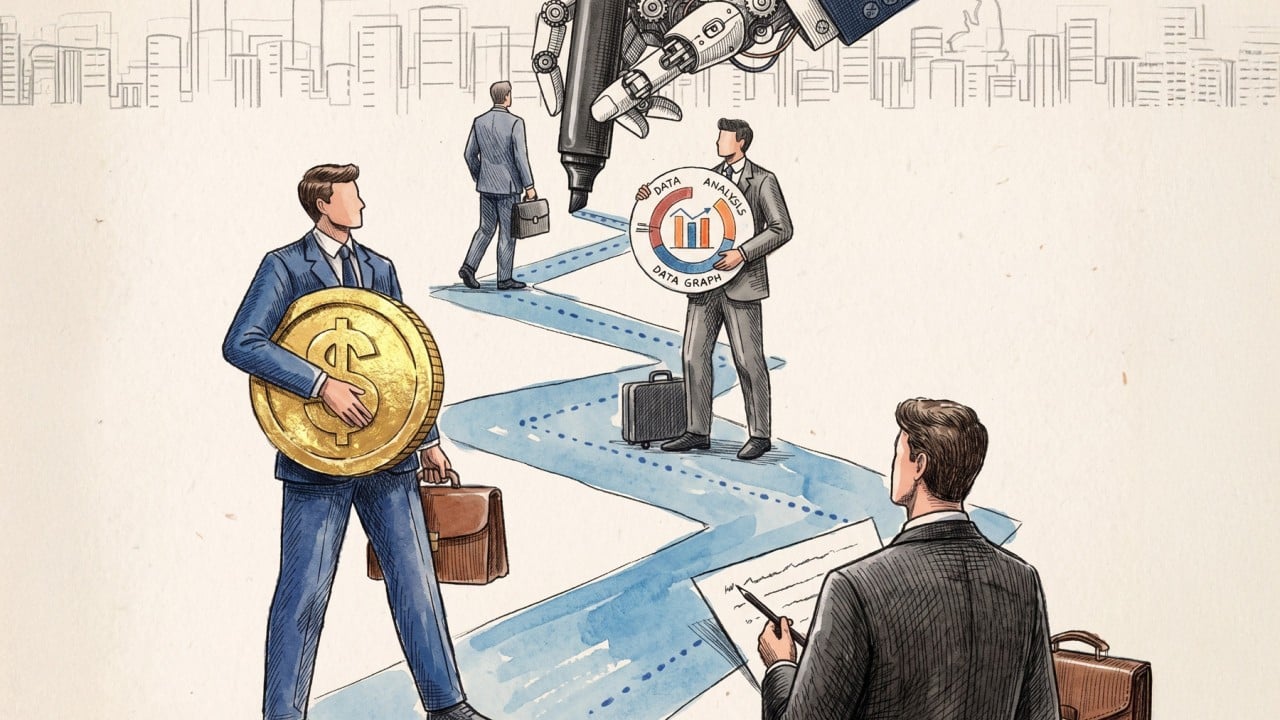
The air in Sheung Wan tastes of dried tangerine peel, salt, and raw ambition.
At seven in the morning, before the humidity settles like a wet wool blanket over the concrete canyons, Raymond sits on a cracked leather stool inside a decades-old logistics office. His grandfather founded this firm with two wooden desks and a telephone that rarely stopped ringing. Today, Raymond stares at a glowing monitor displaying a dashboard of stalled container shipments, shifting tariff walls, and currency fluctuations that look like cardiograms of a dying patient.
Outside his window, Victoria Harbour churns. The gray water carries rusted freighters and sleek carbon-fiber ferries alike, all cutting through the same restless tide.
Raymond is not panicking. He has survived three distinct economic contractions, a global pandemic that emptied the streets for months, and a structural rewrite of global trade routes that rendered his father’s business model obsolete overnight. Yet, as he sips his lukewarm tea, he is doing something radical.
He is dismantling everything he knows.
To understand how modern enterprises in this territory are surviving an era of profound friction, you have to abandon the spreadsheets and look at the people holding the pencils. The standard corporate playbook—the one written during the frictionless decades of cheap capital and predictable borders—is dead. What replaced it is not a set of neat managerial theories, but a gritty, instinctual reinvention born from a rare brand of urban survivalism.
Consider what happens when a traditional trading house, one that has moved plastic goods from Shenzhen factories to Western ports for forty years, wakes up to find its margins squeezed to the bone. Rent is astronomical. Labor is scarce. The old buyers are diversifying their supply chains away from a single point of failure, scattering their orders across Vietnam, India, and Mexico.
A lesser firm folds its tents. They complain about the weather, the politics, the costs, and they fade into the footnotes of trade registries.
The resilient firms do something else. They evolve into architects.
Take the quiet transformation happening in Kwun Tong industrial lofts. Here, former textile traders are morphing into boutique supply-chain engineers. They no longer just ship goods; they design the digital nervous system that allows a brand in London to track raw materials from a sustainable farm in Indonesia through assembly lines in the New Territories, all verified by immutable ledgers. They stopped selling transport and started selling certainty.
Certainty is the most valuable currency on earth right now.
When the ground shifts beneath your feet, rigidity is fatal. For decades, the competitive advantage of this city was speed and location. You could land cargo, clear customs, and finance a deal faster than anywhere else on the globe. But speed alone cannot conquer a fragmented planet. When trade lanes fracture, speed just helps you crash faster.
The companies quietly winning right now understand a counterintuitive truth. They are shrinking their footprints while expanding their capabilities.
Meet Fiona, who runs a mid-sized consumer electronics design firm out of a cramped office in Wan Chai. Two years ago, eighty percent of her revenue came from two massive American retail chains. When those clients slashed their inventories amid rising interest rates and shifting consumer habits, Fiona’s cash flow froze solid within thirty days.
She did not lay off her entire team. Instead, she split her engineers into micro-units. She directed one group to take their proprietary sensor technology and pitch it directly to European agricultural firms needing automated soil monitors. She pointed another group toward local healthcare providers desperate for localized, secure data storage that never touched foreign cloud servers.
She diversified not just her customer base, but her fundamental utility.
Within eighteen months, her revenue streams looked like a scattered constellation rather than a fragile bridge. If one star went dark, the others kept burning. This is what operational decentralization actually looks like in practice. It is messy, it requires difficult conversations with terrified employees, and it demands an ego-free willingness to admit that your primary product is merely a starting point.
There is a psychological weight to this kind of transformation that corporate whitepapers rarely capture.
Walk through the financial district after dark. The towers are ablaze with light, but the energy is different from the arrogant, champagne-soaked optimism of the late nineties. The mood now is vigilant, sharp, and intensely focused. People are tired of empty jargon. They have heard every buzzword about future-proofing and digital transformation until their ears bleed. They want results that protect their families, their employees, and their life's work.
This is where the unique historical DNA of the local commercial class kicks in. This population has never had the luxury of permanence. Empires rise, treaties shift, borders redraw themselves, and economic tides pull away from the shore without warning. To build a lasting enterprise here, you have to be comfortable with impermanence. You treat your business not as a monument carved in stone, but as a tent pitched on a windy hill. You check the ropes every single night.
You also invest heavily in the quiet machinery of competence.
While headlines obsess over flashy tech trends, the real winners are executing a masterclass in operational hygiene. They are automating repetitive administrative drag not to replace humans, but to free their smartest people to think about geopolitical risk. They are renegotiating supplier contracts with clauses that anticipate sudden trade embargoes or logistics bottlenecks. They are building emergency cash reserves that would make a conservative accountant smile, knowing that liquidity is oxygen when the financial plumbing clogs.
Listen to how the veterans talk to their younger managers. They do not talk about exponential growth or market domination anymore. They talk about endurance. They talk about optionality. They talk about the art of the pivot executed before the crisis forces your hand.
It is an education forged in fire.
The modern enterprise in this territory is shedding its skin in real time. It is shedding the bloated bureaucracy of the past. It is shedding the lazy assumption that tomorrow will look like yesterday simply because yesterday was profitable.
Back in Sheung Wan, Raymond finishes his tea. The morning rush has finally peaked, filling the narrow streets with the roar of delivery vans and the frantic clatter of wheeled crates. His phone buzzes with a notification from a new client in Dubai, a market he wouldn't have dared touch five years ago.
He doesn't smile triumphantly. He simply nods, types out a short, precise reply, and looks back at the harbour. The water is still gray. The wind is still picking up. But the ship keeps moving forward, finding the channel through the dark.